Snowflake customer breaches show how stolen SaaS tokens can spread one integrator compromise

Snowflake customer breaches show how stolen SaaS tokens can spread one integrator compromise
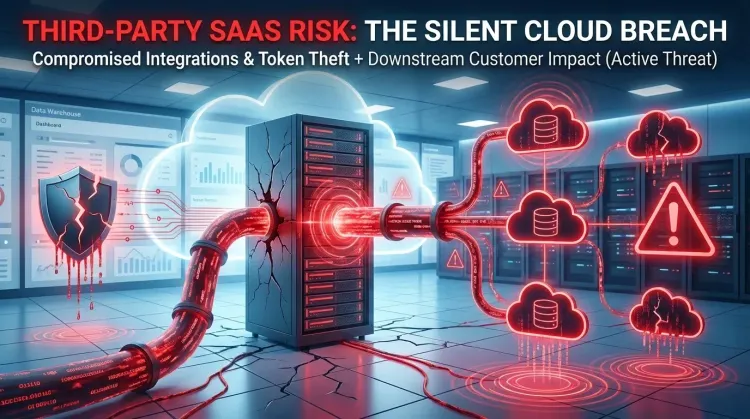
The newest wave of Snowflake-linked customer intrusions is a sharp reminder that modern cloud incidents often begin outside the platform everyone recognizes. Public reporting says multiple organizations suffered data breaches after a third-party SaaS integration provider was breached and authentication tokens were stolen. Snowflake said it detected unusual activity affecting a small number of customer accounts tied to a specific external integration and locked down potentially impacted accounts.
That distinction matters. The strategic lesson is not that Snowflake itself failed. It is that one compromised partner in a connected SaaS chain can create an access path into many customer environments at once. In practice, stolen tokens can become the cloud-era equivalent of shared keys left under the mat.
What happened in the Snowflake-linked attacks
According to BleepingComputer, more than a dozen companies were hit by data theft activity after a breach at SaaS integrator Anodot allegedly exposed authentication tokens. The reporting says most of the downstream theft attempts targeted Snowflake customer environments, while attempted follow-on access to Salesforce was reportedly detected and blocked.
Snowflake told BleepingComputer that it saw unusual activity associated with a specific third-party integration, notified potentially affected customers, and took precautionary action. The company also said the activity did not stem from a vulnerability or direct compromise in Snowflake systems.
That leaves defenders with a familiar but uncomfortable conclusion: cloud security exposure is often created by the trust relationships around a platform, not only by vulnerabilities inside the platform itself.
Why token theft changes the blast radius
A stolen password is dangerous. A stolen integration token can be worse, because it often already carries approved machine-to-machine access and may not trigger the same user-friction controls as an interactive login.
When an attacker gets access through a trusted integration, the result can include:
- direct access to high-value datasets without exploiting the main platform
- quiet data collection under an already approved application context
- difficult scoping during incident response because the trust path crosses vendors
- follow-on abuse of other SaaS environments connected to the same identity fabric or workflow stack
- opportunities for broader lateral movement across cloud services
This is why third-party token compromise should be treated as an identity and access management problem, not just a vendor-risk footnote.
Why this fits a bigger cloud extortion pattern
The current reporting also aligns with a pattern already documented by Google Threat Intelligence and the FBI in earlier SaaS-focused data theft and extortion activity. Those public alerts described how threat actors abused compromised OAuth tokens, connected applications, and cloud trust relationships to exfiltrate data at scale and then pressure victims through extortion.
Even if this latest incident ends up with different technical details or partial attribution changes, the defensive pattern is consistent:
- compromise a trusted SaaS or integration path
- use tokens or delegated access instead of noisy exploitation
- pull data quickly from customer environments
- turn exfiltration into extortion pressure
That is a dangerous model because it bypasses the assumption that every customer breach must begin with a direct attack on the customer.
Immediate actions for defenders
🔴 Review connected apps and third-party integrations now
- Identify every integration with access to Snowflake, Salesforce, and adjacent business platforms.
- Verify which tokens, API credentials, or delegated app permissions remain active.
- Revoke or rotate access for integrations that are no longer essential or cannot be validated quickly.
🔴 Hunt for token abuse, not just failed logins
- Look for unusual data export volume, unexpected service principals, and off-hours access patterns.
- Focus on machine identities and integration accounts that normally escape user-centric detections.
- Treat vendor-linked access anomalies as potential breach activity until disproven.
🟠 Shrink blast radius between SaaS systems
- Reduce standing privileges granted to analytics, automation, and enrichment tools.
- Segment access so one external integration cannot reach every sensitive dataset.
- Limit which datasets and admin actions are exposed through long-lived tokens.
🟠 Prepare the communications side of response
- Build a fast process for checking whether an upstream vendor incident affects your tenants.
- Make sure legal, security, and customer teams can coordinate quickly if extortion claims begin.
- Preserve logs before rotating integrations so forensic timelines remain usable.
Strategic takeaway
The most important security boundary in SaaS is often the trust graph between platforms. The Snowflake-linked thefts show how one breached integrator can become a force multiplier, especially when tokens and connected apps already have the access attackers need.
Defenders should take this as a prompt to reassess every third-party integration that touches sensitive cloud data. If a partner can read it, route it, enrich it, or automate against it, that partner is part of your attack surface. In 2026, the shortest path to a major cloud incident may not be a software flaw at all. It may be a trusted token issued months ago and never challenged again.
References
- https://www.bleepingcomputer.com/news/security/snowflake-customers-hit-in-data-theft-attacks-after-saas-integrator-breach/
- https://cloud.google.com/blog/topics/threat-intelligence/data-theft-salesforce-instances-via-salesloft-drift
- https://www.fbi.gov/file-repository/cyber-alerts/cybercriminal-groups-unc6040-and-unc6395-compromising-salesforce-instances-for-data-theft-and-extortion-091225.pdf/view
FAQ
Public reporting says Snowflake observed unusual activity in a small number of customer accounts linked to a third-party integration and stated the activity did not involve a vulnerability or compromise of Snowflake systems.
Because they can provide already authorized access between services, which may let attackers collect data without needing a traditional exploit or user login.
Review connected applications, rotate or revoke unnecessary tokens, and investigate unusual export or service-account activity across affected SaaS environments.
Because the core risk is third-party trust. One compromised provider can create downstream breach conditions for many customers using the same integration path.