Critical protobuf.js flaw turns untrusted schemas into JavaScript code execution

Critical protobuf.js flaw turns untrusted schemas into JavaScript code execution
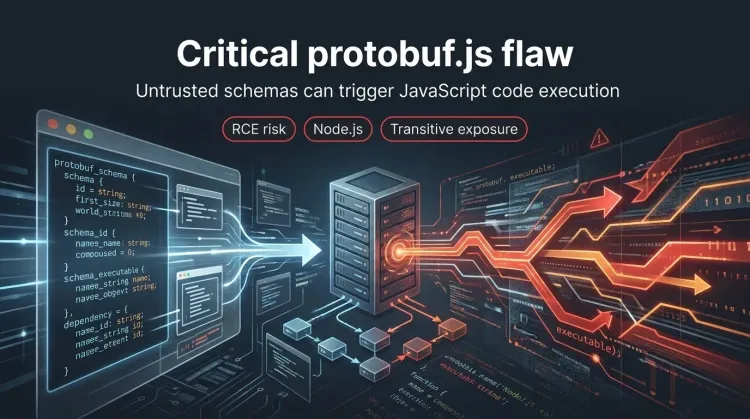
A newly disclosed protobuf.js issue deserves attention well beyond the JavaScript ecosystem. GitHub advisory GHSA-xq3m-2v4x-88gg and Endor Labs' technical write-up show that attacker-controlled protobuf definitions can be turned into arbitrary JavaScript execution when vulnerable applications compile and decode those schemas at runtime.
The key defender lesson is simple: this is not just a library bug. It is a trust-boundary failure. Teams often treat schemas and descriptors like passive configuration, but in this case untrusted schema input can become a live exploit path.
What happened
According to the GitHub advisory, protobuf.js compiles protobuf definitions into JavaScript functions. The vulnerable code path does not safely validate attacker-controlled type names before feeding generated source into the Function() constructor.
That means a malicious schema can inject arbitrary JavaScript into the generated decoder logic. When the application later decodes data using that schema, the injected code runs.
Endor Labs says the issue affects:
- protobufjs 8.0.0 and earlier
- protobufjs 7.5.4 and earlier
Patched versions are listed as:
- 8.0.1
- 7.5.5
BleepingComputer notes there is no public evidence of active exploitation yet, but the advisory includes a proof of concept and researchers describe exploitation as straightforward when attackers can influence protobuf definitions.
Why this matters for defenders
1. Schema loading becomes an application attack surface
Many teams do not think of .proto files or JSON descriptors as dangerous input. In practice, modern systems often pull schemas from partner services, registries, internal marketplaces, gRPC reflection, or third-party tooling. If that trust boundary is weak, a single poisoned descriptor can become a remote code execution event.
2. The blast radius can reach far beyond one package
protobuf.js is deeply embedded across Node.js and JavaScript-heavy cloud environments. It is also commonly pulled in through transitive dependencies. Endor Labs specifically called out broad exposure through protobuf-driven stacks and dependency trees, which means some teams may be affected without realizing the package is present.
This is why the story also has a software supply chain dimension. The risk is not that protobuf.js itself was backdoored, but that a widely reused dependency can convert untrusted partner or registry content into code execution.
3. Post-exploitation impact can escalate quickly
If an attacker lands code execution inside an application process, the next questions are predictable: what secrets are exposed, what internal services are reachable, and what downstream trust can be abused? Depending on the environment, that could include cloud credentials, service-account tokens, internal APIs, and sensitive data stores.
Where exposure is most realistic
The public technical analysis points to several realistic exposure patterns:
- applications that load protobuf schemas from outside the local codebase
- dynamic gRPC or reflection-driven tooling
- internal schema registries with broad publisher access
- SaaS or data-processing products that accept customer-supplied descriptors
- developer workflows that decode traffic or test interoperability with third-party schemas
If your environment only uses locally maintained, tightly controlled protobuf definitions stored in version-controlled repositories, your risk is lower. If schema loading crosses organizational or user trust boundaries, the risk is materially higher.
What defenders should do now
1. Upgrade protobuf.js immediately
Move affected deployments to 8.0.1 or 7.5.5, depending on your supported branch. This should be handled like any other critical vulnerability with code-execution consequences.
2. Audit transitive dependencies
Do not stop at direct dependencies. Check lockfiles, SBOMs, and build outputs for transitive protobuf.js exposure across services, internal tools, and CI pipelines.
3. Reclassify schema input as untrusted
If your systems accept or fetch protobuf definitions from outside the application's own trusted repository, treat that path as hostile input. Restrict who can publish schemas, validate provenance, and reduce runtime schema loading where possible.
4. Prefer static or precompiled schemas in production
When architecture allows it, avoid runtime compilation of externally sourced schemas. The closer schema handling gets to precompiled, version-controlled assets, the smaller the attack surface becomes.
5. Prepare for credential review and containment
If you suspect abuse, do not stop at patching. Review application secrets, cloud roles, service accounts, and downstream access that may have been exposed through compromised processes. That belongs in the incident response plan, not as an afterthought.
Strategic takeaway
This protobuf.js flaw is a good example of a growing pattern in modern software risk: developer-friendly dynamic behavior can quietly become executable trust when fed attacker-controlled input. For defenders, the lesson is broader than one advisory. Schemas, config files, descriptors, and other "data-shaped" artifacts deserve the same trust analysis teams already apply to code.
If an application compiles or interprets external definitions at runtime, defenders should assume that boundary can become an execution boundary too.
References
FAQ
It is the GitHub Security Advisory identifier for an arbitrary code execution issue in protobuf.js caused by unsafe dynamic code generation from attacker-controlled protobuf definitions.
Public reporting and the technical advisory say the issue affects 8.0.0 and earlier plus 7.5.4 and earlier.
The published fixes are 8.0.1 and 7.5.5.
At the time of disclosure, researchers said they had no public evidence of active exploitation. However, the proof of concept is public and the exploit path is described as straightforward when attackers can influence schema input.
Patch affected versions, audit transitive dependencies, and review any runtime schema-loading paths that accept protobuf definitions from outside tightly controlled repositories.
How to cite
Lucas Oliveira. Critical protobuf.js flaw turns untrusted schemas into JavaScript code execution. 17 Aug 2026. Invaders Cybersecurity. https://invaders.ie/resources/blog/vulnerability/critical-protobufjs-flaw-schema-code-execution.
Subscribe via RSS.
Written by
Lucas Oliveira
Research
A DevOps engineer and cybersecurity enthusiast with a passion for uncovering the latest in zero-day exploits, automation, and emerging tech. I write to share real-world insights from the trenches of IT and security, aiming to make complex topics more accessible and actionable. Whether I’m building tools, tracking threat actors, or experimenting with AI workflows, I’m always exploring new ways to stay one step ahead in today’s fast-moving digital landscape.
Hot TopicsLast 7 days
Categories
Stay Updated
Get the latest cybersecurity insights delivered to your inbox.