Exchange CVE-2026-42897 patches land after active OWA exploitation

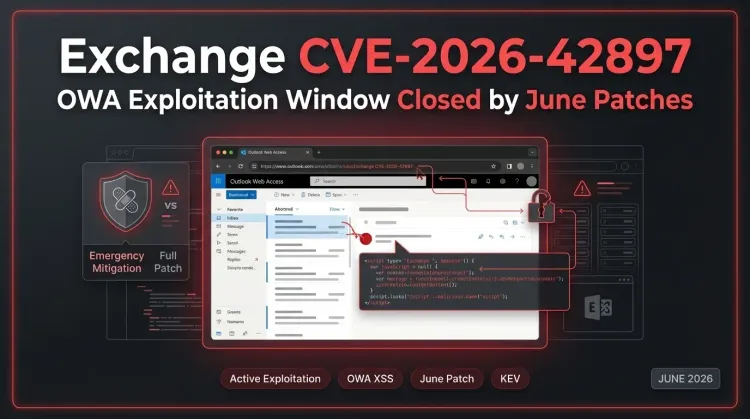
Exchange CVE-2026-42897 patches land after active OWA exploitation
Microsoft has now shipped the June 2026 Exchange security updates for CVE-2026-42897, ending a dangerous gap between public warning and full remediation for an actively exploited on-prem Exchange issue. For defenders, the important point is not simply that a patch exists now. It is that many organizations spent nearly a month relying on a temporary mitigation while a live zero-day affected Outlook Web Access.
That is why this story matters on June 13, 2026, not only on May 14 when Microsoft first disclosed the issue. If your Exchange estate depended on the emergency workaround, you should treat this week as the point to patch, validate, and check whether earlier exposure left you with a cleanup problem instead of just a maintenance task.
What Microsoft and CISA confirmed
Microsoft warned on May 14, 2026 that CVE-2026-42897 was being exploited in the wild. CISA added it to the Known Exploited Vulnerabilities catalog on May 15, 2026, with a federal remediation deadline of May 29, 2026.
The affected products are:
- Exchange Server Subscription Edition
- Exchange Server 2016
- Exchange Server 2019
Microsoft describes the bug as a spoofing flaw, while public reporting and Microsoft guidance also frame it as an Outlook Web Access cross-site scripting path. The practical impact is the same: a specially crafted email can trigger arbitrary JavaScript in the browser context when a user opens it in OWA and certain interaction conditions are met.
That means this is not a backend-only bug that requires deep attacker positioning. It intersects directly with email handling and the webmail layer defenders expose to real users every day.
Why the June patch is more important than the original alert
When Microsoft disclosed the threat in May, the company did not have a full security update ready. Instead, it pushed an Exchange Emergency Mitigation service rule, identified as M2, that applies a URL Rewrite-based protection for CVE-2026-42897.
That mitigation was useful, but it should never be mistaken for the end state. Temporary protections are there to buy time, not to close the book on the incident. Microsoft has now released the actual June 9 security updates, and its support documentation lists CVE-2026-42897 among the Exchange vulnerabilities resolved by those packages.
This distinction matters operationally:
- emergency mitigation reduces immediate exposure
- a full security update is the durable remediation step
- exposure assessment still matters if the system was internet-reachable during the exploitation window
In other words, patching now is not optional just because M2 existed.
The hidden risk in "we already mitigated it"
Teams often lose urgency once a workaround is in place. That is a mistake here.
Microsoft's Exchange Emergency Mitigation service depends on infrastructure and policy assumptions. The service needs outbound connectivity to retrieve signed mitigations, and Microsoft explicitly warns that SSL inspection around officeclient.microsoft.com can break mitigation validation behavior. If a deployment was misconfigured, disconnected, or manually tuned in a way that blocked EM service behavior, defenders may have assumed protection they did not actually have.
Even where the mitigation was applied correctly, it still leaves a second question: did exploitation happen before or during that window? That is why this issue should sit partly in incident response, not only in routine patch management.
What defenders should do now
1. Install the June 9 Exchange security updates immediately
If any affected Exchange systems remain unpatched, move now. Microsoft support pages for the June 2026 Exchange updates explicitly include CVE-2026-42897 in the resolved vulnerability set.
2. Do not treat M2 as a permanent substitute for patching
The M2 URL Rewrite mitigation was a bridge. It is not the final control state you want to keep relying on for an actively exploited vulnerability.
3. Validate whether EM service protections were actually in effect
Check whether the Exchange Emergency Mitigation service had the required outbound access and whether SSL interception or local policy interfered with updates from officeclient.microsoft.com.
4. Review OWA exposure during the exploitation window
If the environment exposed OWA to the internet between May 14, 2026 and the patch rollout on June 9, 2026, assume you need a short exposure review. That includes verifying update state, mitigation state, and unusual user-facing activity around OWA sessions.
5. Prioritize older Exchange estates
Exchange 2016 and 2019 environments deserve special attention because many organizations keep them alive longer than they should. Operational drift and deferred upgrade habits are exactly what turn a manageable patch cycle into a late incident response engagement.
The bigger lesson
Exchange risk rarely stays confined to CVSS language. What matters here is the chain of reality:
- Microsoft disclosed live exploitation on May 14.
- CISA moved the issue into KEV on May 15.
- Organizations had to rely on a mitigation phase before the June 9 updates arrived.
- Defenders now need to close that loop with patching and validation.
That is a familiar pattern for high-value enterprise infrastructure. The attack window opens before the final fix is ready, defenders deploy stopgaps, and weeks later some teams mistake "temporarily reduced risk" for "fully remediated." CVE-2026-42897 is exactly the kind of issue that punishes that assumption.
References
- CISA Adds One Known Exploited Vulnerability to Catalog
- Addressing Exchange Server May 2026 vulnerability CVE-2026-42897
- Released: June 2026 Exchange Server Security Updates
- Description of the security update for Microsoft Exchange Server Subscription Edition RTM: June 09, 2026 (KB5094139)
- Microsoft Patches Exploited Exchange Server Vulnerability
FAQ
No. As of June 9, 2026, Microsoft has released Exchange security updates that fix the issue. Organizations should move from workaround-only thinking to full remediation and validation.
Because the vulnerable path sits in normal business workflow. User interaction requirements do not make webmail exploitation low priority when the platform is internet-facing and under active attack.
Microsoft lists Exchange Server Subscription Edition, Exchange Server 2016, and Exchange Server 2019.
If you relied on the emergency mitigation, patch now and confirm whether the mitigation actually applied cleanly across your environment.