CVE-2026-33032 in nginx-ui Enables Full Nginx Server Takeover via Unauthenticated MCP Access

CVE-2026-33032 in nginx-ui Enables Full Nginx Server Takeover via Unauthenticated MCP Access
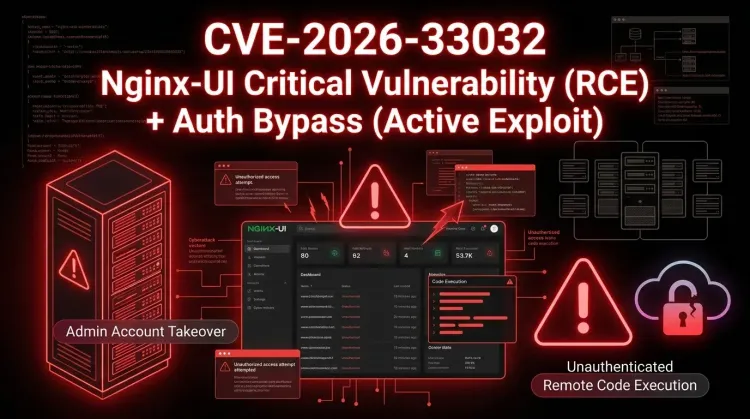
A critical flaw in nginx-ui, the web-based Nginx management tool, can let attackers take over the Nginx service without valid credentials. The issue, tracked as CVE-2026-33032, affects the product's MCP integration and has already drawn attention because it enables direct access to high-impact management functions over the network.
According to the vendor advisory, nginx-ui exposes two MCP-related HTTP endpoints, /mcp and /mcp_message. The problem is that /mcp enforces both IP whitelisting and authentication, but /mcp_message does not enforce authentication. At the same time, the default IP whitelist is effectively allow all when left empty. That combination means a network-reachable attacker can invoke MCP tools without logging in.
Why this matters
This is not a low-impact management bug. The exposed MCP tools can perform operations such as restarting Nginx, reloading configurations, reading existing config files, and creating or modifying configuration content. In practical terms, that gives an attacker a direct path to complete Nginx service takeover.
The consequences can be severe:
- modify server blocks to redirect or intercept traffic
- inject malicious reverse proxy rules
- capture credentials or session tokens passing through Nginx
- break service availability with invalid configs or forced reloads
- expose backend topology and sensitive configuration details
If nginx-ui is reachable from untrusted networks, this becomes a very short path from network access to operational compromise.
What makes the bug dangerous
The root issue is a mismatch in security controls between the two MCP endpoints. Both routes ultimately invoke the same MCP handler, but only one of them is protected by authentication middleware. With the IP whitelist empty by default, the supposedly restricted surface becomes remotely accessible.
That design creates a classic fail-open exposure. Defenders may assume the management path is protected, while an alternative endpoint still allows tool execution.
Versions and fix
Public advisories indicate that nginx-ui 2.3.5 and earlier are affected. A fixed release is available in v2.3.6, published on 2026-04-08.
Teams using nginx-ui should treat this as an urgent upgrade, especially where the management interface is reachable from internal user networks, shared admin segments, VPN ranges, or any internet-exposed path.
What defenders should do now
Recommended actions:
- upgrade nginx-ui to v2.3.6 or later immediately
- restrict network exposure to the nginx-ui management interface
- audit whether
/mcpand/mcp_messageare reachable from untrusted hosts - review Nginx configuration files for unauthorized changes
- check for suspicious reloads, restarts, or unexpected proxy behavior
- rotate secrets if traffic interception or config abuse is suspected
Bottom line
CVE-2026-33032 shows how dangerous unauthenticated MCP-style management exposure can become when high-impact tools sit behind inconsistent access controls. For teams running nginx-ui, this is a patch-now issue, not something to leave for a routine maintenance cycle.
References
How to cite
Lucas Oliveira. CVE-2026-33032 in nginx-ui Enables Full Nginx Server Takeover via Unauthenticated MCP Access. 15 Apr 2026. Invaders Cybersecurity. https://invaders.ie/resources/blog/vulnerability/nginx-ui-cve-2026-33032-full-nginx-takeover.
Subscribe via RSS.
Written by
Lucas Oliveira
Research
A DevOps engineer and cybersecurity enthusiast with a passion for uncovering the latest in zero-day exploits, automation, and emerging tech. I write to share real-world insights from the trenches of IT and security, aiming to make complex topics more accessible and actionable. Whether I’m building tools, tracking threat actors, or experimenting with AI workflows, I’m always exploring new ways to stay one step ahead in today’s fast-moving digital landscape.
Hot TopicsLast 7 days
Categories
Stay Updated
Get the latest cybersecurity insights delivered to your inbox.