Dropbox breach shows why third-party identity links need zero trust

Dropbox breach shows why third-party identity links need zero trust
Dropbox has confirmed that roughly 5,000 user accounts were accessed without authorization in August 2026 through a weakness tied to Lenovo ID authentication. The incident did not require stolen Dropbox passwords. The reported path was simpler and more uncomfortable: an attacker could register a Lenovo ID using someone else's email address, then use that identity relationship to access the Dropbox account associated with the same email address.
The unauthorized access window ran from August 4 to August 21, 2026. Public reporting based on Dropbox's user notifications says fewer than one-third of affected accounts had files viewed or downloaded. Dropbox said the affected accounts did not have Dropbox two-factor authentication enabled.
This is a data breach, but it is also a warning about federated identity design. If a service accepts a third-party identity assertion as enough proof to enter an existing account, it must be certain the third party has verified the right thing and that account linking cannot happen silently.
What happened
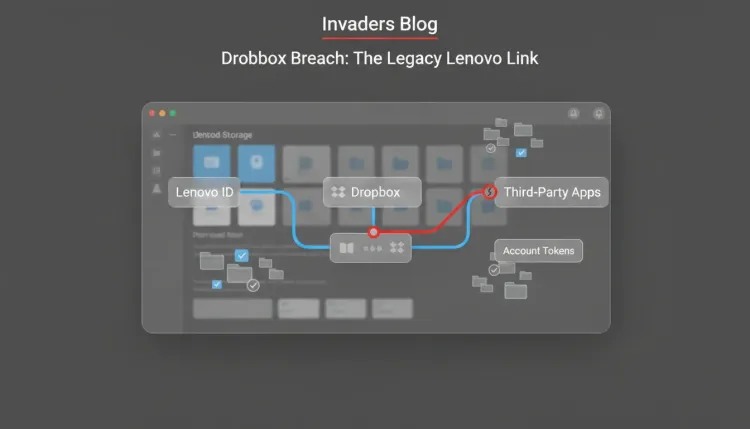
Dropbox uses Lenovo Identity Provider Services as one authentication path. According to notices sent to affected users and public reporting, an issue in Lenovo's email verification process allowed an unauthorized party to create a Lenovo ID with another person's email address.
That Lenovo ID could then be used to log in to the Dropbox account registered to the same email address. In affected cases, the attacker did not need the victim's Dropbox password or access to the victim's email inbox.
Dropbox responded by expiring sessions authenticated through Lenovo ID, removing Lenovo ID links from affected Dropbox accounts, and changing the flow so Lenovo ID access requires the Dropbox password before it can be used. Dropbox also notified affected users and reported the incident to data protection regulators.
Lenovo described the issue as involving a legacy integration between Lenovo ID and Dropbox that could be used to improperly authenticate certain Dropbox accounts. Lenovo also said its own customers were not affected while the investigation continued.
Why this matters
This incident is not just about Dropbox and Lenovo. It is a common pattern in identity integrations: one system treats email address matching as proof that two accounts belong to the same person.
That is dangerous. Email addresses can be unverified, reassigned, mistyped, changed, aliased, or asserted by a compromised or weak identity provider. OpenID Connect guidance is clear that claims such as email should not be used as the unique identifier for an end user. The stable subject identifier, together with the issuer, is what relying parties should bind to.
When email becomes the account-linking key, a flaw in one provider's verification process can become an account takeover path in another service. The relying application may not have a password bug, but it still grants the session.
The control failure
The failure mode appears to sit at the trust boundary between the identity provider and the relying service.
For defenders and product security teams, the important questions are:
- Can a new third-party login method be attached to an existing account without first proving control through an already trusted method?
- Does the application trust
emailoremail_verifiedas an account-binding primitive? - Are external identity providers allowed to create sessions for pre-existing local accounts automatically?
- Are high-risk identity-linking events logged and visible to users?
- Does two-factor authentication still apply when a user enters through a federated login route?
The Dropbox incident suggests a practical lesson: identity federation should reduce password exposure, but it must not bypass account ownership proof.
What affected users should do
Users who received a Dropbox notice should treat the account as exposed during the August 4 to August 21 window.
Immediate steps:
- Review Dropbox account activity and linked devices.
- Log out unknown sessions and remove unfamiliar connected apps.
- Enable Dropbox two-factor authentication.
- Change the Dropbox password and email account password if there is any suspicion of broader access.
- Review sensitive files that may have been viewed or downloaded.
- Rotate secrets stored in Dropbox, including API keys, recovery codes, SSH keys, password exports, business documents, and configuration files.
- Watch for follow-on phishing that references files or context from the account.
If Dropbox stored business secrets, this should be handled as an incident response case, not just a personal account cleanup.
What organizations should audit
Organizations should use the incident to review identity integrations across SaaS, cloud storage, CRM, developer tooling, HR platforms, and internal apps.
Prioritize systems where:
- users can sign in with multiple identity providers
- account linking is based on email address
- new login methods can be added without reauthentication
- partner or legacy identity providers remain enabled
- two-factor authentication is optional or inconsistently enforced
- files, tokens, source code, or customer records are stored
Security teams should also review whether identity events are sent to the SIEM with enough detail to reconstruct which provider issued the session, which subject identifier was used, whether email was verified, and whether a new account link was created.
Detection ideas
Useful signals include:
new federated identity link
login via legacy identity provider
login from Lenovo ID
first-time SSO login for existing account
email claim changed
email_verified assertion accepted
new session without password challenge
file download burst after first federated login
For Dropbox specifically, affected users and administrators should review device lists, active web sessions, file access activity, connected apps, shared links, and unusually timed downloads.
For broader SaaS environments, hunt for accounts where a new social login, SSO provider, or external identity was attached shortly before unusual access. That pattern can expose a weak link in single sign-on implementation before attackers scale it.
Design lessons for identity teams
Relying parties should not link an external identity to an existing local account only because the email address matches. A safer design requires step-up verification through an already trusted factor, such as the existing password, WebAuthn credential, recovery process, or enterprise identity provider.
Identity teams should also:
- bind users to stable issuer and subject identifiers, not mutable email strings
- require explicit user confirmation before adding a new login method
- preserve two-factor authentication requirements across federated routes
- disable stale or legacy identity integrations
- alert users and administrators when new identity links are created
- maintain logs for account linking, provider selection, and session issuance
The best time to discover a broken trust relationship is during design review. The second-best time is during an audit before attackers find it.
Executive takeaway
The Dropbox-Lenovo incident shows how a small verification failure in one identity provider can become unauthorized access in another service. For users, the priority is enabling two-factor authentication, reviewing activity, and rotating anything sensitive that may have been stored in the account.
For organizations, the bigger lesson is architectural. Every third-party identity link is a trust decision. Treat legacy SSO paths, email-based account matching, and silent provider linking as attack surfaces worthy of the same scrutiny as exposed APIs.
References
- https://www.bleepingcomputer.com/news/security/dropbox-accounts-breached-through-lenovo-email-verification-flaw/
- https://www.techradar.com/pro/security/over-5-000-dropbox-accounts-have-been-hacked-and-the-attackers-only-needed-an-email-address
- https://openid.net/specs/openid-connect-core-1_0.html
- https://help.dropbox.com/security/device-list-remote-sign-out
FAQ
Public reporting says roughly 5,000 Dropbox accounts were affected.
No. The reported attack path used a Lenovo ID created with the victim's email address, then relied on the Dropbox-Lenovo authentication relationship.
Dropbox reportedly said fewer than one-third of affected accounts had files viewed or downloaded.
Dropbox said affected accounts did not have Dropbox two-factor authentication enabled. Users should enable it immediately.
Do not treat email address matching as sufficient proof for account linking. Require reauthentication or step-up verification before adding any new federated login method to an existing account.