McKesson Cyber Incident Raises Fresh Questions About Healthcare SaaS Exposure

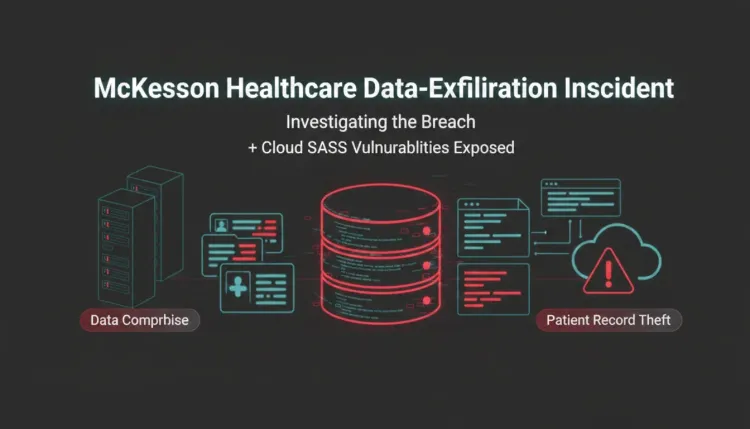
McKesson Cyber Incident Raises Fresh Questions About Healthcare SaaS Exposure
Executive Summary
McKesson disclosed a cybersecurity incident on August 28, 2026, after discovering unauthorized activity affecting its information systems on August 25. The company says the investigation is still in its early stages, but a customer notice confirms unauthorized access to third-party applications and exfiltration of data. Public reporting also links the incident to ShinyHunters, which claims it stole roughly 284 million patient-related data records, though that figure remains a raw record count claim and not a confirmed count of affected individuals.
For healthcare, pharmacy, and life sciences security teams, this is not just another data breach headline. It is a reminder that identity controls, SaaS visibility, third-party application governance, and incident response readiness now sit directly inside patient-data risk.
What happened?
McKesson, one of the largest healthcare and pharmaceutical distribution companies in the United States, filed a Form 8-K with the U.S. Securities and Exchange Commission saying it discovered a cybersecurity incident on August 25, 2026. In that filing, McKesson said the investigation was in its early stages and that, as of the filing date, it had not determined the incident was material or likely to have a material impact on the company.
A separate McKesson notice to customers adds the operational detail that matters most for defenders: the incident involved third-party applications, unauthorized access, and data exfiltration. McKesson says it activated response protocols, launched an investigation, and brought in cybersecurity experts. It also warned customers that they may experience intermittent service degradation believed to be related to the incident.
The public technical picture is still incomplete. McKesson has not disclosed which third-party applications were accessed, how the intrusion began, which data elements were taken, or how many people may be affected.
ShinyHunters claim remains serious, but not fully verified
BleepingComputer reports that ShinyHunters claimed responsibility for the attack and alleged that phishing by phone, often called vishing, was used against McKesson employees. The group reportedly claimed that compromised Okta single sign-on accounts were then used to reach Salesforce and Snowflake environments.
The same reporting says ShinyHunters claimed around 1TB of data was exfiltrated over four days, between August 21 and August 25, and that the dataset contained about 284 million patient-related records. That number should be handled carefully. BleepingComputer notes that the actor later clarified the figure as a raw count of records or lines, not a count of unique patients. McKesson has not publicly confirmed the actor's claimed data types, record volume, initial access path, or affected environments.
Even with those caveats, the alleged pattern is familiar: social engineering against identity, abuse of trusted SaaS access, large-scale data theft, and extortion pressure. It is the type of sequence healthcare defenders should prepare to investigate before every detail is publicly confirmed.
Why this matters for healthcare organizations
Healthcare data is unusually durable. Passwords can be reset, but patient identity, medical history, insurance identifiers, prescriptions, appointment data, and provider relationships cannot be rotated cleanly. When a major healthcare services provider reports third-party application access and data exfiltration, downstream risk can extend beyond the initially compromised systems.
The incident also reinforces a practical issue for security teams: SaaS platforms are now part of the core attack surface. Identity providers, customer-support systems, cloud data warehouses, analytics platforms, and integration tools often contain the same sensitive data that used to sit deeper inside enterprise networks.
That changes the investigation priority. Defenders should not only ask whether malware executed on endpoints. They should ask whether valid accounts accessed abnormal records, whether support cases or exports were touched, whether OAuth grants or service accounts were abused, and whether large downloads crossed normal business thresholds.
Defensive priorities now
Organizations connected to McKesson or similar healthcare supply-chain services should start with exposure management rather than speculation.
Review vendor notices, support communications, and contractual breach-notification channels for updates. Confirm whether any McKesson-connected workflows include patient, claims, pharmacy, shipment, provider, or billing data. Map which internal teams own those integrations, and identify where the same data is replicated in local warehouses or downstream systems.
Security teams should also review their own SaaS telemetry. The alleged use of compromised identity and cloud applications is a reminder to look closely at impossible travel, new device fingerprints, anomalous Okta session behavior, unusual Salesforce report exports, Snowflake query spikes, new API tokens, and unexpected OAuth application grants.
For healthcare entities, third-party risk should move beyond annual questionnaires. High-value vendors need practical monitoring hooks: named incident contacts, data-flow inventories, escalation procedures, and rehearsed decision trees for when a partner discloses exfiltration before the final victim count is known.
Detection and response checklist
- Confirm whether your organization exchanges patient, pharmacy, shipment, provider, billing, claims, or support data with McKesson-managed systems.
- Preserve logs for identity, SaaS, endpoint, email, VPN, and data warehouse activity covering at least August 21 through August 28, 2026.
- Hunt for suspicious sign-ins, MFA resets, help-desk impersonation, new devices, risky OAuth grants, and abnormal API activity tied to privileged or support users.
- Review Salesforce, Snowflake, and other cloud-data platforms for unusual exports, large queries, new integrations, or access from unfamiliar locations.
- Prepare patient, partner, and regulator communication paths, but separate confirmed facts from threat-actor claims.
- Validate that third-party incident-response playbooks define who can pause integrations, rotate credentials, notify legal teams, and preserve evidence.
- Monitor for follow-on fraud, targeted social engineering, and scams that may reference healthcare, pharmacy, insurance, or prescription information.
Strategic analysis
The McKesson disclosure fits a broader pressure point in healthcare security: attackers do not need to breach every hospital when shared vendors, SaaS platforms, and identity systems can concentrate sensitive data in fewer places. Whether ShinyHunters' full claim proves accurate or not, the confirmed elements already matter: third-party applications were accessed, data was exfiltrated, and the investigation is still developing.
That uncertainty is exactly why defenders should act early. The right posture is not panic, but disciplined preparation: preserve telemetry, verify data flows, tighten identity monitoring, and prepare communications that can evolve as facts become clearer.
Healthcare organizations should treat this as a live case study in SaaS-era breach response. The most useful question is not only "were we affected?" It is "could we quickly prove whether a similar identity-led data theft touched our own patient data?"
References
- https://www.mckesson.com/utility/cybersecurity/
- https://www.stocktitan.net/sec-filings/MCK/8-k-mckesson-corp-reports-material-event-fcb03c61b0cf.html
- https://www.bleepingcomputer.com/news/security/mckesson-discloses-breach-after-shinyhunters-claims-patient-data-theft/
- https://cyberinsider.com/mckesson-data-breach-exposing-284-million-patients/
FAQ
McKesson confirmed it discovered a cybersecurity incident on August 25, 2026, and later said the incident involved third-party applications, unauthorized access, and exfiltration of data.
No. That number is a ShinyHunters claim reported publicly as a raw count of patient-related records, not a verified count of unique affected people. McKesson has not publicly confirmed the volume or exact data types stolen.
This should be treated primarily as a data-breach and third-party application exposure case until McKesson publishes more technical detail.
Confirm data flows with McKesson-linked services, preserve relevant logs, monitor vendor updates, and review SaaS and identity telemetry for abnormal access or exports.
The incident highlights how healthcare risk increasingly concentrates in SaaS, identity, support, and data-warehouse platforms that connect many downstream organizations.