GitHub breach forces GHES signing-key rotation

GitHub breach forces GHES signing-key rotation | 2026
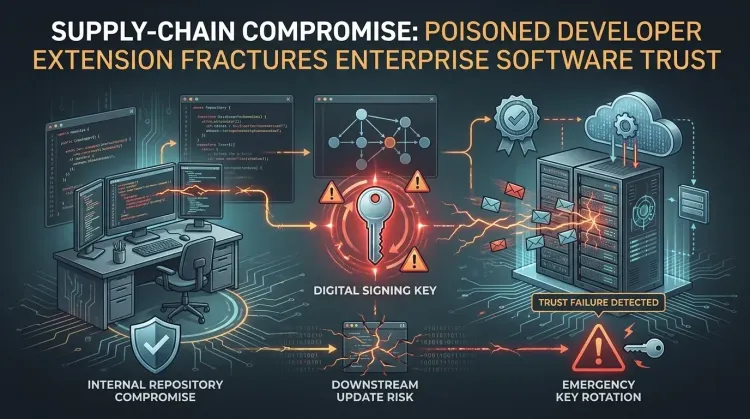
GitHub's May 2026 incident is a useful reminder that developer tooling is now part of the production trust chain. According to GitHub, the company detected and contained a compromise on May 18, 2026 after an employee device installed a poisoned third-party VS Code extension. By May 20, 2026, GitHub said the activity involved exfiltration of internal repositories only, and that attacker claims of roughly 3,800 repositories were directionally consistent with the investigation.
The most important downstream consequence arrived on May 26, 2026: GitHub told GitHub Enterprise Server customers to rotate the GPG public key used to verify upgrade packages. That makes this more than a corporate data breach. It is a supply-chain trust event that changed the update path for downstream enterprise infrastructure.
What GitHub confirmed
GitHub's updated incident post says the company activated its response process after detecting malicious activity, investigated the compromise, rotated critical secrets, and denied the threat actor further access. The same update says the investigation is still ongoing.
Three facts matter most for defenders:
- the initial compromise path was a poisoned developer extension on a GitHub employee device
- GitHub's current assessment is exfiltration of internal repositories rather than customer repositories hosted on GitHub
- GitHub Enterprise Server customers must rotate the package-signing key before installing future GHES releases
That last point changes the story. Once a provider has to rotate trust material used to validate software updates, the event stops looking like an isolated workstation compromise and starts looking like an ecosystem-level incident response problem.
Why GHES customers need to care now
GitHub Docs explain that GHES upgrade packages are signed with a GPG key so administrators can verify that packages came from GitHub. After GitHub rotates that key, every GHES instance must update the stored public key before packages signed with the new key will install successfully.
If teams do nothing, future upgrades will fail signature verification with:
Error: The file provided is not a valid GitHub Enterprise Server package.
GitHub also published a rotation script and a SHA256 digest for independent verification:
3009bf5cdef034e153008cc375a05ac0bdbb1a2a325b22adb300c028e3766b43
In practice, that means defenders now have two parallel jobs:
- treat the upstream compromise as a secret-review and trust-review event
- make sure GHES update operations will not break the next time emergency patching is required
The hidden operational risk
The breach itself involved internal repositories, but the bigger lesson is about transitive trust. A malicious extension on one endpoint was enough to trigger:
- secret rotation inside GitHub
- emergency guidance for downstream GHES administrators
- a change in the signing chain used to validate enterprise upgrade packages
That is why this incident fits the modern software supply-chain pattern. The attacker did not need direct access to a customer's appliance to create downstream operational risk. Compromising a developer trust surface created pressure on every organization that depends on GitHub's release validation path.
From a threat intelligence perspective, this is the part defenders should remember: supply-chain incidents increasingly propagate through trust dependencies rather than direct exploitation of each victim.
Version and upgrade caveats
GitHub's documentation adds an important constraint that some administrators may miss during emergency handling.
- GHES versions prior to 3.16 are not being re-signed with the new key
- instances on 3.13 or earlier cannot rotate the new public key successfully until they are upgraded to at least 3.14
- previously downloaded upgrade packages signed with the old key will fail verification after rotation
This matters because some organizations still treat self-hosted developer infrastructure as slow-moving internal tooling. In this case, lagging versions directly complicate recovery and patch readiness.
Detection and response priorities
If your organization runs GHES, the operational priority is straightforward.
1. Validate the signing-key rotation path
Confirm administrators understand whether the deployment is single-node, HA, or clustered, and rehearse the GitHub-provided rotation steps before the next urgent patch cycle.
2. Review update provenance controls
Make sure teams only download GHES updates from official GitHub sources and verify the published integrity data before execution. This is an access control problem as much as an operations problem: too many hands in the update path increases the chance of accidental trust bypass.
3. Revisit extension trust on privileged engineering endpoints
The trigger here was a poisoned extension on one employee device. That should push security teams to review which extensions are allowed on workstations with privileged repository or release access, how publisher trust is validated, and whether extension installation is monitored or restricted.
4. Treat developer endpoints as part of the release boundary
If a workstation can reach source code, release tooling, or signing workflows, it belongs inside the same security boundary as CI/CD and production release infrastructure.
5. Prepare for faster patch cadence
GitHub explicitly said GHES customers should prepare to take security updates at an increased rate in the coming months. That is a signal to test upgrade windows, dependencies, rollback plans, and network reachability to enterprise.github.com before the next advisory lands.
Strategic takeaway
The practical lesson is not simply "rotate the key." It is that developer-tool trust can become release-chain risk very quickly. A poisoned extension on a single laptop forced GitHub to rotate core trust material for self-hosted enterprise customers. That is exactly the kind of blast-radius expansion defenders should expect more often as build pipelines, extensions, and cloud development surfaces keep converging.
Organizations that run GHES should treat this as a trust-chain exercise: validate the new signing key, review developer endpoint controls, and assume that security for release infrastructure now starts well before the package is built.
References
FAQ
GitHub says it detected and contained a compromise on May 18, 2026 involving a poisoned third-party VS Code extension on an employee device. The company says the current assessment is exfiltration of internal repositories only.
GitHub rotated the signing key used for GHES upgrade packages. Customers must update the stored GPG public key on their instance before future releases signed with the new key can be installed.
Future GHES upgrades will fail signature verification, which can delay patching during a high-pressure security event.
GitHub Docs say versions earlier than 3.16 are not being re-signed with the new key, and instances on 3.13 or earlier must first upgrade to at least 3.14 before rotating the new public key.
How to cite
Lucas Oliveira. GitHub breach forces GHES signing-key rotation. 17 Aug 2026. Invaders Cybersecurity. https://invaders.ie/resources/blog/supply-chain-attack/github-breach-forces-ghes-signing-key-rotation.
Subscribe via RSS.
Written by
Lucas Oliveira
Research
A DevOps engineer and cybersecurity enthusiast with a passion for uncovering the latest in zero-day exploits, automation, and emerging tech. I write to share real-world insights from the trenches of IT and security, aiming to make complex topics more accessible and actionable. Whether I’m building tools, tracking threat actors, or experimenting with AI workflows, I’m always exploring new ways to stay one step ahead in today’s fast-moving digital landscape.
Hot TopicsLast 7 days
Categories
Stay Updated
Get the latest cybersecurity insights delivered to your inbox.