MALFEX’s `imgdecode` Package Shows Why Native npm Addons Need Supply-Chain Scrutiny

MALFEX’s imgdecode Package Shows Why Native npm Addons Need Supply-Chain Scrutiny
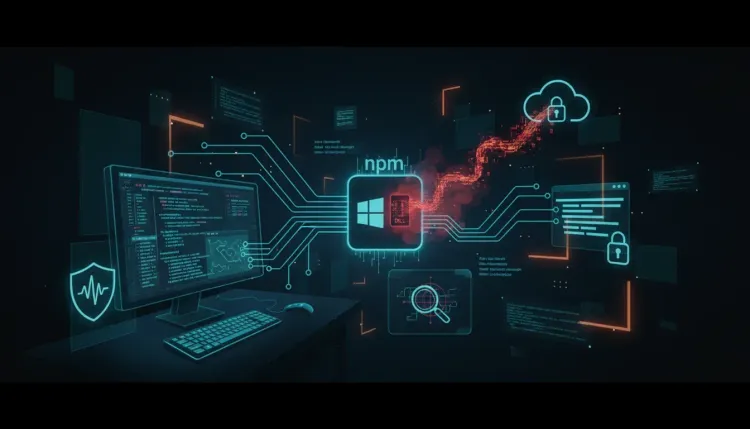
The latest MALFEX campaign has moved its most dangerous logic out of readable JavaScript and into a compiled Windows native addon. That change is easy to miss in a conventional dependency review, but it gives defenders a clear warning: an npm package can look small, lack an install hook, and still execute a full malware loader when an application imports it.
The package is not an image decoder
Researchers identified imgdecode, an npm package first published on September 30, 2026 by the account malfexteste8. The latest reported version, 1.0.3, was published on October 11 and had reached 979 downloads when the campaign was documented. The package was described as still available at the time of reporting.
Its JavaScript entry point is only nine lines long. The important behavior sits inside a precompiled Windows .node addon, which functions as a DLL. When a Node.js process requires the package from an interactive Windows console, the addon attempts to retrieve encrypted shellcode from GitHub, decrypts it, and injects the result into a new dllhost.exe process.
That design changes the inspection problem. A code review focused on JavaScript may see almost nothing suspicious. A control that only checks for postinstall scripts or build steps may also miss the package, because the malicious behavior is already present in the native binary and does not need an installation hook.
Why this is a supply-chain attack
This is a software supply chain problem because the attacker is abusing the trust developers place in a public dependency registry and in familiar package-install workflows. The package does not need to compromise a popular library to create risk. It only needs to appear plausible enough for a developer, build job, or internal tool to install it.
MALFEX also shows how operators can tune malware for the blind spots of automated analysis. The addon checks whether standard output is attached to an interactive console, which can prevent the payload from activating in some CI runners and sandboxes. It also uses anti-analysis checks for virtual machines, process-monitoring tools, and packet-analysis utilities.
The payload behavior reported by researchers goes well beyond one-time execution. It can search for browser data, cryptocurrency wallets, Discord and Telegram data, seed phrases, .env files, and private-key formats such as .pem, .ppk, and .kdbx. It can also provide command execution, file transfer, process control, screenshots, clipboard access, and simulated mouse and keyboard input through a WebSocket connection.
For organizations, the most serious consequence may be credential theft from a developer workstation or build runner. A compromised .env file can expose cloud tokens, package-registry credentials, database passwords, and deployment keys. If those credentials are reused in CI/CD or production automation, a developer-side compromise can become a second-stage intrusion.
What defenders should check now
Organizations that use Windows development environments should treat any installation of imgdecode or the related packages reported in the MALFEX campaign as a potential compromise, not merely a dependency cleanup task.
1. Identify exposure
Search lockfiles, package caches, artifact repositories, CI logs, and endpoint telemetry for imgdecode, imgbundle, cdn-img-fetch, img-to-native, native-runner, and runhelper. Preserve the relevant lockfiles and timestamps before removing packages so the investigation retains a reliable timeline.
2. Isolate and rotate
Quarantine affected Windows hosts and suspend their build or deployment permissions. Rotate secrets that may have been readable from .env files, browser stores, wallets, source repositories, package registries, and cloud control planes. Rotation should happen from a known-clean device, with identity and access management logs reviewed for unusual sign-ins and token use.
3. Hunt for execution and persistence
Review process telemetry for dllhost.exe launched by Node.js, suspicious child processes, outbound connections to unfamiliar GitHub content, and the package's reported persistence mechanisms, including a Run key and a scheduled task named MicrosoftEdgeUpdateService. Look for credential access, archive creation, clipboard collection, and unexpected WebSocket traffic.
4. Harden dependency intake
Require lockfiles and provenance checks for production builds, restrict native addons where they are not needed, and scan .node binaries as executable code rather than treating them as ordinary package data. Registry reputation and download counts are useful context, but they are not proof of safety.
The broader lesson
MALFEX is a reminder that modern dependency security cannot stop at package metadata or readable source. Native modules, generated binaries, and prebuilt release artifacts deserve the same scrutiny as scripts. For defenders, the practical question is not only “Was a malicious install hook present?” It is also “What executes when this application imports the package on a real developer or build machine?”
That distinction is where software supply-chain defense becomes operational: inventory the dependency, inspect the artifact, monitor the host, and assume exposed secrets need to be replaced.
References
FAQ
The latest MALFEX campaign has moved its most dangerous logic out of readable JavaScript and into a compiled Windows native addon. That change is easy to miss in a conventional dependency review, but it gives defenders a clear warning: an npm package can look small, lack an install hook, and still execute a full malware loader when an application imports it.