Rust crate owners targeted in video-call supply chain campaign

Rust crate owners targeted in video-call supply chain campaign
Rust's security response working group and the crates.io team have warned that prominent Rust contributors and owners of popular crates are being targeted through convincing video-call lures. The campaign is not just another round of developer phishing. Its likely goal is to compromise trusted maintainer devices and accounts so attackers can publish malware through software that downstream users already trust.
That makes this a supply chain attack problem. The first visible contact may look like a job opportunity, contract discussion, or project collaboration, but the strategic target is package integrity: maintainer credentials, publishing sessions, GitHub access, and the trust relationship between crates.io packages and the teams that depend on them.
What Rust warned about
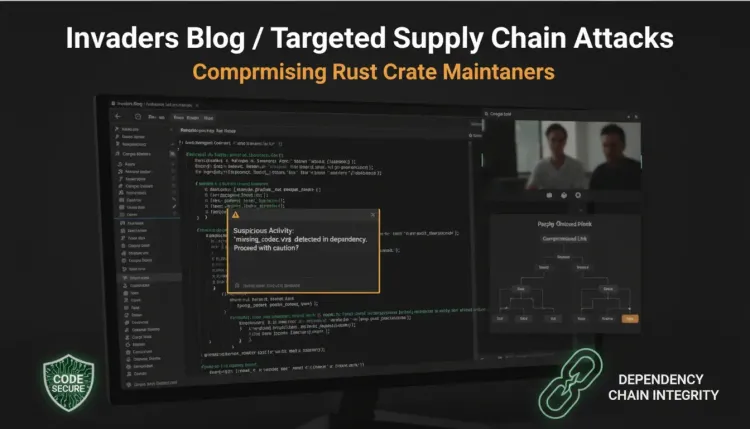
On September 17, 2026, the Rust project said it believes an ongoing campaign is targeting rust-lang members and popular crate owners. The observed pattern starts with a video call arranged around something positive: a job, project, or contract opportunity. During the call, the target is pushed to install something on their machine, such as a supposed missing audio codec, or to run an attacker-supplied command, including commands placed on the clipboard.
The Rust advisory also noted that the attackers create new but legitimate-looking company profiles with plausible LinkedIn presences, which helps them pass quick checks. That detail matters because many maintainers are used to receiving collaboration requests, sponsorship discussions, and recruiter messages. The attack hides inside normal professional noise.
SecurityWeek and The Register connected the tactics to techniques often associated with North Korean fake-recruiter campaigns, while Rust's own post was careful about direct attribution. The operational lesson is the same either way: attackers are moving toward the people who can publish code, not only toward the code itself.
Why this matters beyond Rust
Rust's package ecosystem is valuable because crates are widely reused, often deep inside developer tooling, infrastructure code, CLI utilities, and production services. A popular crate owner with a compromised workstation or publishing account can become a distribution channel before downstream users realize anything changed.
The warning also follows recent Rust ecosystem incidents. Rust reported an August 2026 supply-chain attack involving the arrayref crate, where a malicious package was briefly published through a compromised maintainer path. That incident was contained quickly, but it showed why attackers care about maintainers: one trusted package can reach many environments faster than a generic phishing email.
This is the uncomfortable shift defenders need to absorb. Package maintainers are now part of the attack surface. A small open-source project can sit upstream of thousands of builds, and a maintainer's laptop may be as strategically important as an internal production server.
The lure is social, but the blast radius is technical
The first move in this campaign is social engineering. The attacker tries to create urgency, familiarity, and plausibility around a live call. From there, the technical objective is to make the victim execute attacker-controlled code or disclose access through a compromised browser, terminal, clipboard, session token, or developer account.
For organizations consuming Rust packages, this means dependency risk cannot be reduced to "is the source repository public?" or "does the package have many downloads?" Trust has to include who can publish, how releases are approved, whether maintainers use phishing-resistant authentication, and whether dependency updates are monitored for unusual changes.
For maintainers, the defensive priority is even more personal and immediate: treat unexpected video calls as an execution boundary. If a stranger on a call asks you to install a codec, run a shell command, paste a clipboard command, clone a private assessment repository, or troubleshoot meeting software outside your normal platform, assume the call has turned hostile.
What maintainers should do now
Rust's advice is practical: be suspicious of cold outreach, prefer calls you set up yourself on platforms you already trust, and re-check account health. Maintainers should go further where possible:
- Use phishing-resistant MFA or hardware security keys on GitHub, crates.io-linked accounts, email, and password managers.
- Review recent account sessions, OAuth applications, SSH keys, personal access tokens, and package ownership changes.
- Separate package publishing from day-to-day browsing, messaging, and video-call activity where feasible.
- Avoid running commands from chat, clipboard, screen-share instructions, assessment repositories, or meeting troubleshooting prompts.
- Require a second maintainer review for high-impact crate releases or ownership changes.
- Keep recovery contacts and security reporting paths current for crates.io and project repositories.
If there is any concern that a device or account was exposed, rotate credentials from a known-clean machine, revoke active sessions, review recent package releases, and contact the relevant registry or project security team quickly.
What security teams should monitor
Security teams that rely on Rust dependencies should not wait for a confirmed malicious release before improving controls. Useful monitoring includes:
- New crate versions published outside normal maintainer patterns.
- Package updates that introduce build scripts, obfuscated code, new network behavior, or unexpected binary artifacts.
- Sudden ownership changes, maintainer additions, or token creation events on important upstream projects.
- Developer endpoints that execute commands copied from browsers, meeting apps, chat clients, or interview repositories.
- Suspicious outbound connections shortly after video calls or recruiter-style interactions.
- Internal builds that pull newly released dependency versions without review gates.
The right model is layered. Registry-level monitoring catches some abuse, but enterprise defenders also need dependency pinning, provenance checks, software composition analysis, build isolation, and incident response playbooks for compromised upstream packages.
How organizations should adjust dependency governance
This campaign reinforces a simple rule: dependency governance should account for maintainer compromise, not only malicious outsiders submitting suspicious code. That means organizations should identify high-impact packages, understand how updates enter production, and decide which dependencies require additional review before automatic rollout.
Teams should also reduce secret exposure in build environments. If a poisoned crate runs during build or test, it should not be able to steal broad cloud tokens, signing keys, production credentials, or long-lived repository access. Build systems need least privilege, short-lived credentials, and network controls that assume a dependency could behave maliciously.
For critical Rust dependencies, consider monitoring release cadence and maintainers' public advisories. A sudden patch release is not automatically suspicious, but a high-risk dependency update deserves context: what changed, who published it, whether upstream acknowledged it, and whether the package introduced new install-time behavior.
The broader signal
Attackers have learned that developer trust is a high-leverage target. They do not need to break the Rust language, crates.io infrastructure, or a company's perimeter if they can convince one trusted maintainer to run one command during a friendly-looking call.
The best response is not panic. It is treating maintainers, publishing credentials, and build pipelines as production security assets. Rust's warning gives defenders a chance to harden before the next compromised package becomes the headline.
References
FAQ
Rust's security response working group and the crates.io team have warned that prominent Rust contributors and owners of popular crates are being targeted through convincing video-call lures. The campaign is not just another round of developer phishing. Its likely goal is to compromise trusted maintainer devices and accounts so attackers can publish malware through software that downstream users already trust.
Rust's package ecosystem is valuable because crates are widely reused, often deep inside developer tooling, infrastructure code, CLI utilities, and production services. A popular crate owner with a compromised workstation or publishing account can become a distribution channel before downstream users realize anything changed.
How to cite
Lucas Oliveira. Rust crate owners targeted in video-call supply chain campaign. 22 Sept 2026. Invaders Cybersecurity. https://invaders.ie/resources/blog/supply-chain-attack/rust-crate-owners-targeted-video-call-supply-chain-campaign.
Subscribe via RSS.
Written by
Lucas Oliveira
Research
A DevOps engineer and cybersecurity enthusiast with a passion for uncovering the latest in zero-day exploits, automation, and emerging tech. I write to share real-world insights from the trenches of IT and security, aiming to make complex topics more accessible and actionable. Whether I’m building tools, tracking threat actors, or experimenting with AI workflows, I’m always exploring new ways to stay one step ahead in today’s fast-moving digital landscape.
Hot TopicsLast 7 days
Categories
Stay Updated
Get the latest cybersecurity insights delivered to your inbox.