N-able N-central flaw exposes MSP consoles to account takeover

N-able N-central flaw exposes MSP consoles to account takeover
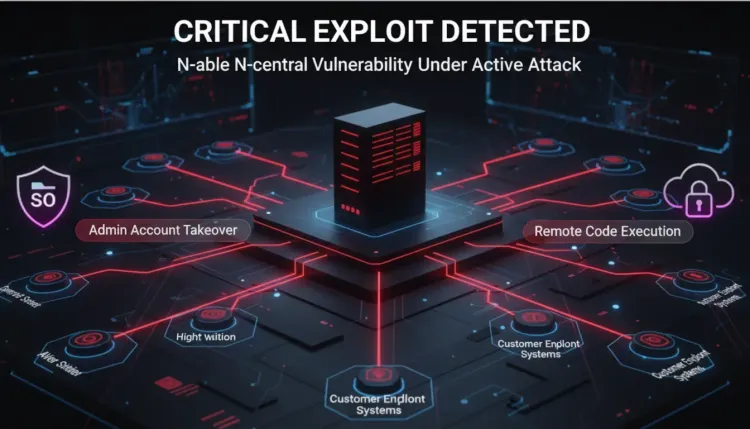
N-able has released an emergency hotfix for N-central after confirming active exploitation of an authentication bypass vulnerability that can lead to account takeover. The flaw, tracked as CVE-2026-18577, affects N-central versions through 2026.3.1 and is especially sensitive because N-central is a remote monitoring and management platform used by managed service providers to administer many downstream customer environments from one console.
The issue is not just another vulnerability in an enterprise application. In an MSP setting, the management plane is the blast radius. If attackers gain administrative access to an RMM console, they may be able to use the same trusted tooling that defenders use every day: remote access sessions, automation jobs, scripts, endpoint agents, and configuration changes across customer networks.
N-able says customers should upgrade to N-central 2026.3.1.7. Hosted N-central instances are being updated automatically according to schedules communicated by N-able, while self-hosted customers need to apply the hotfix themselves. For exposed or high-risk environments, security teams should treat the update as urgent and pair it with a focused review of console, remote-control, and endpoint activity.
What happened
N-able published N-central 2026.3 Hotfix 1 on August 2, 2026, identifying build 2026.3.1.7 as the mitigation for CVE-2026-18577. The CVE record describes the issue as an incomplete patch for CVE-2026-18556 that allows authentication bypass and account takeover in N-central versions through 2026.3.1.
That sequence matters. The first defensive assumption after a critical vendor advisory is often simple: upgrade to the fixed branch and move on. Here, defenders need to verify they are on the specific hotfix build, not merely on a recent 2026.3 release that may have been considered current before the updated advisory.
Huntress, which published rapid-response guidance after reviewing activity around the issue, says exploitation can give remote attackers administrative access to vulnerable N-central servers. From there, attackers may abuse built-in RMM functions such as Take Control sessions, scripting, automation jobs, and tool deployment to reach managed endpoints. Huntress also noted observed activity involving Cloudflare-based tunnels for persistence, while cautioning that N-able has not yet published full root-cause details.
Why RMM compromise is different
Remote monitoring and management systems sit in a privileged operational position. They are designed to reach endpoints, apply changes, run scripts, gather telemetry, and help technicians fix problems quickly. That is exactly why attackers like them.
When an RMM platform is compromised, the attacker does not always need to build a noisy custom intrusion path. They can operate through trusted administrative channels. A malicious job can look like automation. A remote session can look like support. A pushed tool can blend into the management workflow. This creates a difficult incident response problem, especially for MSPs that manage many customers with shared operational processes.
The downstream risk is also asymmetric. One vulnerable central server can affect many customer environments. The practical question for defenders is not only "was the N-central server patched?" It is also "what did the console do before it was patched, and where did those actions land?"
What defenders should check
The first priority is version confirmation. Self-hosted N-central deployments should be upgraded to 2026.3.1.7, and hosted customers should verify the upgrade status with N-able communications. Teams should also restrict access to the console using firewall rules, VPN, known administrative IP ranges, SSO where available, and multi-factor authentication.
After patching, review N-central activity for signs that the platform itself was used as the intrusion path. Focus on events that would be unusual for your technicians and normal maintenance windows:
- Unexpected administrative logins or sessions
- New users, role changes, or weakened authentication settings
- Access from unfamiliar IP ranges or geographies
- Take Control sessions against domain controllers, file servers, backup servers, or other high-value systems
- Jobs or scripts created shortly before or during the exposure window
- Automation that touched unusually large numbers of endpoints
- New remote-access tools, tunnels, services, or persistence mechanisms on managed devices
Huntress specifically recommends reviewing N-central UI and remote-access logs, including Take Control activity, and validating suspicious sessions against the viewer identity, source IP, target host, and time of day. On Windows endpoints managed through N-central, Take Control activity may leave useful breadcrumbs in GetSupportService_N-Central logs, but those logs are not proof of compromise by themselves. They are pivots for investigation.
MSPs need a management-plane playbook
This incident is a reminder that RMM platforms need a dedicated security model. They should not be treated like ordinary internal applications. They need tightly scoped administrative access, strong authentication, aggressive logging, explicit customer segmentation, regular account review, and alerting on broad automation.
For MSPs, the most important controls are boring but decisive: keep the console off the public internet, enforce MFA for every administrative user, remove dormant accounts, require named technician identities, monitor privileged changes, and keep a reliable audit trail for remote sessions and automation jobs. If an attacker can use the platform, defenders need enough context to separate legitimate operational work from malicious use.
Customer communication also matters. If there is evidence that an RMM console was accessed or abused, impacted customers need clear answers about which systems were touched, what commands ran, what remote sessions occurred, and whether credentials, backup systems, identity infrastructure, or security tools were affected.
The broader lesson
Attackers continue to target tools that provide scale. VPNs, identity systems, endpoint management platforms, CI/CD services, and RMM consoles are attractive because they sit above many assets at once. A single compromise can become a distribution mechanism.
The N-able hotfix closes the immediate exposure, but the defensive lesson is larger: management planes deserve the same scrutiny as production identity providers. Patch fast, restrict reachability, log deeply, and investigate the actions taken through trusted consoles. In centralized administration, control is the asset.
Sources
- N-able Status, "N-central 2026.3 Hotfix 1 - Mitigation for CVE-2026-18577," published August 2, 2026.
- N-able, "N-central Security Update - August 2, 2026," published August 3, 2026.
- CVE.org, "CVE-2026-18577," published August 2026.
- Huntress, "Rapid Response: Critical N-able N-central Vulnerability and Active Exploitation," published August 3, 2026.
- Arctic Wolf, "CVE-2026-18556 / CVE-2026-18577: N-able N-central Authentication Bypass Vulnerabilities Require Immediate Patching," published August 3, 2026.
Written by
Lucas Oliveira
Research
A DevOps engineer and cybersecurity enthusiast with a passion for uncovering the latest in zero-day exploits, automation, and emerging tech. I write to share real-world insights from the trenches of IT and security, aiming to make complex topics more accessible and actionable. Whether I’m building tools, tracking threat actors, or experimenting with AI workflows, I’m always exploring new ways to stay one step ahead in today’s fast-moving digital landscape.
Hot TopicsLast 7 days
Categories
Stay Updated
Get the latest cybersecurity insights delivered to your inbox.