Cisco CUCM SSRF bug turns WebDialer exposure into a path toward root

Cisco CUCM SSRF bug turns WebDialer exposure into a path toward root
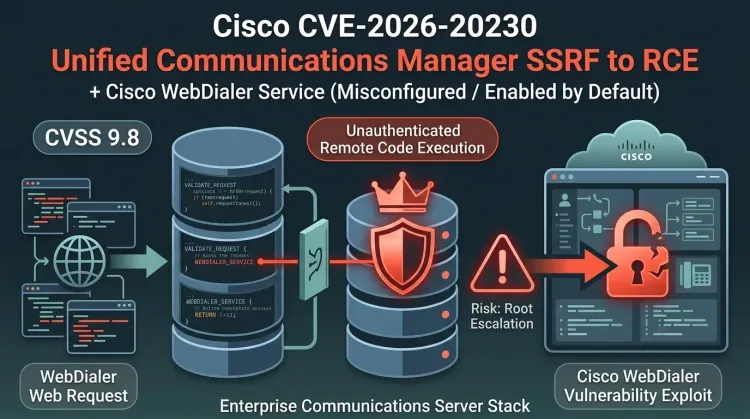
Cisco's latest Unified Communications Manager advisory deserves attention because it turns a familiar vulnerability class into a much more dangerous operator problem. CVE-2026-20230 is formally described as a server-side request forgery issue, but Cisco says successful exploitation can let an unauthenticated attacker write files to the underlying operating system and later use that foothold to escalate to root.
That makes the practical question much simpler than the acronym: is WebDialer enabled anywhere it should not be? If the answer is yes, defenders may have a direct unauthenticated path from HTTP request handling into a deeper compromise chain on a voice and collaboration platform that often sits close to internal identity and call-control workflows.
What Cisco disclosed
Cisco says the flaw affects Cisco Unified Communications Manager and Unified Communications Manager Session Management Edition when the WebDialer service is enabled. The issue is caused by improper input validation in specific HTTP requests, which allows an unauthenticated remote attacker to trigger SSRF behavior through the device.
The important escalation detail is Cisco's own wording: successful exploitation can write files to the underlying operating system that may later be used to elevate privileges to root. That is why Cisco rated the advisory as critical in practice even though the base CVSS vector does not immediately read like a classic unauthenticated remote code execution bug.
There are two pieces of good news. First, Cisco says WebDialer is disabled by default. Second, fixed releases are available. But that should not create false comfort. Defaults do not protect environments where features were enabled years ago and then forgotten, and exposed collaboration infrastructure tends to accumulate exceptions over time.
Why this matters beyond "just SSRF"
SSRF is often underestimated because it sounds indirect. In reality, SSRF becomes dangerous when a trusted application can be coerced into making privileged requests or handling data flows it was never meant to expose. In this case, Cisco is warning about a file-write path that can become a stepping stone to root, which moves the issue closer to a post-auth or chained-compromise outcome than to a harmless metadata fetch bug.
That is where access control and system hardening matter. Unified communications platforms are rarely isolated toys. They often connect to directory services, user provisioning, and internal voice-routing logic. A root-capable foothold on that layer can become a bigger operational problem than the headline "SSRF" initially suggests.
For defenders, the more useful framing is exposure management. If WebDialer is running, the vulnerability is relevant. If it is not, the attack path described by Cisco is materially reduced. That makes this a rare case where a specific service inventory check gives an immediate answer about likely exposure.
What defenders should do first
Cisco provides a straightforward validation path:
- Log in to Cisco Unified CM Administration.
- Switch to Cisco Unified Serviceability.
- Open
Control Center - Feature Services. - Check whether the
Cisco WebDialer Web Servicestatus isStarted.
If it is started, WebDialer is enabled and the advisory applies.
Cisco says there are no workarounds that fully address the vulnerability, but it does offer a practical mitigation: disable WebDialer until a patch can be applied if the service is not required. That is an unusually actionable control because it shrinks exposure before a maintenance window is available.
Patch and mitigation guidance
Cisco lists the following fixed paths in the advisory:
- Release 14: upgrade to
14SU6 - Release 15: upgrade to
15SU5when available, or use the version-specificCOPpatch Cisco references
The detail that matters here is sequencing. If WebDialer is enabled on an internet-reachable or broadly reachable system, it makes sense to disable it first where operationally acceptable, then plan the upgrade. That reduces the time spent exposed while waiting for formal patch rollout, change approval, or maintenance coordination with telecom teams.
This is also a good time to review who can reach Unified CM management and application interfaces. Restricting unnecessary paths, validating reverse-proxy exposure, and checking whether old service exceptions still exist can reduce the attack surface around the vulnerable feature.
Detection and response posture
Cisco says it is aware of proof-of-concept exploit code but is not aware of malicious use at the time of publication. That means defenders should not treat this as confirmed in-the-wild exploitation, but they also should not assume the window will stay quiet for long. Bugs with unauthenticated reachability, a vendor-confirmed path toward root, and a crisp exposure condition tend to attract rapid testing.
Security teams should use this advisory to answer three questions quickly:
- Is WebDialer enabled anywhere in production or DR?
- Are any of those systems reachable from untrusted networks or overly broad internal segments?
- Can telecom and security teams align on disablement or patch timing without delaying action?
If the platform is critical to business continuity, this becomes an incident response and change-management coordination task as much as a vulnerability task. Voice infrastructure often falls between ownership boundaries, and those boundary gaps are exactly where risky defaults and legacy feature exposure survive longest.
The broader lesson
CVE-2026-20230 is a reminder that "disabled by default" is not the same as "disabled in your environment." In mature estates, legacy enablement, migration drift, and exception-based administration often re-open services that security teams assume are off.
The right response here is pragmatic: inventory WebDialer, disable it where it is unnecessary, patch to Cisco's fixed releases, and tighten reachability around Unified CM services. For teams that do that quickly, this is a manageable June advisory. For teams that assume defaults equal reality, it is a preventable path from web exposure to root-level risk.
References
How to cite
Lucas Oliveira. Cisco CUCM SSRF bug turns WebDialer exposure into a path toward root. 8 Jun 2026. Invaders Cybersecurity. https://invaders.ie/resources/blog/vulnerability/cisco-cucm-ssrf-bug-turns-webdialer-exposure-into-a-path-toward-root.
Subscribe via RSS.
Written by
Lucas Oliveira
Research
A DevOps engineer and cybersecurity enthusiast with a passion for uncovering the latest in zero-day exploits, automation, and emerging tech. I write to share real-world insights from the trenches of IT and security, aiming to make complex topics more accessible and actionable. Whether I’m building tools, tracking threat actors, or experimenting with AI workflows, I’m always exploring new ways to stay one step ahead in today’s fast-moving digital landscape.
Hot TopicsLast 7 days
Categories
Stay Updated
Get the latest cybersecurity insights delivered to your inbox.