CVE-2026-24301: Microsoft Copilot CoSnitch Data Exposure

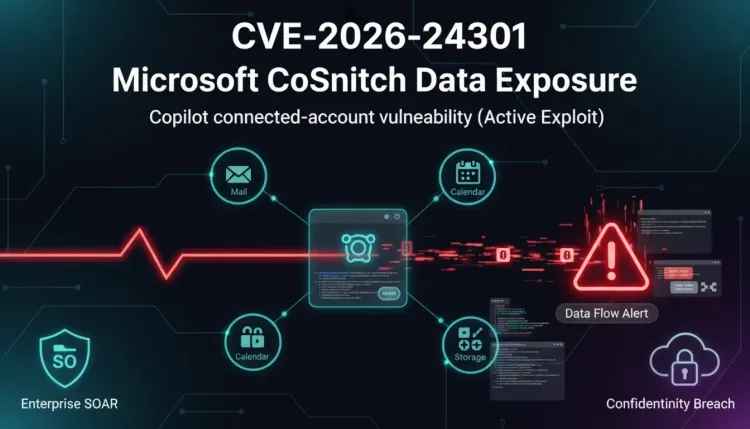
CVE-2026-24301: Microsoft Copilot CoSnitch Data Exposure
CVE-2026-24301 is a newly published Microsoft Copilot vulnerability that turns a familiar enterprise risk into a sharper operational problem: connected AI assistants can become a path to sensitive data when external input, delegated access, and weak isolation meet in the same workflow.
Public reporting on August 19, 2026 described the issue as "CoSnitch," a one-click attack path against Microsoft Copilot Personal. The NVD entry describes the underlying weakness as improper neutralization of special elements used in a command, classifying it under CWE-77 command injection and scoring it as critical.
For defenders, the immediate lesson is not only to track the specific CVE. It is to reassess how much organizational or personal data an AI assistant can reach after a user connects mail, files, calendars, cloud drives, or productivity accounts.
What happened
NVD published CVE-2026-24301 on August 18, 2026, based on Microsoft-provided details. The record says an unauthorized network attacker can disclose information through Microsoft Copilot by exploiting a command injection weakness.
Cybersecurity News reported the next day that the flaw, nicknamed CoSnitch, can allow attackers to siphon sensitive data from connected accounts after a victim clicks a malicious link. That makes user interaction part of the trigger, but it does not make the issue low impact. In AI assistant environments, one click can expose data across several linked services if the assistant has broad delegated access.
The public technical detail is still limited, so defenders should avoid overfitting detections to a single payload format. The reliable facts are the CVE identifier, the affected Microsoft Copilot service context, the command injection classification, the high confidentiality/integrity/availability impact in the CVSS vector, and the need to review connected-account exposure.
Why this matters for AI assistant security
Copilot-style tools sit near a growing amount of sensitive information. Users connect email, files, cloud storage, identity-linked apps, and personal productivity data because the value of the assistant depends on context. That same context becomes blast radius when a vulnerability lets attacker-controlled input influence assistant behavior or backend command handling.
Traditional patch thinking is too narrow here. If an enterprise AI assistant has access to mailbox content, files, meeting notes, customer documents, OAuth-connected applications, or personal accounts, a vulnerability can become a data-governance incident even before classic malware appears.
This is why AI security needs to be treated as part of identity, application security, and data-loss prevention. The security boundary is not only the model. It is the entire chain of prompts, connectors, delegated permissions, rendering paths, backend services, and audit logs.
Who is affected
The public NVD record identifies Microsoft Copilot as the affected product context and marks the CVE as an exclusively hosted service issue. Organizations should map exposure based on which Copilot experiences are enabled, which users have connected accounts, and which sensitive repositories those accounts can reach.
Consumer and personal Copilot users should review linked services and assume that connected account scope matters. Enterprise teams should look beyond license inventory and examine where Copilot can read from Microsoft 365, SharePoint, OneDrive, Teams, Exchange, browser sessions, plugins, or third-party connectors.
Even if the vulnerable service is patched server-side, incident responders still need to know whether suspicious links were clicked, whether unusual assistant activity occurred, and whether sensitive data was queried or exported around the exposure window.
What defenders should do first
Start with service status and vendor guidance. For hosted Microsoft services, remediation is often server-side, but customers still need to confirm whether any tenant-level action, policy update, connector review, or user advisory is required.
Next, reduce the blast radius of connected accounts. Review which users have Copilot access, which accounts or applications are connected, and whether high-risk data repositories are available through assistant workflows. Remove stale or unnecessary connectors and tighten scopes where possible.
Security teams should also review logs for suspicious Copilot access patterns, unusual link-click activity, unexpected data queries, and abnormal access to files or mail immediately after external-link interaction. If audit coverage is incomplete, that gap should be treated as a control issue, not a reason to assume no impact.
// Example pattern only: adapt table and field names to your tenant logging.
AuditLogs
| where TimeGenerated > ago(14d)
| where OperationName has_any ("Copilot", "Connected app", "OAuth", "FileAccessed")
| summarize Events=count(), Resources=make_set(TargetResources, 20) by UserPrincipalName, bin(TimeGenerated, 1h)
| where Events > 20
For higher-risk users, especially executives, finance, legal, engineering, and security administrators, pair log review with token and consent review. If there is evidence of suspicious activity, rotate exposed credentials, revoke risky OAuth grants, and preserve logs for incident response.
Strategic takeaway
CoSnitch fits a larger pattern: AI productivity tools are becoming high-value access brokers. Attackers no longer need to compromise every downstream service if an assistant already has delegated access to retrieve and summarize sensitive data.
That does not mean organizations should abandon AI assistants. It means they need the same maturity around least privilege, connector governance, auditability, and response playbooks that they already expect for identity providers and cloud platforms.
The practical control is simple to state and hard to operationalize: every AI assistant should have a defined data boundary, a monitored access path, and a revocation plan.
References
FAQ
CVE-2026-24301 is a critical Microsoft Copilot vulnerability tied to command injection. Public records say it can allow an unauthorized network attacker to disclose information.
CoSnitch is the nickname used in public reporting for the CVE-2026-24301 Microsoft Copilot issue. The reported attack path involves a malicious link and possible data theft from connected accounts.
The NVD record identifies Microsoft Copilot as the affected hosted service context. Users and organizations with connected Copilot accounts should review exposure based on enabled services, connectors, and accessible data.
Confirm Microsoft remediation guidance, review Copilot access and connected-account scope, and look for suspicious link-click or assistant activity. High-risk users should get priority review.
Patching or hosted-service remediation closes the vulnerability path, but it does not answer whether sensitive data was accessed before remediation. Teams should still review logs, connected apps, and exposed data paths.
Review Copilot activity, OAuth consent events, connected-app changes, file access, mailbox access, and suspicious link-click telemetry. Correlate those events around the disclosure and remediation window.
How to cite
Lucas Oliveira. CVE-2026-24301: Microsoft Copilot CoSnitch Data Exposure. 19 Aug 2026. Invaders Cybersecurity. https://invaders.ie/resources/blog/vulnerability/cve-2026-24301-microsoft-copilot-cosnitch-data-exposure.
Subscribe via RSS.
Written by
Lucas Oliveira
Research
A DevOps engineer and cybersecurity enthusiast with a passion for uncovering the latest in zero-day exploits, automation, and emerging tech. I write to share real-world insights from the trenches of IT and security, aiming to make complex topics more accessible and actionable. Whether I’m building tools, tracking threat actors, or experimenting with AI workflows, I’m always exploring new ways to stay one step ahead in today’s fast-moving digital landscape.
Hot TopicsLast 7 days
Categories
Stay Updated
Get the latest cybersecurity insights delivered to your inbox.