CVE-2026-33032 lets attackers take over exposed nginx-ui servers

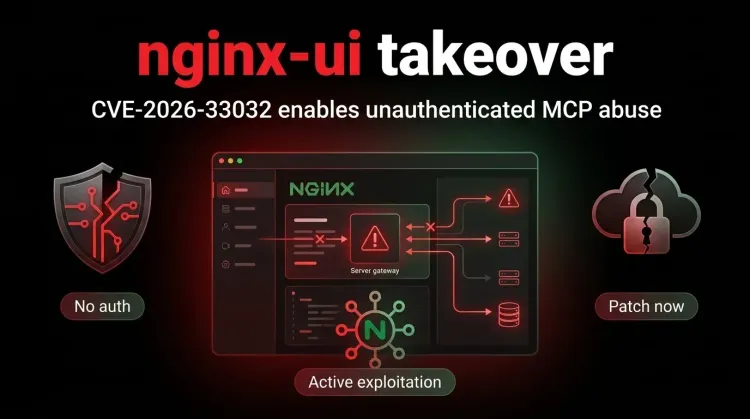
CVE-2026-33032 lets attackers take over exposed nginx-ui servers
CVE-2026-33032 is the kind of vulnerability defenders should treat as an internet-facing emergency, not a routine admin-panel patch. The flaw sits in nginx-ui's Model Context Protocol integration, where the /mcp_message endpoint can process privileged actions without authentication when the default IP allowlist is empty. For exposed instances, that can translate directly into full control over nginx configuration and behavior.
The bigger issue is what that access means in practice. nginx is often the front door for production traffic, internal apps, APIs, and identity flows. If an attacker can rewrite configs and trigger reloads from an exposed management interface, they can move from simple misconfiguration abuse to traffic interception, service disruption, and downstream command-and-control opportunities.
What happened
According to the GitHub advisory, nginx-ui exposes both /mcp and /mcp_message for MCP operations, but only /mcp is protected by authentication middleware. The /mcp_message route relies on IP filtering alone, and the default whitelist behavior is effectively fail-open.
That means a remote attacker with network access can invoke the same privileged MCP tools used for normal administration, including actions to:
- create or modify nginx configuration files
- read existing configuration data and backend details
- reload or restart nginx after making changes
- enable malicious reverse-proxy behavior or break service availability
NVD describes the issue as missing authentication for a critical function. Public reporting also says the flaw is now under active exploitation, which materially changes the defender response timeline.
Why this matters beyond one admin panel
This is not just a web UI bug. It is a control-plane exposure problem.
nginx often brokers traffic to sensitive services, authentication workflows, and internal applications. If attackers gain write access to that layer, they can alter routing, capture headers, expose backend paths, or deny service at one of the most trusted choke points in the environment.
In practical terms, a compromised nginx-ui instance can become a path to:
- exposure of admin or API request metadata
- interception of session material moving through the reverse proxy
- unauthorized route changes that redirect users or services
- rapid operational disruption after invalid or hostile config reloads
That is why teams should treat this as both a patching issue and an access control issue. If an admin surface is reachable from the internet, the blast radius is much larger than the CVE text alone suggests.
Exposure picture defenders should assume
BleepingComputer reports that Pluto Security observed roughly 2,600 publicly exposed instances that could be vulnerable, with notable concentration across multiple countries. The same reporting notes public proof-of-concept details and active exploitation signals.
The GitHub advisory also outlines impact that goes well beyond simple configuration tampering. Attackers may be able to:
- exfiltrate nginx configuration files and learn backend topology
- inject hostile server blocks or logging rules
- capture authorization headers or other sensitive traffic metadata
- force nginx reloads that immediately apply attacker-controlled changes
For defenders, the important lesson is that MCP-enabled operational tooling should be threat-modeled like any other high-privilege admin API. Novel protocol layers do not reduce the need for strong authentication and safe defaults.
What to do now
1. Identify exposed nginx-ui instances immediately
Inventory internet-facing nginx-ui deployments, especially those listening on default management ports or published through temporary operations shortcuts. If you do not need remote reachability, remove it now.
2. Upgrade to a fixed release
Public reporting points to nginx-ui 2.3.6 as the current secure target. Any exposed deployment on 2.3.5 or earlier should be treated as urgent.
3. Restrict access even after patching
Do not leave nginx-ui broadly reachable. Place it behind VPN access, hardened admin ingress, or tightly scoped management networks. A management interface that can rewrite reverse-proxy config should never rely on convenience defaults.
4. Hunt for tampering indicators
Review nginx configuration changes, unexpected reload events, new server blocks, unusual upstream destinations, and suspicious header logging behavior. If the instance was exposed, assume config read access may already have occurred.
5. Reassess adjacent trust assumptions
If nginx fronts login paths, admin panels, or sensitive APIs, evaluate whether hostile config changes could have exposed credentials, tokens, or traffic metadata. The response may need to go beyond patching into credential rotation and application log review.
Strategic takeaway
CVE-2026-33032 is a sharp example of how modern admin tooling can turn convenience features into critical exposure when security controls are asymmetric or fail open. A single unauthenticated path into a privileged management layer is enough to convert a proxy into attacker-controlled infrastructure.
For defenders, the priority is clear: patch fast, reduce exposure, and treat internet-facing control planes with the same urgency you would apply to a compromised identity provider or edge device.
References
FAQ
It is an authentication-bypass flaw in nginx-ui's MCP integration that lets remote attackers invoke privileged nginx management actions without credentials.
Because nginx-ui can modify and reload live nginx configuration, which gives attackers a path to traffic interception, service disruption, and configuration exfiltration.
Internet-exposed nginx-ui deployments running version 2.3.5 or earlier, especially where the management interface can reach production proxy configurations.
Find exposed instances, upgrade to a fixed version, restrict management access, and review for suspicious configuration changes or abnormal reload activity.
How to cite
Lucas Oliveira. CVE-2026-33032 lets attackers take over exposed nginx-ui servers. 17 Aug 2026. Invaders Cybersecurity. https://invaders.ie/resources/blog/vulnerability/cve-2026-33032-nginx-ui-mcp-server-takeover.
Subscribe via RSS.
Written by
Lucas Oliveira
Research
A DevOps engineer and cybersecurity enthusiast with a passion for uncovering the latest in zero-day exploits, automation, and emerging tech. I write to share real-world insights from the trenches of IT and security, aiming to make complex topics more accessible and actionable. Whether I’m building tools, tracking threat actors, or experimenting with AI workflows, I’m always exploring new ways to stay one step ahead in today’s fast-moving digital landscape.
Hot TopicsLast 7 days
Categories
Stay Updated
Get the latest cybersecurity insights delivered to your inbox.