CVE-2026-41615: Microsoft Authenticator Token Theft Risk

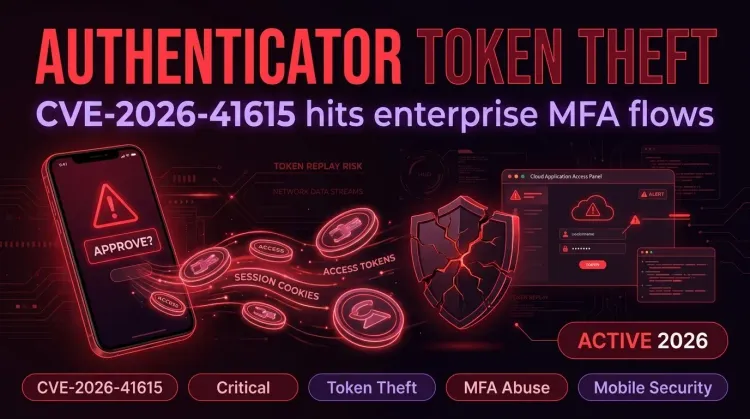
CVE-2026-41615: Microsoft Authenticator Token Theft Risk | 2026
Executive Summary
CVE-2026-41615 is a critical Microsoft Authenticator flaw that can expose enterprise authentication tokens after a user approves a malicious but convincing request. The issue affects how the app handles certain approval flows tied to work accounts, creating a path from user interaction to token theft and possible downstream account abuse.
At disclosure, reporting around the issue pointed to a CVSS 9.6 severity rating from Microsoft, with fixed releases available for Android 6.2605.2973+ and iOS 6.8.47+. There was no public evidence of active exploitation at publication time, but the combination of mobile workflow abuse, social engineering, and token exposure makes this a high-priority update for teams responsible for Identity and Access Management.
The Flaw: Token Exposure Through a Malicious Approval Flow
CVE-2026-41615 is a critical-severity vulnerability in Microsoft Authenticator that can allow exposure of work-account tokens to an unauthorized actor. In practical terms, the attack appears to rely on getting a user to approve a request that looks legitimate, then abusing the resulting flow to obtain tokens that can support further access.
How the Exploit Works
- Lure the victim: The attacker sends or triggers a prompt designed to look like a legitimate enterprise sign-in or approval request.
- Abuse trust in MFA UX: The victim interacts with the Microsoft Authenticator prompt, believing it is part of a real workflow.
- Capture or expose tokens: The vulnerable flow can reveal tokens associated with the victim's work account.
- Reuse tokens for access: Those tokens may then support session abuse, lateral cloud access, or account takeover-style follow-on activity depending on tenant controls.
- Expand impact: If the compromised account has privileged access, the blast radius can extend into M365, cloud apps, admin portals, and internal data.
A simplified attack chain looks like this:
Attacker-crafted approval request
        ↓
Victim accepts malicious prompt in Microsoft Authenticator
        ↓
Work-account token exposed
        ↓
Token replay / session abuse / cloud account access
The patch path is straightforward: update Microsoft Authenticator to Android 6.2605.2973 or later and iOS 6.8.47 or later. The key risk is not exploit complexity alone, but the fact that the attack can blend into routine MFA behavior users already recognize.
Timeline: From Disclosure to Patch Guidance
| Date | Event | Status |
|---|---|---|
| 2026-05-14 | CVE-2026-41615 published in public vulnerability tracking | 📢 Public disclosure |
| 2026-05-14 | Microsoft advisory becomes reference point for remediation guidance | ✅ Patch available |
| 2026-05-19 | Wider media reporting highlights token-theft risk and enterprise impact | 🔍 Continuing threat |
Why This Matters: Identity Security Is Now the Front Door
Mobile authenticators sit directly in the path of modern enterprise access. When a weakness affects token handling in an MFA app, the problem is bigger than one compromised device.
Key Challenges
- Users are trained to approve login flows: Attackers only need a believable moment of friction to turn normal authentication behavior into a compromise path.
- Token theft is operationally efficient: Stolen tokens can reduce the need for malware, password theft, or noisy post-compromise actions.
- Cloud blast radius can be large: A single exposed work-account token may provide access to Microsoft 365 resources, SaaS apps, or administrative workflows depending on tenant design.
This is what makes CVE-2026-41615 more important than a generic mobile bug. It intersects user behavior, authentication trust, and token-based cloud access in one place.
Defensive Posture: Immediate Actions
🔴 Patch Microsoft Authenticator Now
- Update all managed Android devices to 6.2605.2973+.
- Update all managed iOS devices to 6.8.47+.
- Verify version compliance through MDM, EMM, or enterprise app inventory.
👥 Warn Users About Approval Abuse
- Tell users not to approve unexpected authentication prompts.
- Reinforce that repeated or out-of-context MFA requests should be reported immediately.
- Pair patch guidance with short awareness training on suspicious prompt behavior.
🔍 Hunt for Token Reuse and Suspicious Sign-ins
- Review sign-in logs for unusual device changes, impossible travel, or short-interval approvals followed by new cloud sessions.
- Investigate high-risk accounts that recently approved MFA prompts from unfamiliar contexts.
- Prioritize privileged identities, executives, IT admins, and finance users.
Example Microsoft-style investigation logic:
SigninLogs
| where TimeGenerated > ago(7d)
| where AppDisplayName contains "Microsoft"
| summarize count(), make_set(IPAddress), make_set(DeviceDetail) by UserPrincipalName
🛡️ Tighten Conditional Access and Session Controls
- Reduce token usefulness by enforcing stricter conditional access for high-risk sessions.
- Require reauthentication for sensitive admin actions where possible.
- Shorten session persistence for privileged roles.
- Review whether device compliance, phishing-resistant MFA, or step-up verification can reduce abuse paths.
Bottom Line
CVE-2026-41615 turns a trusted MFA moment into a potential token-theft opportunity, which is exactly why it deserves urgent enterprise attention.
Key Takeaways
✅ Patch first — update Microsoft Authenticator on Android and iOS without waiting for exploit confirmation.
✅ Treat this as an identity incident risk — exposed tokens can matter as much as exposed passwords in cloud-first environments.
✅ Pair remediation with awareness — technical fixes help, but user approval behavior remains part of the attack surface.
For security teams: verify app versions, review risky sign-in activity, and communicate clearly to employees that unexpected MFA prompts should never be approved.
References
FAQ
CVE-2026-41615 is a critical Microsoft Authenticator vulnerability that can expose work-account tokens after a malicious approval flow. The core concern is token theft tied to enterprise authentication workflows.
Reported fixed versions are Microsoft Authenticator 6.2605.2973+ on Android and 6.8.47+ on iOS. Organizations should confirm deployment through managed-device tooling.
At the time of publication, there was no public evidence of active exploitation or a public exploit. Even so, the severity and identity impact justify urgent patching.
How to cite
Lucas Oliveira. CVE-2026-41615: Microsoft Authenticator Token Theft Risk. 17 Aug 2026. Invaders Cybersecurity. https://invaders.ie/resources/blog/vulnerability/cve-2026-41615-microsoft-authenticator-token-theft-risk.
Subscribe via RSS.
Written by
Lucas Oliveira
Research
A DevOps engineer and cybersecurity enthusiast with a passion for uncovering the latest in zero-day exploits, automation, and emerging tech. I write to share real-world insights from the trenches of IT and security, aiming to make complex topics more accessible and actionable. Whether I’m building tools, tracking threat actors, or experimenting with AI workflows, I’m always exploring new ways to stay one step ahead in today’s fast-moving digital landscape.
Hot TopicsLast 7 days
Categories
Stay Updated
Get the latest cybersecurity insights delivered to your inbox.