Oracle E-Business Suite flaw hits CISA KEV as payment systems face takeover risk

Oracle E-Business Suite flaw hits CISA KEV as payment systems face takeover risk
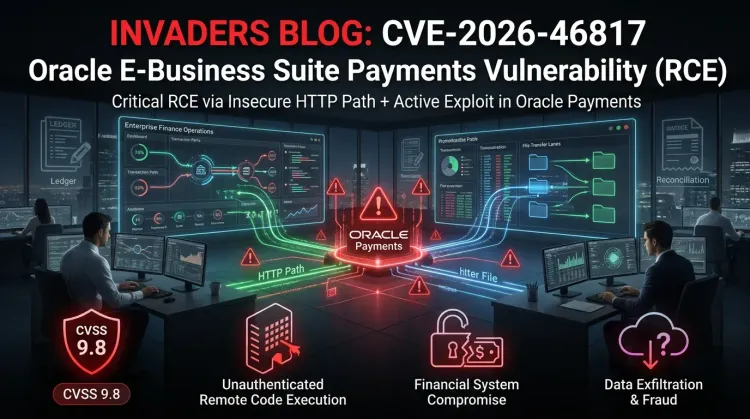
CISA has added CVE-2026-46817, a critical Oracle E-Business Suite vulnerability, to its Known Exploited Vulnerabilities catalog after evidence of active exploitation. The issue affects Oracle Payments, specifically the File Transmission component, and it is the kind of enterprise application flaw that deserves more than routine patch tracking.
The operational concern is direct: Oracle and NVD describe the bug as an easily exploitable vulnerability that lets an unauthenticated attacker with network access over HTTP compromise Oracle Payments. Successful exploitation can result in takeover of Oracle Payments. Oracle assigns the issue a CVSS 3.1 score of 9.8.
CISA's KEV update gives affected U.S. federal civilian agencies a July 18, 2026 due date under BOD 26-04. For everyone else, the deadline is still a useful signal. This is a financial business application, the attack path does not require credentials, and exploitation is no longer theoretical.
What CVE-2026-46817 affects
CVE-2026-46817 sits in Oracle Payments, part of Oracle E-Business Suite. Oracle's May 2026 Critical Security Patch Update lists affected supported versions as Oracle E-Business Suite 12.2.3 through 12.2.15.
The vulnerable component is File Transmission. That matters because payment and file-transfer workflows often touch sensitive financial operations, business partner data, banking integrations, supplier processes, reconciliation flows, and internal control evidence. An application-layer compromise in that space can become a business-impact problem quickly.
NVD records the issue with this CVSS vector:
CVSS:3.1/AV:N/AC:L/PR:N/UI:N/S:U/C:H/I:H/A:H
In plain English, the vulnerability is network reachable, low complexity, requires no privileges, requires no user interaction, and can have high confidentiality, integrity, and availability impact. It is not the kind of bug that should sit behind a normal monthly change window if the affected system is reachable.
Why CISA's KEV entry changes the priority
Oracle shipped patches for this issue in the May 2026 Critical Security Patch Update. That already made it important. CISA KEV inclusion changes the urgency because it marks CVE-2026-46817 as an exploited zero-day or recently exploited vulnerability from a defender-prioritization perspective.
According to NVD's KEV metadata, CISA added the vulnerability on July 15, 2026, with a July 18, 2026 due date. The required action is to apply mitigations in accordance with vendor instructions, follow BOD 26-04 guidance, and perform forensic triage where applicable.
That last part is important. For an exploited business-critical platform, patching is necessary, but it is not enough. If a vulnerable Oracle EBS instance was exposed to untrusted networks during the exploitation window, teams should assume they may need incident response, not only vulnerability management.
The exposed-instance problem
BleepingComputer reported that Shadowserver was tracking more than 1,000 internet-exposed Oracle EBS instances, with more than half located in the United States. That number does not prove compromise. It does show why attackers care.
Oracle E-Business Suite is not a small niche service. In many organizations it supports finance, procurement, payroll, order management, supplier workflows, HR-adjacent processes, and internal business operations. The systems are often old enough to carry architectural debt, important enough to be hard to patch casually, and connected enough that a foothold may expose more than one application screen.
That combination creates a familiar enterprise risk pattern:
- a critical application stays reachable because business processes depend on it
- patching is delayed because downtime is expensive
- authentication assumptions hide weaker internet exposure
- integration accounts and file-transfer workflows become attractive follow-on targets
- defenders struggle to determine whether the application was merely vulnerable or actually accessed
This is where exposure management becomes more useful than a simple CVE spreadsheet. The priority is not only "is the patch installed?" It is "which Oracle EBS surfaces were reachable, what role did they play in financial operations, and what would compromise let an attacker change or steal?"
What defenders should do first
The first step is inventory. Find every Oracle E-Business Suite deployment, including production, disaster recovery, test, partner-accessible, and old migration environments. Then identify whether any instance runs a supported affected version from 12.2.3 through 12.2.15 and whether Oracle's May 2026 Critical Security Patch Update has been applied.
For systems that are internet-facing or reachable from broad networks, reduce exposure immediately while patch work is coordinated:
- restrict HTTP and HTTPS access to required administrative and business paths
- move external access behind strong network controls where possible
- review reverse proxies, load balancers, VPN paths, partner connections, and firewall rules
- remove unused public endpoints and stale test integrations
- confirm that file-transfer workflows are expected and logged
These controls can reduce immediate risk, but they do not replace patching. Oracle's own guidance is clear that blocking protocols or removing access can reduce risk before patching, yet neither approach fixes the underlying vulnerability.
What to investigate after patching
Because CISA says the flaw is actively exploited, exposed vulnerable instances should be reviewed for signs of access. The most useful evidence is likely to live across application logs, HTTP access logs, proxy records, file-transfer records, identity logs, database audit trails, and outbound network telemetry.
Defenders should look for:
- unusual requests to Oracle Payments or File Transmission paths
- unexpected payment file submissions, downloads, uploads, or transfers
- newly created or modified application users, roles, privileges, profiles, or workflow settings
- suspicious administrative activity from unfamiliar IP addresses
- changes to supplier, bank, payment, or reconciliation configuration
- abnormal outbound connections from EBS application servers
- failed or malformed HTTP requests around the suspected exploitation window
- signs that credentials, API tokens, private keys, or integration secrets were accessed
The credential question deserves special attention. Even if the initial bug is described as improper privilege management and missing authentication controls, the post-exploitation impact may involve credential theft, payment manipulation, data export, persistence, or preparation for later fraud.
Why Oracle EBS needs a different response model
Enterprise resource planning and payments platforms are often treated as business systems first and security systems second. That is backwards during active exploitation. These platforms hold trusted workflow authority. They can approve, move, export, reconcile, or stage data in ways that ordinary endpoints cannot.
A compromised Oracle Payments component may give attackers opportunities that look less like classic malware and more like business process abuse. They may inspect payment configuration, alter workflows, stage fraudulent transfers, harvest partner data, or quietly prepare access for a later intrusion. That means the review should include both security telemetry and business-control telemetry.
Security teams should work with ERP administrators, finance operations, internal audit, and identity teams. The investigation should answer not only whether a server was attacked, but whether any payment-relevant configuration, workflow, file, partner path, or privileged account changed unexpectedly.
Patch management lesson
There is a broader lesson here. Oracle patched CVE-2026-46817 in May. CISA added it to KEV in mid-July after exploitation evidence. That gap is where many enterprise incidents live: a vendor fix exists, but the affected application is complicated, highly customized, business-critical, and therefore slower to update.
Good patch management for systems like Oracle EBS cannot rely only on monthly scanning. It needs ownership, exposure context, compensating controls, tested rollback plans, and a clear threshold for emergency change. A CVSS 9.8 no-auth takeover bug in a payments component should cross that threshold.
The practical rule is simple: if an ERP, payment, identity, remote management, VPN, security appliance, or file-transfer platform has an unauthenticated critical bug and public exploitation evidence, it belongs at the top of the queue.
Strategic takeaway
CVE-2026-46817 is not just another Oracle advisory. It is a reminder that business applications can be high-value attack infrastructure from an adversary's point of view.
Affected organizations should patch Oracle E-Business Suite immediately, restrict unnecessary reachability, and investigate exposed systems for compromise. The most mature response will combine vulnerability management, ERP administration, finance controls, and incident response in one track.
When a payments platform can be taken over without credentials, the question is not whether the advisory is severe enough. It is whether the organization can prove the vulnerable surface was patched, constrained, and clean.
References
FAQ
CVE-2026-46817 is a critical Oracle E-Business Suite vulnerability in the Oracle Payments File Transmission component. Oracle and NVD say it can allow an unauthenticated attacker with network access via HTTP to compromise Oracle Payments.
Oracle lists affected supported versions as Oracle E-Business Suite 12.2.3 through 12.2.15.
Yes. CISA added the vulnerability to the Known Exploited Vulnerabilities catalog based on active exploitation evidence. NVD's KEV metadata also marks CISA's SSVC exploitation field as active.
CISA lists a July 18, 2026 due date for affected U.S. federal civilian executive branch systems. Other organizations should still treat the date as an urgent prioritization signal.
Apply Oracle's May 2026 Critical Security Patch Update, reduce unnecessary HTTP and HTTPS exposure, review Oracle Payments and File Transmission activity, and investigate any internet-facing vulnerable instance for signs of compromise.
How to cite
Lucas Oliveira. Oracle E-Business Suite flaw hits CISA KEV as payment systems face takeover risk. 17 Aug 2026. Invaders Cybersecurity. https://invaders.ie/resources/blog/vulnerability/oracle-ebs-cve-2026-46817-kev-payment-takeover-risk.
Subscribe via RSS.
Written by
Lucas Oliveira
Research
A DevOps engineer and cybersecurity enthusiast with a passion for uncovering the latest in zero-day exploits, automation, and emerging tech. I write to share real-world insights from the trenches of IT and security, aiming to make complex topics more accessible and actionable. Whether I’m building tools, tracking threat actors, or experimenting with AI workflows, I’m always exploring new ways to stay one step ahead in today’s fast-moving digital landscape.
Hot TopicsLast 7 days
Categories
Stay Updated
Get the latest cybersecurity insights delivered to your inbox.