SAP Commerce Cloud CVE-2026-58231 Is a Reminder That Patch Windows Are Now Measured in Days

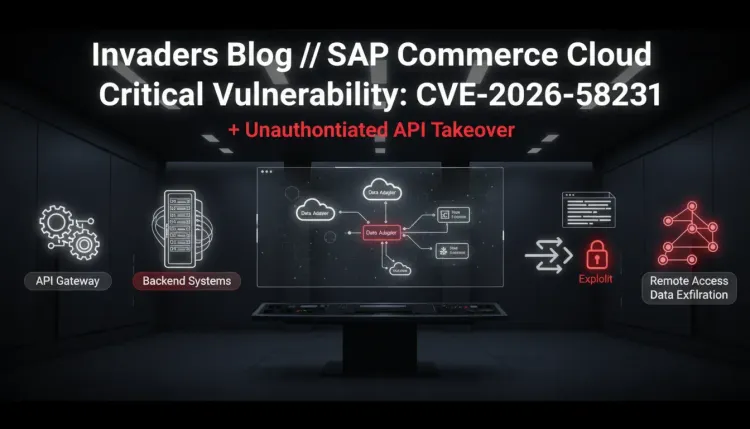
SAP Commerce Cloud CVE-2026-58231 Is a Reminder That Patch Windows Are Now Measured in Days
SAP's August Patch Day shipped a maximum-severity fix for SAP Commerce Cloud. Within days, researchers were already reporting exploitation attempts against the flaw.
The issue is tracked as CVE-2026-58231 and affects the SAP Commerce Cloud Data Hub Adapter in COM_CLOUD 2211 and 2211-JDK21. SAP rates it Critical with a CVSS score of 10.0. NVD's description is blunt: an unauthenticated attacker can abuse a default authentication client and send crafted input to functions that do not validate it sufficiently. Successful exploitation can lead to arbitrary code execution and compromise of internal components.
For defenders, the headline is not only the score. It is the time compression. A flaw disclosed on August 11 was reportedly being probed in honeypots by August 14. That is a short enough gap that any organization waiting for the next maintenance window may already be inside the attacker window.
What SAP Patched
SAP's August 2026 security notes list CVE-2026-58231 as an improper authorization issue in SAP Commerce Cloud's Data Hub Adapter. The affected product versions are COM_CLOUD 2211 and 2211-JDK21, and the note is assigned the highest CVSS score: 10.0.
The public CVE record describes a path where an unauthenticated attacker can abuse a default authentication client, reach vulnerable functions, and provide specially crafted input. The result is not a narrow information leak. The expected impact includes code execution and compromise of internal components, with high confidentiality, integrity, and availability impact.
That combination matters:
- No privileges required
- Network attack vector
- Low attack complexity
- No user interaction
- Potential arbitrary code execution
- Impact beyond the exposed component
This is the kind of vulnerability that moves quickly from advisory review to emergency exposure management.
Why the Exploitation Reports Matter
The Hacker News reported on August 15 that exploitation attempts were being observed shortly after the patch release, citing Defused Cyber honeypot activity. Defused Cyber said attempts against CVE-2026-58231 were hitting its sensors three days after SAP released the fix.
There is an important nuance: SAP's original patch note and early public records did not frame the issue as known exploited at disclosure time. That is normal. Many enterprise vulnerabilities begin as "patch now" advisories and then become active scanning or exploitation stories after reverse engineering, detection, or opportunistic probing begins.
Defenders should treat this sequence as a warning about operational tempo. Attackers do not need a mature public proof-of-concept to begin testing internet-facing systems. They can diff patches, scan for exposed endpoints, replay partial techniques, and iterate against honeypots and real targets. Even noisy failed attempts can become useful reconnaissance.
In other words, the presence of early exploit attempts changes the priority from "schedule remediation" to "verify exposure, patch, and hunt."
Why Commerce Platforms Are Attractive Targets
SAP Commerce Cloud often sits close to customer activity, order flows, integrations, identity paths, and backend business systems. The Data Hub Adapter is especially sensitive because integration components are designed to move data between systems.
That makes authorization and validation failures dangerous. If an attacker can reach a trusted integration path, the blast radius can extend beyond the single web-facing service. Depending on deployment details, compromise could affect application logic, internal services, credentials, data pipelines, and operational availability.
Commerce environments also tend to be difficult to patch casually. They are revenue-facing, integrated with payment and fulfillment workflows, and often surrounded by custom extensions. That operational complexity is exactly why attackers like them. A high-impact flaw in a system that teams hesitate to restart can create a wide remediation gap.
This is where access control becomes more than an application design topic. Teams need to know which clients, adapters, integration endpoints, service accounts, and administrative paths are reachable before a crisis lands.
What Security Teams Should Do Now
First, identify whether SAP Commerce Cloud Data Hub Adapter is present in the environment and whether affected versions COM_CLOUD 2211 or 2211-JDK21 are in use. Do not rely only on ownership records. Confirm from deployment inventory, platform configuration, and running services.
Second, apply SAP Security Note 3771065 and confirm that the fix is present in production. For systems behind release pipelines, verify the deployed build, not only the package repository or staging environment.
Third, reduce exposure while remediation is underway. If integration endpoints are internet-reachable, move quickly to restrict access through network controls, allowlists, identity-aware access, or other compensating controls appropriate to the environment.
Fourth, review logs for unusual access to Commerce Cloud integration paths, Data Hub Adapter functions, authentication client behavior, unexpected errors, and suspicious request patterns beginning before August 11 and continuing through the patch window. Early exploitation attempts may be noisy, but they can still reveal targeting.
Fifth, rotate secrets or service credentials if there is evidence of compromise. Code execution against a commerce integration component can turn into credential access, internal pivoting, or persistence. This is where a clean incident response process matters: preserve evidence, scope impact, contain access, and only then restore normal trust.
A Practical Triage Checklist
Security and platform teams should prioritize the following:
- Confirm affected SAP Commerce Cloud versions and Data Hub Adapter exposure.
- Apply SAP's August 2026 security update for CVE-2026-58231.
- Validate production deployment of the fix.
- Restrict external access to integration endpoints wherever possible.
- Review WAF, reverse proxy, application, and identity logs for suspicious requests.
- Look for unexpected authentication client usage and unusual validation failures.
- Monitor for new accounts, changed service permissions, modified integrations, and unexplained outbound connections.
- Prepare credential rotation if logs indicate successful exploitation or uncertain exposure.
The most common failure mode in these cases is assuming that a cloud label means the risk is abstracted away. It is not. Cloud-hosted enterprise software still has deployable components, integration surfaces, customizations, and operational decisions that determine exposure.
The Defender Lesson
CVE-2026-58231 is a high-confidence patch-now issue because the technical conditions are severe and the early exploitation timeline is short. It also fits a broader pattern: attackers increasingly move during the interval between vendor patch publication and enterprise rollout completion.
For defenders, the answer is not panic. It is disciplined speed.
Know which systems are exposed. Patch the affected versions. Verify that production is actually fixed. Limit integration surfaces. Hunt around the disclosure window. Be ready to treat suspicious activity as a real incident, not just failed scanning.
When a CVSS 10.0 unauthenticated code execution path starts seeing activity within days, the maintenance calendar should bend around the risk.
References
How to cite
Lucas Oliveira. SAP Commerce Cloud CVE-2026-58231 Is a Reminder That Patch Windows Are Now Measured in Days. 16 Aug 2026. Invaders Cybersecurity. https://invaders.ie/resources/blog/vulnerability/sap-commerce-cloud-cve-2026-58231-patch-window.
Subscribe via RSS.
Written by
Lucas Oliveira
Research
A DevOps engineer and cybersecurity enthusiast with a passion for uncovering the latest in zero-day exploits, automation, and emerging tech. I write to share real-world insights from the trenches of IT and security, aiming to make complex topics more accessible and actionable. Whether I’m building tools, tracking threat actors, or experimenting with AI workflows, I’m always exploring new ways to stay one step ahead in today’s fast-moving digital landscape.
Hot TopicsLast 7 days
Categories
Stay Updated
Get the latest cybersecurity insights delivered to your inbox.