SonicWall SSL-VPN MFA Bypass Is Being Exploited: Patch the Authentication Boundary

SonicWall SSL-VPN MFA Bypass Is Being Exploited: Patch the Authentication Boundary
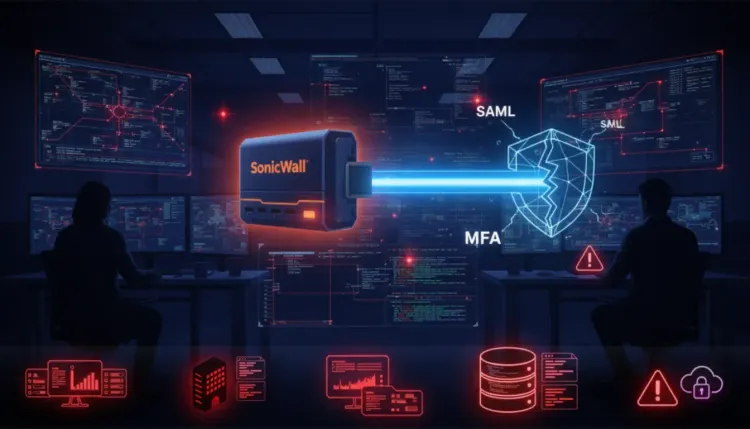
SonicWall has warned that attackers are exploiting a vulnerability in SonicOS SSL-VPN that can bypass SAML-enforced multi-factor authentication. Tracked as CVE-2026-19868, the flaw affects Gen7 and Gen8 firewalls running older SonicOS releases and was added to CISA's Known Exploited Vulnerabilities catalog on November 6, 2026.
The issue does not mean every SonicWall appliance is already compromised. It does mean that a valid credential for an alternate authentication method may be enough to cross a control administrators expected MFA to enforce. For organizations using SSL-VPN as a front door to internal systems, that makes the authentication path an urgent patching and investigation priority.
What SonicWall disclosed
The flaw is a use-of-single-factor-authentication weakness in the SonicOS SSL-VPN service. A user with valid credentials for an alternate authentication method may bypass SAML authentication controls, including SAML-enforced MFA. The vulnerability affects SonicOS Gen7 versions 7.3.3-7015 and earlier and Gen8 versions 8.2.2-8015 and earlier.
SonicWall lists fixed releases in the same advisory: Gen7 customers should move to 7.3.4-7013 or later, while Gen8 customers should move to 8.2.3-8015 or later. The vendor says there is no workaround. The advisory also covers six other SonicOS vulnerabilities, including management-interface flaws and pre-authentication buffer overflows, so treating this as a one-CVE update may leave the appliance exposed to related risk.
Why an MFA bypass changes the incident model
Multi-factor authentication is meant to add an independent proof of identity after a password or other primary credential is presented. An authentication bypass at the VPN boundary can silently remove that second check for a specific login path while the normal SAML flow still appears healthy.
This is an identity and access management problem as much as a firmware problem. If an attacker already holds a password, a local account, or credentials accepted by an alternate method, the security value of the SAML policy may be reduced exactly where the organization relies on it most: remote access into trusted networks.
The practical blast radius depends on what the VPN account can reach. A low-privilege account may expose internal applications and sensitive data. A privileged administrator account may enable configuration changes, new access paths, credential theft, or lateral movement. The firewall should therefore be treated as a high-value attack surface, not just as networking infrastructure.
Defensive actions for SonicWall customers
- Confirm the SonicOS version and appliance generation for every Gen7 and Gen8 firewall. Apply the vendor's fixed release: 7.3.4-7013 or later for Gen7, and 8.2.3-8015 or later for Gen8.
- Prioritize CVE-2026-19868 through patch management. CISA's KEV listing means exploitation has been observed, not merely theorized.
- Review SSL-VPN, SAML, and alternate-authentication configuration. Remove unused login methods, stale accounts, and excessive group access.
- Hunt for successful VPN logins that used an unexpected authentication path, unusual source countries or autonomous systems, impossible-travel patterns, new devices, and activity outside normal administrator windows.
- Revoke sessions and rotate passwords, tokens, and secrets for accounts that authenticated through affected appliances during the exposure window. Reset privileged credentials first.
- Inspect firewall configuration history, administrator logins, exported settings, new local users, policy changes, and unusual outbound connections. Preserve logs before retention windows erase them.
- If compromise indicators exist, isolate the appliance from unnecessary management paths and activate incident response procedures. Patching alone does not remove an attacker who already established persistence.
The broader lesson
An MFA policy is only as strong as every authentication path that can reach the same protected resource. VPN appliances often accumulate legacy methods for break-glass access, migration, support, or compatibility. Those paths become dangerous when they are outside the assumptions of the organization's SAML design.
The immediate task is to patch SonicOS and validate the exact build. The durable task is to inventory every alternate authentication path, minimize remote-access reach, and ensure VPN telemetry can show which identity checks actually occurred. A patched perimeter device is valuable; a perimeter device whose authentication behavior is continuously verified is safer.
References
FAQ
SonicWall has warned that attackers are exploiting a vulnerability in SonicOS SSL-VPN that can bypass SAML-enforced multi-factor authentication. Tracked as CVE-2026-19868, the flaw affects Gen7 and Gen8 firewalls running older SonicOS releases and was added to CISA's Known Exploited Vulnerabilities catalog on November 6, 2026.