Unpatched Tenda router backdoor turns home gateways into a trust problem

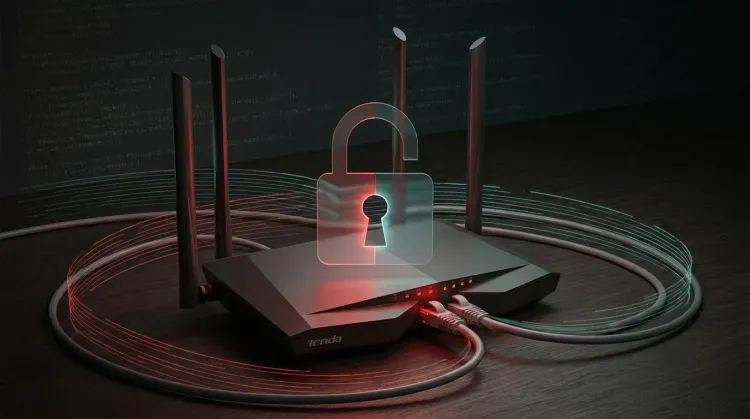
Unpatched Tenda router backdoor turns home gateways into a trust problem
CERT/CC has disclosed an undocumented authentication backdoor in several Tenda router firmware builds. The flaw, tracked as CVE-2026-11405, can let an attacker bypass the normal password check and obtain full administrative access to the web management interface.
That is not just another weak-default-password story. A router sits at the edge of a home office, small business, branch site, or lab network. If its administrative plane can be entered through a hidden path, the device becomes a control point for traffic, DNS, firewall rules, remote access, and connected devices.
The most uncomfortable detail is that there is no vendor patch at the time of disclosure. CERT/CC says it was unable to coordinate with Tenda and has not received a vendor statement. For affected owners, the current response is mitigation, exposure reduction, and replacement planning rather than a clean update cycle.
What CERT/CC disclosed
CERT/CC Vulnerability Note VU#213560, published on July 6, 2026, says several Tenda firmware versions contain an undocumented authentication mechanism in the /bin/httpd web server binary. The issue is inside the login() function.
According to CERT/CC and the NVD record, the login process first follows the normal password verification path. If that fails, it calls GetValue("sys.rzadmin.password") to read an alternate password from the device configuration and compares it directly against the user-supplied password in plaintext.
If the values match, the device grants role=2 administrative access and creates a valid session. CERT/CC also notes that the associated username is not validated, meaning any username can work if paired with the hidden password value.
That makes CVE-2026-11405 an authentication bypass problem with a severe operational impact: the configured administrator password is no longer the only gate protecting the router.
Affected firmware builds
CERT/CC lists the following affected Tenda firmware versions:
US_FH1201V1.0BR_V1.2.0.14(408)_EN_TDUS_W15EV1.0br_V15.11.0.5(1068_1567_841)_EN_TDEUS_AC10V1.0re_V15.03.06.46_multi_TDE01US_AC5V1.0RTL_V15.03.06.48_multi_TDE01US_AC6V2.0RTL_V15.03.06.51_multi_T
BleepingComputer maps those builds to Tenda FH1201, W15E, AC10, AC5, and AC6 V2 router lines. The CVE record lists the same affected firmware builds and assigns the issue a CISA-ADP CVSS 3.1 score of 9.8, with network attack vector, low complexity, no privileges required, no user interaction, and high confidentiality, integrity, and availability impact.
NVD has not yet provided its own enrichment assessment, but the published CISA-ADP vector is enough to treat the issue as critical for any exposed device.
Why this is worse than a normal router bug
Many router incidents fall into familiar buckets: outdated firmware, default passwords, exposed admin panels, command injection, or a UPnP mistake. Those are serious, but they usually have a visible configuration or patching story.
This case is different because the risky behavior is hidden inside the firmware. The user can choose a strong admin password and still be exposed to a second authentication path that is not visible in the management interface.
That changes the trust model. The question is no longer only "is the admin password strong?" It becomes "can the device firmware itself be trusted to enforce the authentication boundary?"
For small offices and home networks, that boundary matters. A compromised router can:
- change DNS settings and redirect users to hostile infrastructure
- alter firewall rules or port forwards
- expose internal services that were meant to stay private
- observe or manipulate traffic metadata
- weaken Wi-Fi and local-network controls
- become a foothold for broader lateral movement
Even where encrypted traffic protects content, router control still gives attackers leverage over routing, name resolution, availability, and local discovery.
The remote management risk
CERT/CC's primary mitigation is to disable remote web management. That advice matters because remote management changes who can reach the vulnerable interface.
If remote management is enabled, the administrative dashboard may be reachable from the internet. In that scenario, automated scanning can become the first stage of exploitation. Attackers do not need to be physically nearby or already connected to the Wi-Fi network. They only need to find reachable management interfaces and test the bypass condition.
If remote management is disabled, the risk does not disappear. It shifts inward. An attacker already on the local network, whether through Wi-Fi access, a compromised endpoint, a guest device, or another local foothold, may still be able to target the management interface.
That distinction is important for incident response. Disabling remote management reduces internet-scale exposure, but it does not remove the backdoor from firmware and it does not prove the device was never accessed.
No patch changes the response plan
The most practical difficulty is that CERT/CC lists no available fix. Tenda was notified on May 19, 2026, and the advisory says no vendor statement was received.
When there is no patch, defenders should avoid pretending this is a normal update ticket. The response has to split into three tracks:
- Identify whether affected firmware is present.
- Reduce reachable management exposure immediately.
- Decide whether the device can remain in service.
For a consumer home network, temporary mitigation may be acceptable while watching for a vendor update. For a business, clinic, retail site, or any network with compliance obligations, continued use of an unpatched edge device with an undocumented admin bypass deserves a much stricter review.
What owners should do now
Start by checking the exact router model and firmware version from the device's status or system information page. Compare the full firmware string against CERT/CC's affected list. Partial model matching is not enough because firmware strings matter.
If a device matches:
- disable remote web management immediately
- change the default LAN IP address to reduce opportunistic local scanning
- ensure the admin interface is not exposed through port forwarding
- review DNS, DHCP, firewall, and port-forward settings for unauthorized changes
- check for unknown administrator users or changed credentials
- reboot only after preserving relevant configuration and logs where possible
- plan replacement if no fixed firmware becomes available quickly
For managed environments, inventory is the first control. Tenda devices may be present in small offices, temporary project sites, labs, home offices, or unmanaged branch setups even if they are not part of the official enterprise network standard.
What defenders should hunt for
The advisory does not report active exploitation, and defenders should not invent indicators that do not exist. But the vulnerability is network-reachable and automatable, so basic hunting is justified where affected devices are deployed.
Useful checks include:
- internet exposure of router management ports
- recent successful logins to the router dashboard from unusual internal or external addresses
- changes to DNS server settings
- new or modified port forwards
- disabled firewall or security features
- changed Wi-Fi security settings
- unexpected DHCP range or gateway changes
- newly exposed internal services
In business networks, compare current router configuration against a known-good backup. If no backup exists, export and preserve the current configuration before making major changes so investigators can review what changed.
The broader lesson
CVE-2026-11405 is a reminder that edge devices are not passive appliances. They are software systems with privileged access to the network path. When their firmware includes an undocumented backdoor, the compromise is not limited to the device. It can reshape the network around it.
This is why router and IoT security should not be treated as a low-priority home-user problem. Small routers often protect high-value work: remote employees, point-of-sale systems, labs, cameras, VoIP systems, and admin workstations. They may not appear in endpoint dashboards, but they still control whether traffic reaches its intended destination.
The best short-term answer is disciplined containment: identify affected devices, remove internet exposure, verify configuration, and replace unpatched units where the risk is unacceptable. The longer-term answer is procurement discipline. If a vendor cannot coordinate on a critical hidden authentication mechanism, that vendor's devices should be difficult to justify at the edge of trusted networks.
References
FAQ
Public reporting reviewed for this article does not confirm active exploitation. BleepingComputer notes that router-focused botnets are likely to target the issue in the future, but that is a risk assessment rather than a confirmed exploitation report.
No. The issue is an alternate authentication mechanism in firmware. A stronger visible admin password is good hygiene, but it does not remove the hidden path described by CERT/CC.
It is an important mitigation, but not a full fix. It reduces internet exposure. It does not remove the backdoor, and it does not protect against an attacker who can already reach the device from the local network.
If no fixed firmware is available, the safest option is replacement with a supported device from a vendor that provides clear security updates and vulnerability coordination.
How to cite
Lucas Oliveira. Unpatched Tenda router backdoor turns home gateways into a trust problem. 17 Aug 2026. Invaders Cybersecurity. https://invaders.ie/resources/blog/vulnerability/tenda-router-backdoor-cve-2026-11405.
Subscribe via RSS.
Written by
Lucas Oliveira
Research
A DevOps engineer and cybersecurity enthusiast with a passion for uncovering the latest in zero-day exploits, automation, and emerging tech. I write to share real-world insights from the trenches of IT and security, aiming to make complex topics more accessible and actionable. Whether I’m building tools, tracking threat actors, or experimenting with AI workflows, I’m always exploring new ways to stay one step ahead in today’s fast-moving digital landscape.
Hot TopicsLast 7 days
Categories
Stay Updated
Get the latest cybersecurity insights delivered to your inbox.