VMware Aria Operations flaws enable credential theft and privilege escalation

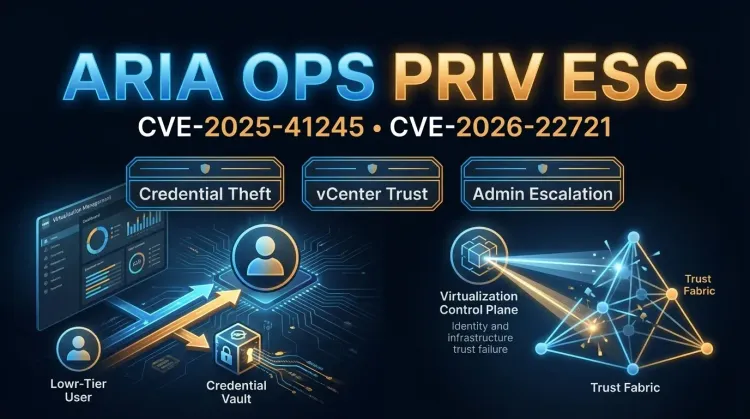
VMware Aria Operations flaws enable credential theft and privilege escalation
Two security flaws in Broadcom VMware Aria Operations show how quickly weak privilege boundaries inside management platforms can become a path to broader infrastructure compromise. Research by Lorin Lehawany analyzes CVE-2025-41245 and CVE-2026-22721, showing how a user with limited privileges can retrieve stored credentials, escalate inside Aria Operations, and potentially pivot deeper into virtualized enterprise environments.
The issue matters because Aria Operations sits close to the operational core of VMware deployments. It is not just another application in the environment. It is a monitoring and management layer tied to systems like vCenter, identity infrastructure, and cloud integrations. If attackers can gain elevated access there, they may be able to manipulate configuration, extract privileged secrets, and move laterally across the virtualization control plane.
Why these VMware Aria Operations bugs matter
The two CVEs expose different weaknesses, but together they create a dangerous picture. One issue leaks credentials through insecure handling of stored resources. The other allows users with certain vCenter-linked privileges to gain broader access inside Aria Operations than they should have. Chaining those paths turns a low-privilege foothold into a route toward high-value administrative access.
That makes this more than a simple vulnerability. In environments where Aria Operations is trusted to monitor or orchestrate activity across multiple systems, compromise can weaken visibility, expose secrets, and support further lateral movement.
CVE-2025-41245: credential exposure through insecure resource handling
According to the research, CVE-2025-41245 is an information disclosure issue affecting the 8.18.x line. A non-administrative user can retrieve credentials belonging to other users because of insecure initialization and handling of resources.
In practice, that means a user who should have limited visibility may still access authentication material that opens the door to more privileged workflows. In environments where Aria stores credentials for integrations and management connections, that kind of leak can become a stepping stone to much broader compromise.
CVE-2026-22721: privilege escalation through vCenter integration
The second issue, CVE-2026-22721, affects both 8.18.x and 9.x according to the write-up. It stems from improper privilege management in the integration between vCenter and Aria Operations.
Even when roles are managed externally in vCenter and not clearly exposed in Aria’s own interface, a user can still inherit meaningful privileges inside Aria. The research shows that a user appearing relatively harmless in Aria may still have enough effective power to manage authentication sources or manipulate stored integrations.
That creates a dangerous mismatch between what administrators think users can do and what those users can actually reach.
How the attack path expands
The research highlights several practical escalation routes:
- Manage authentication sources and create a path to a new administrative account under attacker control.
- Access stored credentials tied to integrations and privileged services.
- Abuse validation and connectivity features to leak secrets to attacker-controlled systems.
- Pivot into higher-value platforms such as VMware Identity Manager, vCenter, or VMware Cloud Director.
Once that happens, the impact can move far beyond Aria itself. The attacker is no longer just escalating inside a monitoring tool. They are moving toward the systems that manage identity, virtualization, and tenant infrastructure.
Credential theft turns this into a platform compromise risk
One of the most serious aspects of the research is the demonstrated theft of stored credentials. By abusing integration workflows and connection validation behavior, an attacker can coerce Aria Operations into sending privileged credentials to an attacker-controlled endpoint.
That includes credentials for:
- VMware Identity Manager
- vCenter
- VMware Cloud Director
For defenders, this is the real strategic risk. The compromise of a management plane product is bad enough on its own. But when that product also stores or brokers access to other infrastructure, it can become an accelerator for enterprise-wide compromise.
This is closely tied to identity and access management and access control. Once those boundaries fail inside a central management product, downstream trust relationships become much easier to abuse.
Affected versions and patch status
The research and vendor advisories indicate:
- CVE-2025-41245 affects the 8.18.x line and is not applicable to 9.x.
- CVE-2026-22721 affects both 8.18.x and 9.x.
- Broadcom issued fixes for both issues through separate advisories and patch releases.
Broadcom’s advisories referenced in the disclosure are:
- VMSA-2025-0015
- VMSA-2026-0001
The write-up notes that a workaround may also include disabling the vCenter login feature where appropriate, though patching remains the primary recommendation.
Immediate defensive actions
🔴 Patch and reduce exposure
- Update Aria Operations to a fixed version as soon as possible.
- Review Broadcom advisories and confirm which product line and patch level apply in your environment.
- Disable features that expand trust unnecessarily, including vCenter login paths, if operationally feasible.
🟠 Review privilege assumptions
- Reassess what low-privilege and vCenter-linked users can effectively do inside Aria Operations.
- Audit who can manage authentication sources, integrations, and stored credentials.
- Treat apparently low-risk roles with caution if privilege mapping is handled indirectly.
🟡 Investigate stored credential exposure
- Review secrets stored for Aria integrations.
- Rotate credentials for high-value downstream systems if exposure is suspected.
- Prioritize checks around Identity Manager, vCenter, and Cloud Director integrations.
🟢 Hunt for unusual administrative behavior
- Look for unexpected changes to authentication sources.
- Investigate suspicious validation or connectivity tests against external endpoints.
- Review whether Aria-originated actions were used to manage virtual machines or integration settings in unusual ways.
Disclosure timeline at a glance
The disclosure timeline described in the research shows coordinated reporting between the researchers and Broadcom, with the first issue patched in September 2025 and the second patch released in February 2026.
That is useful context for defenders because it confirms these issues were not accidental edge cases. They were treated as security-relevant flaws serious enough to warrant advisories, patches, and public disclosure.
Bottom line
CVE-2025-41245 and CVE-2026-22721 show how privilege and credential handling weaknesses inside VMware Aria Operations can turn a limited foothold into control over critical management workflows. When a trusted monitoring and orchestration layer can leak secrets or overgrant privilege, the blast radius extends far beyond a single application.
For security teams, the practical takeaway is straightforward: patch quickly, review role mappings carefully, audit stored credentials, and treat management-plane products as high-value attack surfaces rather than neutral infrastructure.