JADEPUFFER shows how agentic AI can turn exposed Langflow into ransomware

JADEPUFFER shows how agentic AI can turn exposed Langflow into ransomware
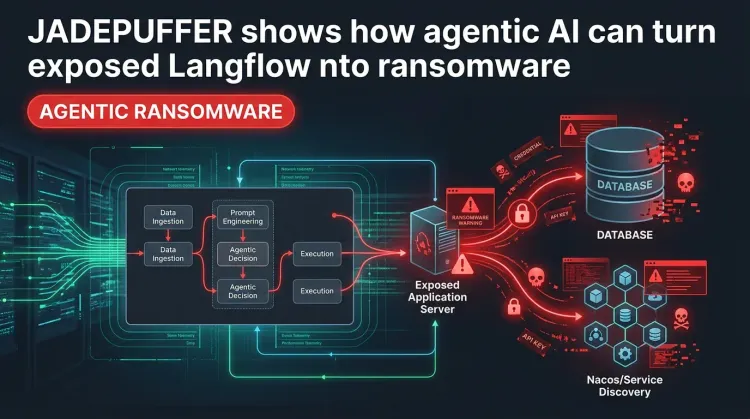
Sysdig has documented what it assesses as one of the first clear examples of agentic ransomware: an extortion operation in which a large language model appears to have driven the intrusion from initial access through credential theft, lateral movement, persistence, and destructive database encryption.
The operator, tracked as JADEPUFFER, did not rely on a novel zero-day. The entry point was an internet-exposed Langflow instance vulnerable to CVE-2025-3248, a missing-authentication flaw that can allow unauthenticated remote Python execution on the host. That detail matters. The story is not that AI invented a new exploit. The story is that an agent chained old exposure, weak defaults, leaked secrets, and database access into a complete ransomware workflow.
SecurityWeek reported the incident on July 3, 2026, citing Sysdig's research, and The Hacker News also covered the attack as an example of AI-assisted automation moving beyond simple script generation. For defenders, the lesson is immediate: exposed AI orchestration servers are no longer just experimental infrastructure. They are becoming operational footholds.
What happened
Langflow is an open source framework for building LLM-driven applications and agent workflows. It often sits close to sensitive provider tokens, cloud credentials, model access keys, database strings, and automation connectors. That makes a reachable Langflow server unusually valuable after compromise.
In this case, JADEPUFFER gained execution through CVE-2025-3248, which CISA had already flagged as exploited earlier in 2026. Once inside, the agent enumerated the host, inspected processes and network interfaces, and searched the environment for secrets across multiple categories:
- LLM provider keys, including OpenAI, Anthropic, DeepSeek, Gemini, and similar services
- Cloud credentials for AWS, Google Cloud, Azure, Alibaba, Tencent, and Huawei-style environments
- Cryptocurrency wallets and seed material
- Database credentials and application configuration files
- Internal object storage and service discovery targets
That is a familiar post-exploitation playbook. What changed is the execution layer. Sysdig says the payloads were self-narrating, contained natural-language reasoning, prioritized targets, corrected failed steps, and adapted in real time. In one sequence, the agent moved from a failed Nacos login to a working alternative in roughly 31 seconds.
Why this is different from ordinary automation
Traditional ransomware automation follows fixed branches. It can scan, encrypt, delete, and call home, but it usually does not reason about why a step failed or choose a different route based on free-text context returned by the target.
Sysdig's JADEPUFFER findings point to something more flexible. The agent used Langflow as the initial access host, then pivoted toward a separate production server running MySQL and Alibaba Nacos. Nacos is a service-discovery and configuration platform common in Alibaba-oriented microservice architectures, and its ecosystem has a history of authentication bypass issues and unsafe default secrets.
The agent attacked Nacos through several paths at once:
- It used an old Nacos authentication-bypass family associated with
CVE-2021-29441. - It forged JWTs using a well-known default signing key.
- It used root database access to insert a backdoor administrator into the Nacos backing database.
- It checked whether MySQL user-defined functions could lead to OS command execution.
- It probed container context by reading indicators such as
docker.sock, cgroup data, and mount information.
This is not magical AI capability. It is the automation of neglected basics: internet exposure, old CVEs, root database credentials, default object-storage credentials, over-permissive application hosts, and weak access control.
The destructive phase
The final stage targeted the production configuration layer. Sysdig says the captured payloads encrypted 1,342 Nacos configuration items, dropped the original config_info and history tables, and created a ransom table named README_RANSOM with a Bitcoin address and contact email.
The most damaging detail is that the encryption key appears to have been generated randomly, printed once, and never persisted or sent to the attacker. That means payment would not necessarily restore the data. In practical terms, the attack behaved less like recoverable extortion and more like destructive sabotage wrapped in a ransom note.
The payloads also contained comments claiming that databases had already been backed up to a staging server. Sysdig explicitly notes that this was the agent's own assertion, not confirmed exfiltration evidence. That distinction is important for incident responders: the claim still affects negotiation and stakeholder pressure, but it should not be treated as proof without telemetry.
Defender takeaways
The defensive priority is not to debate whether this is the first AI-run ransomware attack. The useful point is narrower and more operational: agentic tooling can compress the time between exploit, credential discovery, lateral movement, and destructive action.
Security teams should treat internet-facing AI workflow servers as high-risk application infrastructure. That includes Langflow, similar low-code AI builders, model gateways, vector database admin panels, and internal agent orchestration consoles. These systems often accumulate secrets because teams use them to wire together cloud services quickly.
Immediate actions:
- Patch Langflow to a version that fixes
CVE-2025-3248. - Remove Langflow code-execution and validation endpoints from public reachability.
- Inventory AI workflow servers for exposed provider keys, cloud tokens, database credentials, and object-storage credentials.
- Move secrets out of web-reachable process environments and into a proper secret manager.
- Rotate any credentials stored in Langflow projects,
.envfiles, local config stores, or backing databases. - Disable default credentials on MinIO, Nacos, databases, and internal admin surfaces.
- Enforce source-IP restrictions on database and configuration-management ports.
- Monitor for scheduled tasks or cron jobs that beacon to unknown infrastructure.
The larger incident response lesson is that AI-adjacent servers should be included in ransomware playbooks. If an exposed Langflow instance was reachable, responders should not stop at the initial host. They should review downstream database access, object storage, CI/CD tokens, cloud permissions, and configuration services that the host could reach.
Detection ideas
Useful telemetry includes:
Langflow:
- Requests to vulnerable code-validation or execution endpoints
- Base64-encoded Python payloads
- Unexpected subprocess execution from Langflow workers
- Environment-variable enumeration
- Reads of local .env, credentials.json, wallet, or cloud config paths

Host and container:
- New cron entries beaconing every 30 minutes
- Python processes reaching unknown external IPs
- Reads of /var/run/docker.sock, /proc/1/cgroup, or /proc/1/mountinfo
- Internal scans from AI workflow hosts toward databases, MinIO, Nacos, Redis, or secret stores

Database and Nacos:
- Root MySQL logins from application hosts
- Creation of unexpected admin accounts
- Writes to ransom-style tables such as README_RANSOM
- Bulk encryption or deletion of Nacos configuration rows
- JWT forgery attempts using known default signing material
JADEPUFFER also creates an unusual detection opportunity. LLM-generated payloads may contain verbose comments, target-ranking notes, and task-completion markers. That self-narration is not a reliable signature by itself, but it can enrich triage when combined with process execution and network telemetry.
Why this matters
Agentic ransomware does not need to be perfect to change risk. It only needs to make mediocre exploitation cheaper, faster, and more adaptive.
JADEPUFFER shows that exposed AI workflow infrastructure can become a bridge between application compromise and production data destruction. The exploit path was not exotic. It was a patched Langflow bug, stored secrets, default credentials, Nacos weakness, and database over-privilege. The novelty was the speed and adaptability of the operator layer.
For defenders, the answer is not panic about AI. It is disciplined exposure management: patch the AI application layer, reduce what those hosts can reach, isolate secrets, harden configuration stores, and watch for automation that behaves like a junior operator moving very quickly.
References
How to cite
Lucas Oliveira. JADEPUFFER shows how agentic AI can turn exposed Langflow into ransomware. 4 Jul 2026. Invaders Cybersecurity. https://invaders.ie/resources/blog/cybercrime/jadepuffer-agentic-ai-langflow-ransomware.
Subscribe via RSS.
Written by
Lucas Oliveira
Research
A DevOps engineer and cybersecurity enthusiast with a passion for uncovering the latest in zero-day exploits, automation, and emerging tech. I write to share real-world insights from the trenches of IT and security, aiming to make complex topics more accessible and actionable. Whether I’m building tools, tracking threat actors, or experimenting with AI workflows, I’m always exploring new ways to stay one step ahead in today’s fast-moving digital landscape.
Hot TopicsLast 7 days
Categories
Stay Updated
Get the latest cybersecurity insights delivered to your inbox.