Meduza Stealer Trial: 3 Alleged Creators Face Court

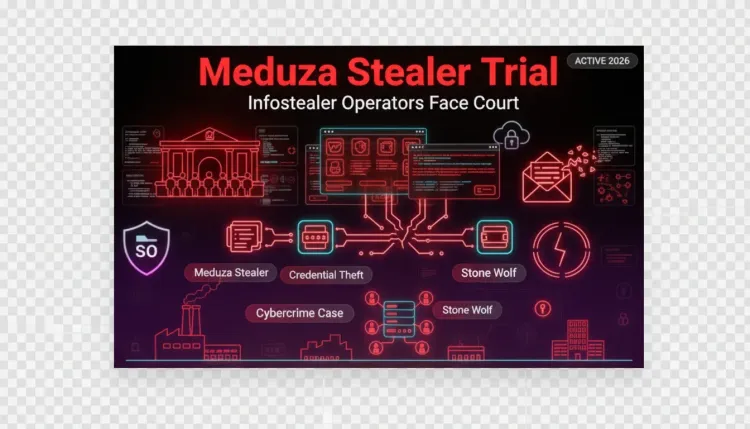
Meduza Stealer Trial: 3 Alleged Creators Face Court | 2026
Executive Summary
Meduza Stealer returned to the security spotlight on September 16, 2026, when Kommersant reported that a court in Astrakhan registered a criminal case against German Abbasov, Vladislav Bakharev, and Artem Voyloshnikov. Russian investigators accuse the three men of creating, using, and distributing malicious computer programs under Part 2 of Article 273 of the Russian Criminal Code.
The case matters beyond the courtroom. Meduza Stealer is a crimeware service built for credential, browser, wallet, and session theft. The alleged May 2025 attacks on Astrakhan Pharmacies and Gazprom Mezhregiongaz Cherkessk show how commercial stealers can move from underground sales into public-sector and industrial targets.
For defenders, this is another reminder that infostealer activity is not background noise. It is an access pipeline.
What happened?
- Summer 2023: Meduza Stealer appeared on underground resources and was marketed as a subscription-style malware-as-a-service product.
- 2023 public positioning: The Meduza service administrator reportedly claimed the project was not affiliated with ransomware groups and prohibited attacks on CIS countries.
- August 2024: BI.ZONE documented Stone Wolf activity using Meduza Stealer against Russian companies after disabling the malware's regional protection logic.
- May 2025: According to a Kommersant source in security services, attackers allegedly accessed systems belonging to Astrakhan Pharmacies and Gazprom Mezhregiongaz Cherkessk and copied official information to servers under their control.
- October 30, 2025: Russian cybercrime police, Astrakhan law enforcement, and National Guard officers carried out searches in Moscow and the Moscow region. Kommersant reported that server equipment, communication devices, and bank cards were seized.
- September 16, 2026: Kommersant reported that the Soviet District Court of Astrakhan registered the criminal case against Abbasov, Bakharev, and Voyloshnikov.
The defendants are accused of creating, using, and distributing malicious computer programs. Kommersant reported that investigators consider Voyloshnikov the organizer of the alleged criminal group. The defendants are currently under restrictions, including a pledge not to leave the city, according to the report.
Important legal caveat: these are allegations until proven in court. At the time of reporting, Kommersant said the court file did not show a separate illegal-access charge, even though the case narrative includes alleged intrusions.
Who is affected?
The direct victims named in Kommersant's reporting are:
- Astrakhan Regional State Institution "Astrakhan Pharmacies"
- Gazprom Mezhregiongaz Cherkessk
The broader exposure is much larger. Meduza Stealer was designed to collect data from Windows systems, including browser data, cryptocurrency wallet material, password manager data, chat and gaming sessions, screenshots, external IP addresses, and system profiling details. That makes it relevant to:
- industrial organizations targeted by phishing lures;
- public-sector entities with sensitive operational data;
- companies whose employees reuse passwords or store sessions in browsers;
- security teams investigating stealer-log exposure in dark-web and Telegram ecosystems;
- incident responders dealing with account takeover, lateral movement, or leaked session cookies.
The named criminal case is local. The defender lesson is global: when a stealer hits one endpoint, identity and SaaS exposure may outlive the initial infection.
Initial access and kill chain
Kommersant's court-focused report does not publish a full technical intrusion chain for the May 2025 incidents. However, prior BI.ZONE reporting on Stone Wolf provides a useful model for how Meduza has been deployed in the wild.
| Phase | Reported behavior | Defender takeaway |
|---|---|---|
| Initial access | BI.ZONE reported phishing emails impersonating a legitimate industrial automation provider. | Treat trusted industry themes and supplier-like lures as high-risk, not generic spam. |
| Delivery | Attackers used archives, decoy documents, and malicious links disguised as files. | Inspect archive contents, link targets, and file masquerading patterns. |
| Execution | Victim interaction triggered the Meduza Stealer payload. | EDR should flag browser/email-spawned download and execution chains. |
| Collection | Meduza collected browser, wallet, password manager, session, application, and system details. | Stealer infections require identity response, not just host cleanup. |
| Evasion and targeting | BI.ZONE reported that Stone Wolf disabled the CIS geofencing module. | Threat actor intent can override developer "rules" in commercial crimeware. |
| Expansion | Russian officials also alleged development of separate malware intended to disable antivirus protection and create botnets. | Hunt for tooling overlap beyond the named stealer. |
MITRE ATT&CK mapping should stay conservative because the public case file is legal rather than deeply technical:
| Tactic | Technique | Why it applies |
|---|---|---|
| Initial Access | Phishing | BI.ZONE documented phishing-based delivery in Stone Wolf Meduza campaigns. |
| Defense Evasion | Masquerading | Prior campaigns used disguised files and decoys. |
| Credential Access | Credentials from Web Browsers | Meduza is known for collecting browser-stored secrets and session material. |
| Collection | Data from Local System | Reports describe system profiling, screenshots, and application inventory collection. |
| Exfiltration | Exfiltration Over Web Service | Kommersant reported copied data being moved to attacker-controlled servers. |
Indicators and detection
This case does not provide a fresh public IOC set for the alleged May 2025 attacks. Instead, defenders should use the case as a trigger to review stealer tradecraft around phishing delivery, browser data access, credential stores, wallet extensions, and unusual outbound transfer.
EDR and endpoint telemetry
Hunt for:
- email client, browser, archive utility, or Office process spawning executables from user-writable directories;
- recently created executables with PDF, document, or archive masquerading;
- access to Chromium and Gecko browser profile paths;
- access to password manager, cryptocurrency wallet, Telegram, Steam, Discord, or Outlook local data;
- screenshot capture followed by outbound network activity;
- sudden antivirus service tampering or exclusions;
- new scheduled tasks, startup entries, or suspicious persistence after a phishing event.
Email security
Prioritize:
- messages impersonating industrial automation, public-sector, utility, or supplier brands;
- ZIP/RAR/7z attachments containing shortcuts, executables, scripts, or remote links;
- emails with legitimate-looking decoy documents paired with suspicious file downloads;
- language and sender-domain mismatches in procurement, invoice, technical support, or industrial-service themes.
Identity and SaaS logs
After any suspected Meduza infection, review:
- impossible travel and new device sign-ins;
- refresh-token or session-token reuse from unfamiliar ASN, VPN, or hosting ranges;
- mailbox rule creation and OAuth consent grants;
- password reset, MFA reset, and recovery email changes;
- privileged portal access from endpoints tied to stealer alerts.
Network, proxy, and DNS
Look for:
- newly seen domains immediately after archive execution;
- POST-heavy traffic from user workstations to unknown VPS or bulletproof-hosting infrastructure;
- Telegram, Discord, Steam, or cloud-storage API usage from unexpected business endpoints;
- repeated connections after browser credential-store reads.
Example Sentinel KQL pattern
DeviceProcessEvents
| where Timestamp > ago(30d)
| where InitiatingProcessFileName in~ ("outlook.exe", "chrome.exe", "msedge.exe", "firefox.exe", "winword.exe", "excel.exe", "7z.exe", "winrar.exe")
| where FolderPath has_any ("\\AppData\\Local\\Temp\\", "\\Downloads\\", "\\AppData\\Roaming\\")
| where FileName endswith ".exe" or FileName endswith ".scr" or FileName endswith ".bat" or FileName endswith ".cmd" or FileName endswith ".ps1"
| project Timestamp, DeviceName, AccountName, InitiatingProcessFileName, FileName, FolderPath, ProcessCommandLine, SHA256
Treat this as an example pattern. Tune it to your telemetry, business software, and known-good updater behavior.
Containment and remediation checklist
Immediate containment (0-24h)
- Isolate endpoints with suspected stealer execution.
- Preserve disk, memory, browser profile, and EDR telemetry before cleaning.
- Reset passwords for accounts used on affected hosts, starting with privileged, email, VPN, SaaS, and cloud accounts.
- Revoke active sessions and refresh tokens, not only passwords.
- Review MFA changes, OAuth grants, mailbox rules, and delegated access.
- Search proxy, DNS, and EDR logs for other hosts that contacted the same infrastructure.
- Check cryptocurrency wallets, developer tokens, SSH keys, API keys, and password managers accessed from the host.
Hardening (24-72h)
- Block execution from high-risk user-writable paths where business operations allow it.
- Enforce archive detonation and attachment sandboxing for high-risk supplier-themed emails.
- Add EDR detections for browser profile scraping and password-store access.
- Require phishing-resistant MFA for privileged and externally accessible accounts.
- Shorten token lifetimes for high-risk SaaS applications.
- Disable browser password storage for privileged users.
- Monitor for leaked enterprise credentials in stealer-log markets.
Longer-term controls (1-4 weeks)
- Build a stealer-response runbook that joins endpoint cleanup with identity containment.
- Baseline normal browser profile access so abnormal credential-store reads stand out.
- Add supplier impersonation scenarios to phishing simulations.
- Map which business applications remain exposed through stolen cookies or refresh tokens.
- Improve dark-web monitoring for corporate domains, executives, administrators, and service accounts.
- Review whether industrial and public-sector systems depend on unmanaged workstations for privileged access.
- Run tabletop exercises for "one endpoint infected, many SaaS sessions exposed."
Strategic analysis: what this signals
The most useful part of this case is not the courtroom drama. It is the way the Meduza story compresses three cybercrime realities into one incident arc.
First, infostealers are mature commercial infrastructure. They are sold, supported, modified, and operated like a service. Once a stealer collects browser cookies, saved credentials, wallet data, or messaging sessions, defenders are no longer dealing with a single infected endpoint. They are dealing with an identity spill.
Second, underground "rules" are weak controls. Meduza reportedly included a geofilter intended to prevent execution in Russia and other CIS countries. BI.ZONE's Stone Wolf reporting showed that attackers could disable that logic. Any vendor, affiliate, or forum rule that depends on voluntary restraint should be treated as temporary.
Third, arrests do not erase exposed data. Even if the alleged creators are convicted, credentials already stolen by customers, affiliates, or downstream buyers may remain useful. Organizations should treat law-enforcement disruption as useful intelligence, not as remediation.
References
FAQ
Kommersant reported that a court in Astrakhan registered a criminal case against German Abbasov, Vladislav Bakharev, and Artem Voyloshnikov. The three are accused of creating, using, and distributing malicious computer programs linked to Meduza Stealer.
Meduza Stealer is an information-stealing malware family marketed through underground channels. Public reporting describes capabilities for stealing browser data, cryptocurrency wallet material, password manager data, session data, screenshots, and system information.
Kommersant reported that a key episode involved Astrakhan Pharmacies and Gazprom Mezhregiongaz Cherkessk. According to the investigation narrative reported by Kommersant, attackers allegedly copied official information to attacker-controlled servers.
Meduza Stealer follows a global crimeware pattern: steal endpoint and identity material, then monetize access through account takeover, fraud, or follow-on intrusion. The prosecution is local, but the stealer risk model applies broadly.
Isolate the host, preserve evidence, reset passwords, revoke active sessions, inspect OAuth and mailbox rules, and hunt for other systems that contacted the same infrastructure. Treat the incident as an identity compromise, not only a malware cleanup.
Kommersant reported that, at the time of its article, the court file did not show a separate charge for illegal access to computer information. The public allegation centers on creating, using, and distributing malicious computer programs.
Kommersant reported that the defendants could face up to five years in prison and a fine of up to 200,000 rubles if found guilty. The outcome will depend on the court process.
How to cite
Lucas Oliveira. Meduza Stealer Trial: 3 Alleged Creators Face Court. 18 Sept 2026. Invaders Cybersecurity. https://invaders.ie/resources/blog/cybercrime/meduza-stealer-trial-3-alleged-creators-face-court.
Subscribe via RSS.
Written by
Lucas Oliveira
Research
A DevOps engineer and cybersecurity enthusiast with a passion for uncovering the latest in zero-day exploits, automation, and emerging tech. I write to share real-world insights from the trenches of IT and security, aiming to make complex topics more accessible and actionable. Whether I’m building tools, tracking threat actors, or experimenting with AI workflows, I’m always exploring new ways to stay one step ahead in today’s fast-moving digital landscape.
Hot TopicsLast 7 days
Categories
Stay Updated
Get the latest cybersecurity insights delivered to your inbox.