Cisco Breach Shows the Real Cost of the Trivy Supply-Chain Attack

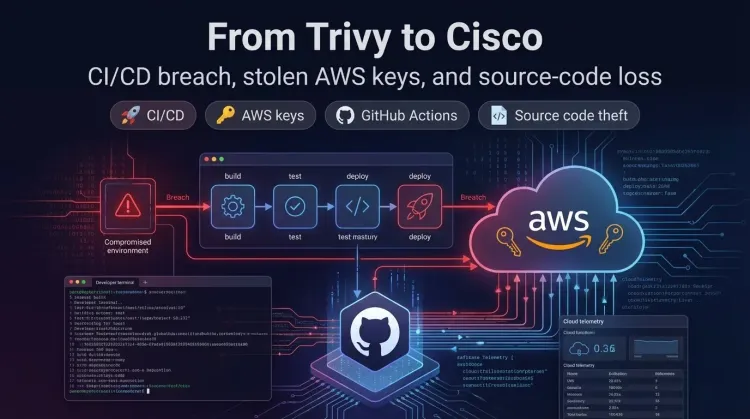
Cisco Breach Shows the Real Cost of the Trivy Supply-Chain Attack
The most important lesson from the Trivy incident is that a supply-chain attack on a trusted security tool does not end when the poisoned release is identified. The real damage often shows up later, inside the environments that trusted the tool. Reporting from BleepingComputer says Cisco suffered exactly that kind of downstream breach after attackers used fallout from the recent Trivy compromise to access its internal development environment, steal AWS keys, and clone hundreds of repositories.
That makes this story bigger than a single vendor breach. It is a case study in CI/CD blast radius. Once attackers get access to runner secrets, cloud credentials, or repository tokens, the attack surface quickly expands from one compromised dependency into cloud abuse, source-code theft, and long-tail follow-on intrusion risk.
What reportedly happened at Cisco
According to BleepingComputer, attackers used stolen credentials tied to the recent Trivy supply-chain incident to breach Cisco’s build and development environment. The report says the compromise affected dozens of devices, including some developer and lab workstations, and that Cisco’s internal teams moved to contain the incident.
The same reporting says multiple AWS keys were stolen and later used for unauthorized activity across a small number of Cisco AWS accounts. Cisco reportedly began isolating affected systems, reimaging impacted assets, and rotating credentials at scale.
The most damaging reported detail is the repository access. BleepingComputer says more than 300 GitHub repositories were cloned, including source code tied to AI-focused Cisco products and unreleased efforts. Some of the allegedly stolen repositories were also said to involve customer-owned code, including sectors such as banking, BPO, and U.S. government work.
If those details hold, this is not just a runner-secret incident. It is an enterprise development-environment breach with meaningful intellectual-property and customer-trust implications.
Why this matters beyond Cisco
Security teams sometimes frame CI/CD compromises as “pipeline issues,” as if the risk ends at the build step. That is a dangerous mental model.
Modern build environments often hold exactly the credentials attackers want:
- cloud access keys
- source control tokens
- signing material
- artifact registry credentials
- deployment secrets
- internal repository access
- webhook and integration tokens
That is why the Trivy compromise was always likely to become a downstream enterprise intrusion story. Once a poisoned GitHub Action or release steals secrets from enough organizations, some of those secrets will unlock bigger environments. Cisco appears to be one of the first clear examples of that second-stage risk becoming visible.
The Trivy incident was never just about Trivy
Public research on the broader campaign already pointed in this direction. Analysts tied the Trivy compromise to a larger TeamPCP-linked pattern that also touched other developer ecosystems and projects, including LiteLLM and Checkmarx KICS. The consistent theme is attacker focus on developer trust chains, build automation, and secret-rich environments.
That matters because defenders should not interpret this as a one-off scanner problem. It is part of a wider pattern: compromise a trusted developer dependency, harvest secrets from CI or workstations, then reuse those secrets for cloud access, repository theft, or follow-on malware delivery.
In other words, the software supply chain is now a direct path into enterprise operations.
What defenders should do now
The right response is not limited to removing bad package versions.
🔴 Treat impacted runners as high-value compromise events
If your environment used the poisoned Trivy components or adjacent affected projects, assume sensitive secrets may have been exposed. Review not only the pipeline but every trust path those secrets unlocked.
🔴 Rotate credentials broadly
This should include:
- GitHub and source-control tokens
- AWS keys and temporary credentials
- registry credentials
- SSH keys
- webhook secrets
- any environment variables or secret-store values accessible to affected runners
Rotation should happen from clean administrative systems, not from possibly impacted runners or workstations.
🔴 Hunt for follow-on cloud abuse
The Cisco reporting is a reminder that the second stage may happen in cloud accounts, not just inside CI. Review IAM activity, unusual API calls, access from unfamiliar source locations, and suspicious creation or use of artifacts, snapshots, or temporary credentials.
🔴 Look for large-scale repository cloning
Audit Git activity for abnormal clone volume, unusual repository access patterns, and use of tokens outside expected workflows. In some cases, the most important evidence may sit in Git platform logs rather than endpoint telemetry.
🟠 Rebuild affected runners and workstations
Where compromise is plausible, rebuilding from clean images is safer than assuming cleanup inside the same environment is enough.
🟠 Reduce future blast radius
Key hardening steps include:
- pinning GitHub Actions to immutable SHAs where possible
- narrowing runner IAM permissions
- isolating build environments from broader developer and production trust paths
- monitoring outbound network activity from runners
- limiting secret exposure in runtime environments
Why rollback is not a sufficient strategy
Many organizations still respond to supply-chain incidents as if the main problem is version hygiene. But if attackers already harvested credentials, the danger is no longer the poisoned package itself. The danger is what those credentials can now unlock.
That is the core lesson from this Cisco story. Even after the original Trivy issue becomes public, the operational damage can continue through stolen tokens, AWS keys, and repository access. A security team that only patches the original dependency may miss the real incident.
Strategic takeaway
Cisco’s reported breach shows the true cost of a modern software supply-chain compromise: the attacker does not need to stay inside the package. They only need the package to open the first door.
For defenders, CI/CD can no longer be treated as disposable automation plumbing. It is part of the production attack surface. If a runner can reach repositories, cloud accounts, signing paths, or unreleased code, then compromise of that runner should be handled with the same seriousness as compromise of a privileged production host.
The practical mindset is simple: when a trusted developer dependency is poisoned, assume the first stage is malware or secret theft, and the second stage is whatever those secrets let the attacker touch next.
References
- Cisco source code stolen in Trivy-linked dev environment breach
- Trivy supply chain attack analysis
- TeamPCP expands compromise from Trivy to Checkmarx KICS
- TeamPCP campaign and downstream impact
- KICS GitHub Action compromise in TeamPCP campaign
- LiteLLM PyPI package compromised in TeamPCP supply chain attack