Cold-Chain OT Is Now a Cybersecurity Boundary: What the Refrigeration Attacks Mean

Cold-Chain OT Is Now a Cybersecurity Boundary: What the Refrigeration Attacks Mean
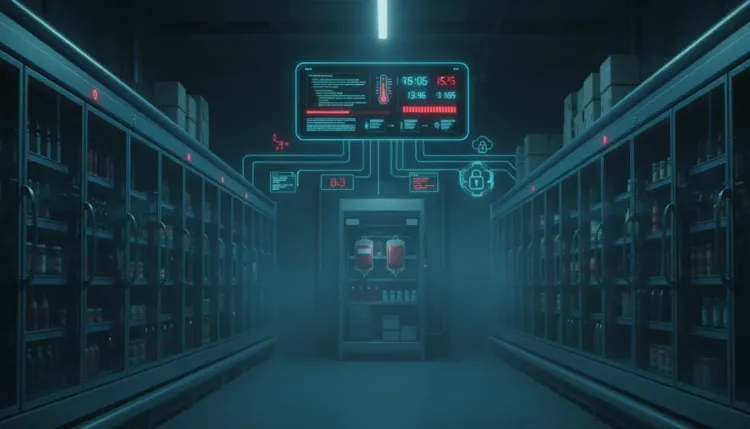
Federal agencies are warning that malicious cyber actors are targeting industrial refrigeration and cold-chain monitoring systems around the world. The systems are not merely sensors: they can log temperatures, manage defrost cycles, optimize energy use, and remotely change the conditions that keep food, medicine, and biological materials safe.
The warning follows a series of incidents in Europe. Attackers remotely changed refrigeration settings at supermarkets in several countries, and France’s national blood service reported that a refrigeration-provider incident altered temperature and defrost settings at three facilities storing blood products. Staff detected the changes and protected the products, but the operational lesson is serious: a cyber event in an overlooked control system can become a safety, inventory, and business-continuity problem within hours.
The attack surface is physical
The joint fact sheet from the FBI, CISA, HHS, USDA, and the Department of Transportation says actors are targeting electronic temperature controllers and commercial refrigeration controllers in retail and cold-storage environments. The agencies identify three broad paths: authentication bypasses, arbitrary code injection, and weak configurations on unpatched or internet-accessible systems.
Successful access can let an attacker change setpoints, force continuous heating or defrost cycles, or hide the current temperature from operators. That can shorten equipment life, create a fire hazard, spoil inventory, or indirectly harm consumers if products are used after unsafe storage. The control panel is therefore part of the organization’s attack surface, even when the appliance is managed by a facilities team rather than the security department.
The affected environments are broader than supermarkets. Healthcare and public-health organizations, food and agriculture companies, chemical facilities, and transportation operators may depend on the same pattern of remote monitoring and control. A supplier or managed-service connection can also turn one exposed management path into a multi-site problem.
What the recent incidents show
Reports from October described refrigeration controllers at an estimated 250 to 350 French supermarkets being manipulated to activate defrost functions. In November, more than 115 stores across Belgium, the Netherlands, Sweden, Luxembourg, Ireland, and Estonia reported disruptions, including shutdowns and extreme temperature changes. At one Swedish store, a system reportedly began generating heat; another reported a setting of 50°C.
On November 2, the French Blood Establishment identified altered temperature and defrost settings at three facilities. The organization said its alarms detected the changes, products were transferred or secured, and no loss of blood products or health impact had been identified. Reporting has linked the incident to a refrigeration equipment provider and a third-party component. The precise exploit used across the incidents has not been conclusively established, so defenders should avoid assuming that one named CVE explains every event.
That uncertainty is itself a hunting signal. Treat unexpected setpoint changes, unexplained defrost cycles, disabled alarms, and new remote-management sessions as security telemetry—not only as maintenance anomalies. Preserve controller logs where available, and collect network traffic when the device cannot produce useful logs.
The hardening checklist
The government advisory recommends actions that map cleanly to a practical incident response and resilience program:
- Remove controller panels and management interfaces from the public internet. Put necessary remote access behind a firewall or equivalent edge control.
- Isolate refrigeration and other operational technology (OT) devices from business networks with dedicated segmentation. Do not assume that a facilities VLAN is automatically safe.
- Change default credentials, enforce strong authentication, and restrict which administrator devices and IP addresses can change setpoints.
- Apply supported firmware and security updates through a documented patch management lifecycle. Replace end-of-life controllers that no longer receive fixes.
- Define safe temperature ranges and alert on deviations. The controller should not be the only place where a dangerous change is visible.
- Maintain offline, tested backups of configurations and operating procedures. Make sure staff can operate safely if remote management is disabled.
- Review logs and network flows for unexpected access, configuration changes, and communications with unfamiliar external systems.
The operational lesson
Cold-chain security is not a niche facilities concern. It is a cyber-physical control problem in which confidentiality may be less important than the integrity and availability of a temperature setpoint. A device that looks harmless in an asset inventory can still control products, equipment, and public-health processes.
Security teams should work with facilities, vendors, and safety owners to map every controller, remote-access path, support account, firmware version, and alarm dependency. Then test the response: who notices a nighttime change, who can isolate the system, who validates product safety, and who reports the incident?
The most important defensive move is to shrink the management boundary before an attacker finds it. If a refrigeration controller does not need to be on the internet, it should not be. If it must be managed remotely, that access should be authenticated, restricted, monitored, and designed to fail safely.
References
FAQ
Federal agencies are warning that malicious cyber actors are targeting industrial refrigeration and cold-chain monitoring systems around the world. The systems are not merely sensors: they can log temperatures, manage defrost cycles, optimize energy use, and remotely change the conditions that keep food, medicine, and biological materials safe.