TrueConf KEV Flaws: When a Video Server Becomes a Malware Distribution Point

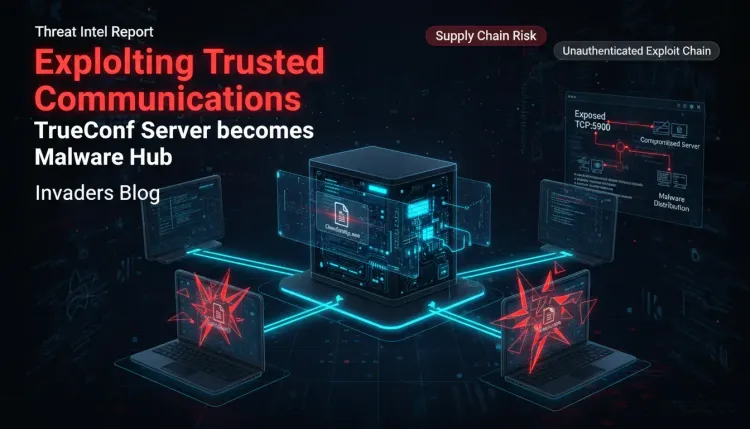
TrueConf KEV Flaws: When a Video Server Becomes a Malware Distribution Point
CISA has added two exploited TrueConf Server vulnerabilities to its Known Exploited Vulnerabilities catalog after attackers chained them in real incidents. The flaws, tracked as CVE-2026-72529 and CVE-2026-72530, affect self-hosted TrueConf Server deployments and can allow unauthenticated remote attackers with access to TCP port 4307 to execute code.
This story sits at the intersection of patching and threat intelligence. The immediate action is to upgrade vulnerable TrueConf servers. The deeper lesson is that trusted collaboration infrastructure can become a software distribution path for malware when attackers compromise the server that provides client installers.
What happened?
Kaspersky reported attacks by the Head Mare group against unpatched TrueConf videoconferencing servers. In the observed campaign, attackers exploited a chain of TrueConf Server vulnerabilities, gained control of the server, and replaced legitimate TrueConf client installers with infected versions that delivered PhantomCore and PhantomGraph malware.
The vulnerabilities were later assigned CVE-2026-72529 and CVE-2026-72530. CISA added both to KEV on August 20, 2026, based on evidence of active exploitation.
The patch path is already available. Kaspersky says the vulnerabilities were fixed in the June 18, 2026 TrueConf Server update: 5.3.9, 5.4.9, and 5.5.5.
The vulnerability chain
The first flaw, CVE-2026-72529, allows a remote unauthorized attacker with network access to the TrueConf server on 4307/TCP to execute an arbitrary script by calling an undocumented function.
The second flaw, CVE-2026-72530, allows a remote unauthorized attacker with access to the same service to use a specially crafted script to escape an isolated environment and execute arbitrary code on the host system.
That chain matters because the second stage changes the blast radius. The risk is not limited to application-level manipulation; attackers can reach the host and then abuse TrueConf's trusted role inside the organization.
Why this matters
Self-hosted communications platforms often sit in a privileged place: internal users trust them, administrators maintain them, and endpoints routinely download updates or client packages from them. Once that server is compromised, the attacker can turn a normal business workflow into a supply chain attack.
In this case, the reported attack path involved replacing client installers. That means defenders must think beyond the server:
- Was the TrueConf server vulnerable and exposed on port 4307?
- Were client installers changed or downloaded during the compromise window?
- Did endpoints execute trojanized installers?
- Are PhantomCore or PhantomGraph artifacts present on user systems?
- Did the attacker establish command-and-control channels or persistence?
The operational response should combine vulnerability management with endpoint investigation.
What defenders should do now
1. Patch TrueConf Server
Upgrade affected TrueConf Server deployments to fixed versions 5.3.9, 5.4.9, 5.5.5, or a later supported release. If the server is older than the supported branches, prioritize migration and remove broad network exposure while that work is underway.
2. Restrict access to TCP port 4307
Do not expose the TrueConf service broadly unless there is a clear business requirement. Restrict access to trusted networks, VPN ranges, or management segments and monitor for unexpected inbound traffic.
3. Verify installer integrity
Check the TrueConf client packages served by the organization. Compare file hashes, signatures, timestamps, and file sizes against known-good vendor packages. Review whether users downloaded installers during the likely exposure window.
4. Hunt on the server and endpoints
Look for web shells, altered files, suspicious service behavior, and unexpected outbound traffic from the TrueConf server. On endpoints, hunt for PhantomCore and PhantomGraph-related artifacts where available, unusual child processes from TrueConf installers, and suspicious connections to cloud storage services used for command-and-control.
5. Treat confirmed installer replacement as an incident
If a poisoned installer was distributed internally, response should include endpoint containment, credential review, mailbox and chat account monitoring, and access control checks for privileged users who installed the client.
Practical detection ideas
Start with exposure and server-side triage:
index=network dest_port=4307
| stats count min(_time) as firstSeen max(_time) as lastSeen by src_ip, dest_ip, action
Then review installer and web directory changes:
index=edr host=trueconf*
(file_name="*.exe" OR file_name="*.msi" OR file_name="*.php" OR file_name="*.dll")
| stats count min(_time) as firstSeen max(_time) as lastSeen by host, file_path, file_hash, process_name, user
Useful review questions:
- Did any TrueConf installer change outside an approved update window?
- Are any client installer binaries unsigned or signed by an unexpected publisher?
- Did the server create suspicious PHP, DLL, or script files?
- Did endpoints launch unusual processes immediately after installing or updating TrueConf?
- Did the TrueConf server or endpoints contact unexpected OneDrive, SSH, or command-and-control infrastructure?
Bottom line
CVE-2026-72529 and CVE-2026-72530 are not only critical TrueConf Server bugs. They are a reminder that collaboration servers can become trusted malware distribution points.
Patch the server, restrict port 4307, verify client installer integrity, and investigate endpoints that may have received software from a compromised TrueConf instance.
References
FAQ
CISA has added two exploited TrueConf Server vulnerabilities to its Known Exploited Vulnerabilities catalog after attackers chained them in real incidents. The flaws, tracked as CVE-2026-72529 and CVE-2026-72530, affect self-hosted TrueConf Server deployments and can allow unauthenticated remote attackers with access to TCP port 4307 to execute code.
Self-hosted communications platforms often sit in a privileged place: internal users trust them, administrators maintain them, and endpoints routinely download updates or client packages from them. Once that server is compromised, the attacker can turn a normal business workflow into a supply chain attack.
Upgrade affected TrueConf Server deployments to fixed versions 5.3.9, 5.4.9, 5.5.5, or a later supported release. If the server is older than the supported branches, prioritize migration and remove broad network exposure while that work is underway.
How to cite
Lucas Oliveira. TrueConf KEV Flaws: When a Video Server Becomes a Malware Distribution Point. 24 Aug 2026. Invaders Cybersecurity. https://invaders.ie/resources/blog/threat-hunting-and-intel/trueconf-kev-flaws-video-server-malware-distribution.
Subscribe via RSS.
Written by
Lucas Oliveira
Research
A DevOps engineer and cybersecurity enthusiast with a passion for uncovering the latest in zero-day exploits, automation, and emerging tech. I write to share real-world insights from the trenches of IT and security, aiming to make complex topics more accessible and actionable. Whether I’m building tools, tracking threat actors, or experimenting with AI workflows, I’m always exploring new ways to stay one step ahead in today’s fast-moving digital landscape.
Hot TopicsLast 7 days
Categories
Stay Updated
Get the latest cybersecurity insights delivered to your inbox.