UK education networks face a wave of web-facing attacks

UK education networks face a wave of web-facing attacks
UK schools, colleges, and universities are again showing why education has become one of the most difficult environments to defend: open networks, high user turnover, public-facing services, constrained budgets, and valuable data all collide in the same place.
New reporting based on SonicWall threat telemetry says attacks against colleges and universities have surged by 67% over the last year. The company recorded more than 19.3 million medium and high-severity intrusion attempts against the sector so far in 2026, compared with 11.5 million events across all of 2025. Most of the activity was concentrated in educational services, with web-based attacks and path traversal attempts dominating the signal.
This is not just another seasonal back-to-school warning. It is a useful threat pattern for defenders: attackers are probing the web-facing edges of education environments at scale, looking for old paths, exposed applications, and weakly governed services that naturally accumulate in open academic networks.
The resolved category for this story is Threat Hunting & Intel. The dominant action is not "patch one CVE." It is to hunt for exploitation attempts, understand exposed services, and harden the parts of the education network most likely to be probed.
What the latest reporting shows
ITPro reported on September 28 that SonicWall observed a sharp increase in cyber activity against UK academic institutions. The numbers are stark: 19.3 million medium and high-severity intrusion attempts so far in 2026, up from 11.5 million across the full previous year. Educational services accounted for 16.8 million of those events.
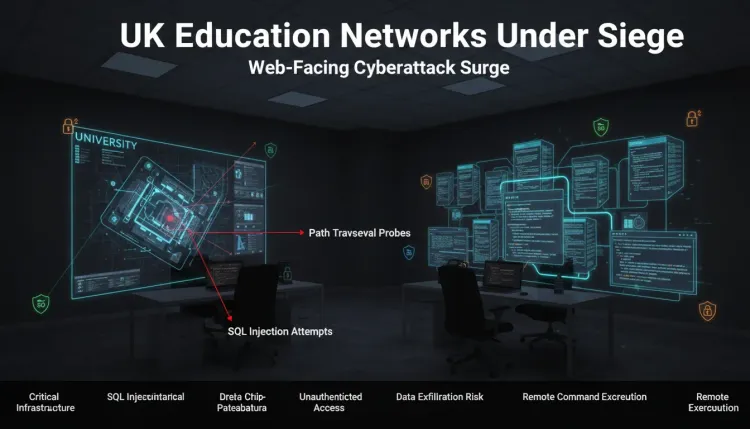
The shape of the activity matters. SonicWall's telemetry points to web-facing infrastructure as the main target area. Path traversal and directory manipulation attacks accounted for 10.2 million hits across the four leading signatures, while web-based attacks accounted for 17.3 million events overall.
That pattern should feel familiar to defenders. Education networks often contain old portals, research applications, library systems, student services, externally reachable collaboration platforms, legacy CMS instances, remote access tools, and third-party integrations. Some are centrally managed. Others belong to departments, labs, contractors, or projects that outlive their original owner.
Attackers do not need every service to be weak. They need one forgotten route into the environment.
Why education is a high-pressure target
Education environments are unusually hard to reduce to a neat perimeter. Universities and colleges are designed for access: students, staff, researchers, visiting academics, partners, vendors, alumni systems, and public-facing services all need to connect. That openness is part of the mission, but it also creates a broad attack surface.
The UK government's Cyber Security Breaches Survey 2025/2026 supports the same picture. In the education annex, 98% of higher education institutions and 88% of further education colleges said they had identified breaches or attacks in the previous 12 months. Secondary schools also saw a significant increase, with 73% reporting breaches or attacks, up from 60% in the previous survey period.
The survey also found that phishing remains overwhelmingly common across education. But the SonicWall telemetry adds another layer: while phishing targets users, automated exploitation and web probing target the infrastructure that keeps the institution running.
For defenders, the two problem sets meet quickly. A compromised account may expose internal services. A vulnerable public application may become an initial foothold. A router, VPN, content management system, or student portal may provide the attacker with a path toward identity systems, file shares, research data, or administrative platforms.
The web edge is the first hunting ground
Path traversal and directory manipulation activity should get attention because these attempts are rarely subtle in aggregate. They often show up as requests for unexpected file paths, encoded traversal sequences, sensitive configuration files, backup files, logs, environment files, or application-specific directories.
Security teams should look across:
- web server access logs
- reverse proxy and WAF logs
- CDN and cloud load balancer logs
- VPN and remote access portals
- student and staff portals
- CMS and LMS platforms
- library and research systems
- exposed APIs and legacy departmental applications
The goal is not to manually read millions of lines. It is to build a quick detection layer around the behaviors most likely to matter: traversal strings, abnormal URL depth, repeated probes across many paths, hits against old framework routes, suspicious user agents, and source IPs moving from scanning to authenticated or successful requests.
When teams find repeated probing, they should avoid dismissing it as internet noise too quickly. The useful question is whether any request changed from a failed probe to a different response code, unusual response size, file download, command execution indicator, or follow-on authenticated activity.
That is where threat hunting becomes practical. The hunt starts with noisy edge attempts, then narrows to the small set of requests that may indicate successful exploitation.
What to prioritize first
Education defenders should start with systems that combine exposure, age, and operational importance.
First, map internet-facing applications. This should include obvious central services and less obvious departmental assets. Asset discovery is especially important in universities, where labs and research groups may run independent infrastructure.
Second, review applications that handle identity, files, student services, payments, remote learning, admissions, HR, or research data. A low-profile web app can matter if it connects to privileged data or identity flows.
Third, compare vulnerability exposure against real traffic. A stale server with no public route is still a problem, but a stale server receiving traversal attempts from the internet is a different operational priority.
Fourth, inspect authentication and session behavior after suspicious probes. Attackers may use web exploitation to steal configuration secrets, then switch into credentialed access. If a probing source is followed by unusual sign-ins, new sessions, or impossible travel, the investigation should widen.
Finally, treat critical education systems as business-critical infrastructure. Learning platforms, exam systems, payroll, safeguarding records, research systems, and identity services often need incident plans that go beyond generic IT continuity.
A practical hunting checklist
Use this as a first pass for the next 24 to 72 hours:
- Inventory exposed web services. Pull from DNS, certificates, WAF/CDN configs, cloud assets, firewall NAT rules, and known departmental domains.
- Search for traversal patterns. Include
../, encoded traversal, double encoding, path normalization tricks, requests for.env, config files, backups, logs, and framework-specific sensitive paths. - Rank by response behavior. Focus on probes that returned 200, 206, 301/302 to sensitive routes, unusually large responses, or errors that reveal file paths.
- Correlate with authentication logs. Look for suspicious sign-ins from the same IP ranges, new devices, password resets, MFA fatigue, or service account activity.
- Check for post-exploitation changes. Review new web files, modified scripts, scheduled jobs, startup items, unfamiliar admin accounts, new API keys, and outbound connections.
- Review vulnerable technologies at the edge. Prioritize old CMS plugins, VPN appliances, remote management panels, LMS integrations, file transfer tools, and unsupported frameworks.
- Preserve evidence. Web and proxy logs rotate quickly. Export high-risk windows before the useful trail disappears.
This checklist gives smaller teams a way to move without needing a perfect tooling stack.
Why this is bigger than ransomware
Ransomware still matters in education, but the telemetry shows why defenders should not frame every education attack as a single ransomware story. Web exploitation can support credential theft, data access, persistence, research espionage, botnet staging, cryptomining, or later extortion.
SonicWall's education reporting also noted active ransomware campaigns in the first half of 2026, but the immediate defensive lesson is broader: schools and universities are being continuously tested across public infrastructure. Some of that testing is opportunistic. Some may support more targeted operations.
The UK National Cyber Security Centre's education guidance has long emphasized that universities and colleges hold valuable data while operating open and collaborative environments. That tension is the heart of the problem. The network cannot simply be locked down like a single-purpose enterprise. It has to be segmented, monitored, and governed without breaking teaching and research.
Defensive moves that actually reduce risk
For education institutions, the highest-value improvements are often boring, specific, and measurable.
Reduce public exposure where possible. Departmental systems, old project sites, staging environments, and admin panels should not remain internet-facing because "they have always been there." If a service has no clear owner, no update path, and no business case for public access, it should be retired or isolated.
Put identity controls around the services that must remain public. Use MFA, conditional access, modern SSO, strong session monitoring, and least-privilege roles. Public does not have to mean weakly governed.
Centralize logs from edge systems. Web server, WAF, CDN, firewall, VPN, proxy, and identity logs should be searchable together. Traversal attempts become more useful when they can be correlated with sign-ins, file access, and endpoint activity.
Patch by exposure, not only by severity. A medium-severity flaw on an internet-facing portal may deserve faster action than a critical flaw buried in an isolated lab system. Context should shape the queue.
Build a lightweight owner model. Every externally reachable service should have a named owner, a patch path, a data classification, and a retirement date or review cadence.
Practice incident response around real education workflows. A compromised learning platform, research server, or student records system has different operational consequences than a generic web server incident.
Strategic takeaway
The latest numbers are a reminder that education is not being attacked only because it is weak. It is being attacked because it is open, distributed, data-rich, and operationally hard to simplify.
That means the answer cannot be only "buy more tools" or "patch faster." The more useful answer is to make the exposed education environment legible: know what is online, know who owns it, know what it connects to, and know when probing turns into possible compromise.
For UK schools, colleges, and universities, the immediate task is to look closely at web-facing infrastructure. Path traversal and directory manipulation attempts are already in the noise. The job now is to find the few signals that matter before an attacker finds the forgotten system first.
References
FAQ
SonicWall telemetry cited by ITPro shows more than 19.3 million medium and high-severity intrusion attempts against the education sector so far in 2026, up from 11.5 million across 2025.
The reporting highlights web-facing attacks, especially path traversal and directory manipulation attempts, as a major part of the activity against education infrastructure.
Education networks are intentionally open and distributed. They must support students, staff, researchers, partners, public services, and many independently managed systems, which expands the attack surface.
Inventory public-facing services, hunt for traversal and web probing patterns, prioritize exposed systems with sensitive data or identity connections, preserve logs, and remove or isolate abandoned services.