CISA Adds Oracle WebLogic Proxy Plug-in Flaw to KEV as Exploitation Pressure Rises

CISA Adds Oracle WebLogic Proxy Plug-in Flaw to KEV as Exploitation Pressure Rises
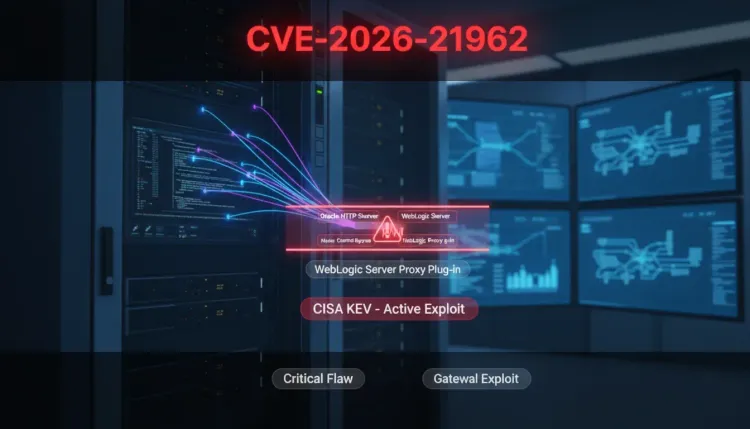
CISA has added CVE-2026-21962, a maximum-severity Oracle HTTP Server and Oracle WebLogic Server Proxy Plug-in flaw, to its Known Exploited Vulnerabilities catalog after evidence of active exploitation. The entry landed on August 24, 2026, with a federal remediation deadline of August 27, which makes this less of a routine Oracle CPU item and more of a short-window exposure check for teams running Oracle middleware at the edge.
The vulnerability affects Oracle HTTP Server and the Oracle WebLogic Server Proxy Plug-in for Apache HTTP Server and IIS. Oracle's January Critical Patch Update listed it as remotely exploitable over HTTP, with a CVSS score of 10.0, low attack complexity, and no required privileges or user interaction. In practical terms, the exposed component sits exactly where many enterprises do not want ambiguity: between public web traffic and application infrastructure.
What Changed
The important change is not that a patch exists. Oracle shipped fixes in January 2026 for affected 12.2.1.4.0, 14.1.1.0.0, and 14.1.2.0.0 deployments. The change is that CISA now says exploitation is active enough to merit KEV treatment.
CISA describes the bug as an improper access control issue that can allow unauthorized creation, deletion, or modification of critical data, as well as unauthorized access to data reachable through the affected Oracle HTTP Server and WebLogic Server Proxy Plug-in components. That places the immediate response firmly in the vulnerability category: identify affected internet-facing or partner-facing systems, patch or mitigate them, and verify that no exposed proxy path was abused before remediation.
Reports cited by The Hacker News connect the KEV addition to earlier scanning and exploitation activity observed against WebLogic environments. That context matters because WebLogic has a long history of attackers recycling durable, high-impact bugs against servers that remain exposed long after patches are available.
Why Defenders Should Prioritize This
Oracle middleware often sits in high-value enterprise zones: identity-adjacent portals, business applications, integration layers, and legacy workloads that are difficult to patch quickly. A flaw that can be reached over HTTP and does not require authentication deserves different handling from an internal-only administrative bug.
Security teams should treat CVE-2026-21962 as an exposure-management problem first. The fastest useful question is not "do we own Oracle?" but "where do Oracle HTTP Server and WebLogic proxy plug-ins terminate inbound HTTP traffic?" That includes load-balanced paths, reverse proxies, stale disaster-recovery nodes, test environments, and business-unit managed instances outside central patch dashboards.
This is also a good moment to revisit patch management assumptions. January fixes that are still absent in late August suggest either asset visibility gaps, maintenance-window friction, or middleware ownership confusion. Any of those can keep the next WebLogic issue alive in the environment too.
Immediate Response Checklist
Start with asset discovery. Search for Oracle HTTP Server and WebLogic Server Proxy Plug-in deployments, especially those exposed to the internet or reachable from untrusted partner networks.
Confirm patch status against Oracle's January 2026 Critical Patch Update guidance. Prioritize the versions CISA lists for CVE-2026-21962 and apply vendor mitigations where patching cannot be completed immediately.
Harden exposed HTTP paths while patching is underway. Restrict management and proxy endpoints to trusted networks, review web server routing rules, and remove stale virtual hosts that still forward traffic into WebLogic.
Review logs for suspicious HTTP requests to Oracle middleware paths. Look for unusual access-control outcomes, unexpected data modification attempts, new administrative behavior, and traffic from unfamiliar infrastructure.
If exposure is confirmed, preserve logs before rotation and run incident triage. Because CISA's KEV entry cites active exploitation, a clean patch record is not enough; teams should also check whether the vulnerable window was abused.
The Bottom Line
CVE-2026-21962 is a patched Oracle middleware flaw that has moved from advisory backlog to active-exploitation priority. For defenders, the reader action is clear: find affected Oracle HTTP Server and WebLogic proxy deployments, patch them quickly, and treat exposed unpatched systems as candidates for compromise review.
The short federal deadline is a useful signal even outside government. If a public-facing middleware component can expose or modify critical data without authentication, it belongs near the top of this week's remediation queue.
References
FAQ
CISA has added CVE-2026-21962, a maximum-severity Oracle HTTP Server and Oracle WebLogic Server Proxy Plug-in flaw, to its Known Exploited Vulnerabilities catalog after evidence of active exploitation.
Start with asset discovery. Search for Oracle HTTP Server and WebLogic Server Proxy Plug-in deployments, especially those exposed to the internet or reachable from untrusted partner networks.