CVE-2026-102489: Zammad Zero-Day Chain Hits Root

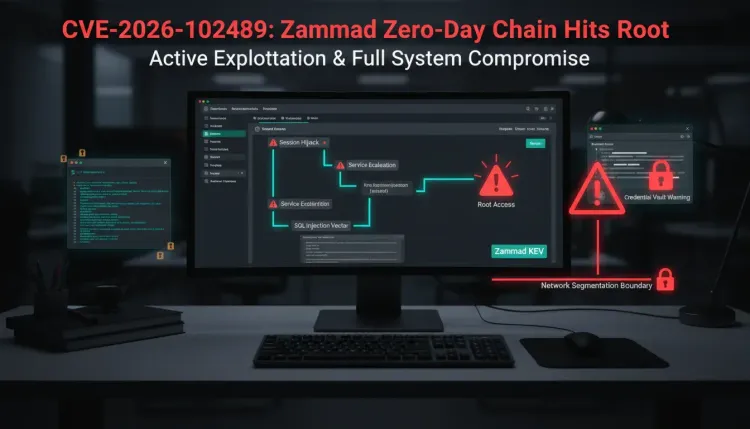
CVE-2026-102489: Zammad Zero-Day Chain Hits Root | 2026
Executive Summary
Since September 21, 2026, the chained CVE-2026-102489 and CVE-2026-102490 vulnerabilities in Zammad have moved from incident detail to urgent remediation priority. The Dutch Institute for Vulnerability Disclosure (DIVD) says the chain enabled attackers to hijack sessions, execute code as the local Zammad service user, and escalate to root during the breach of its own network.
CISA added both flaws to its Known Exploited Vulnerabilities catalog on October 2, 2026, with a federal remediation deadline of October 5, 2026. For defenders, the key point is simple: if a self-hosted Zammad instance is exposed to the internet, this is not only a patching task. It is a digital forensics and incident response task because exploitation is already confirmed.
Zammad and DIVD disagree on parts of the affected-version picture, especially around the second flaw and practical exploitability in newer environments. That uncertainty should not slow down action. Inventory exposed instances, preserve evidence, upgrade, and rotate secrets reachable from the helpdesk host.
The Flaw: Session Hijack to Root
CVE-2026-102489 is a high-severity session fixation weakness that can lead to remote code execution as the local Zammad user. CVE-2026-102490 is an improper privilege management flaw that can turn that local foothold into root access.
The risk comes from chaining. A single bug may have caveats, version limits, or environmental dependencies. Together, the reported path gives an attacker a route from a network-reachable helpdesk interface to full operating-system control, which is why the incident belongs in every exposed-helpdesk review this week.
How the Exploit Works
- Find an exposed Zammad instance: The attacker identifies a self-hosted Zammad deployment reachable over the internet.
- Fix or hijack a session: The attacker abuses the session fixation weakness to gain control of a legitimate application session.
- Execute code as the service user: The compromised session becomes a route to run code under the local
zammadaccount. - Escalate locally: The privilege-management flaw raises that foothold from the application user to root.
- Collect and pivot: From root, the attacker can read tickets, mail integration secrets, database credentials, API tokens, and potentially move into connected systems.
Internet-facing Zammad
  -> session fixation / hijack
  -> code execution as zammad
  -> local privilege escalation
  -> root access on the helpdesk host
The fix path is to upgrade using Zammad's current release guidance, with DIVD recommending version 7 or taking affected instances offline. However, because the chain has been used in the wild, patching should happen after preserving logs and volatile evidence where compromise is plausible.
What Is the Zammad Exploitation Timeline?
| Date | Event | Status |
|---|---|---|
| September 21, 2026 | DIVD says the vulnerabilities were abused during the breach of its network. | Initial compromise |
| September 22-23, 2026 | DIVD analysed and reproduced the vulnerabilities. | Investigation |
| September 24, 2026 | DIVD reported the vulnerabilities to Zammad. | Vendor notification |
| September 26, 2026 | DIVD started scanning for publicly available vulnerable instances and notifying owners. | Exposure response |
| September 30, 2026 | Public reporting tied CVE-2026-102489 and CVE-2026-102490 to the DIVD incident. | Public disclosure |
| October 1, 2026 | Zammad published a public statement and recommended updating to 7.2.0 while it reviewed details. | Vendor guidance |
| October 2, 2026 | CISA added both CVEs to the KEV catalog with an October 5 due date for federal agencies. | Active exploitation |
Why This Matters: Helpdesks Hold Sensitive Context
Helpdesk systems are not just ticket queues. They often contain password reset requests, customer identity data, screenshots, logs, API keys, admin notes, and mail integration credentials. A root compromise on that host can become a data breach, not merely a web application incident.
There are three defensive challenges:
- Exposure is easy to underestimate: Old helpdesk systems, test deployments, and Docker hosts are often forgotten until a scan finds them.
- Patch status is not enough: If exploitation happened before the upgrade, the attacker may already have copied secrets or planted persistence.
- Disclosure details are still evolving: DIVD, CISA, NVD, and Zammad do not fully align on affected versions and exploitability, so defenders should verify their own environment rather than rely on one version line.
The safest mental model is to treat an exposed vulnerable Zammad host as potentially compromised until triage proves otherwise.
Defensive Posture: Immediate Actions
Critical Priority: Find and Contain Exposed Zammad
- Inventory every Zammad instance, including staging systems, old Docker compose deployments, and cloud images.
- Remove internet exposure if the upgrade cannot happen immediately. Put access behind VPN, zero-trust access, or a strict allowlist.
- Preserve evidence before rebuilds or upgrades where exposure is confirmed. Capture logs, process listings, active connections, and relevant disk artifacts.
- Upgrade to the current supported Zammad release and follow vendor advisories for CVE-2026-102489 and CVE-2026-102490.
Investigation and Forensics
Look for unexpected processes running as zammad, root-owned files created near the incident window, suspicious session activity, and unusual outbound connections. DIVD also published a log-check script for indicators of compromise.
# Starting points for triage; adapt paths to your deployment.
journalctl --since "2026-09-20" | grep -iE "zammad|session|sudo|root"
find /opt/zammad /var/lib/zammad /tmp -type f -newermt "2026-09-20" -ls
ps auxww
ss -plant
For SIEM hunting, build a query around unexpected Zammad session events, process launches by the service user, and outbound connections from the helpdesk host.
index=linux (user=zammad OR process_user=zammad OR host_role=helpdesk)
earliest=09/20/2026:00:00:00
| stats values(process) as processes values(dest_ip) as destinations count by host, user
| where count > 0
Secret Rotation
Rotate anything the Zammad server could reach:
- Mailbox credentials used for ticket intake and outbound notifications.
- Database passwords and backup credentials.
- API tokens for CRM, identity, chat, monitoring, or ITSM integrations.
- Local admin keys, SSH keys, and environment secrets stored on the host.
Ticket Data Review
Review whether support tickets contained personal data, credentials, screenshots, internal hostnames, or customer security details. If compromise indicators exist, involve legal, privacy, and customer-communications teams early.
Bottom Line
The Zammad issue is a live exploitation chain, not a theoretical CVE pair.
Key Takeaways
- CVE-2026-102489 and CVE-2026-102490 are being tracked as exploited by CISA, and the chain can move from session control to root.
- Public exposure is the first question. Internet-facing self-hosted helpdesks should be found, restricted, and upgraded first.
- Forensics comes before cleanup where compromise is plausible, because patching or rebuilding too quickly can erase evidence.
- Secret rotation is mandatory if the host shows signs of compromise or held integration credentials.
If your organization runs Zammad, treat today as an exposure-and-triage window: find the instances, preserve evidence, upgrade, and rotate secrets where needed.
References
- DIVD-2026-00015 - Vulnerabilities in Zammad during investigation of case DIVD-2026-00014
- Take care: Local Privilege Escalation (CVE-2026-102490) is reported as being actively exploited
- DIVD says Zammad zero-days enabled AI-driven network breach
- Exploited Zammad helpdesk chain runs from session hijack to root
- Known Exploited Vulnerabilities Catalog
- CVE-2026-102489
FAQ
CVE-2026-102489 is a Zammad session fixation vulnerability that can lead to session hijacking and remote code execution as the local Zammad service user. DIVD says it was part of a chain used during the breach of its network.
CVE-2026-102490 is a reported Zammad local privilege escalation issue. In the reported chain, it can elevate access from the local Zammad user to root on the host.
Yes. CISA added both Zammad CVEs to the Known Exploited Vulnerabilities catalog on October 2, 2026, based on evidence of exploitation in the wild.
DIVD lists Zammad 6.3.0 to 6.5.4 for the RCE path, notes 7.0.0 to 7.1.3 contain the issue but are not practically exploitable due to environment conditions, and lists 1.5.0 to 7.1.0-alpha for the local privilege escalation. Zammad disputes or qualifies parts of the public reporting, so administrators should follow current vendor guidance and upgrade to a supported current release.
Start by inventorying exposed Zammad instances. Preserve evidence on internet-facing systems, restrict access, upgrade, review logs for compromise, and rotate secrets the host could access.
If there is no realistic exposure, patch normally. If the instance was exposed to the internet, preserve key logs and volatile evidence before making major changes so responders can determine whether compromise already occurred.