CVE-2026-104286: FortiMail File Write Zero-Day

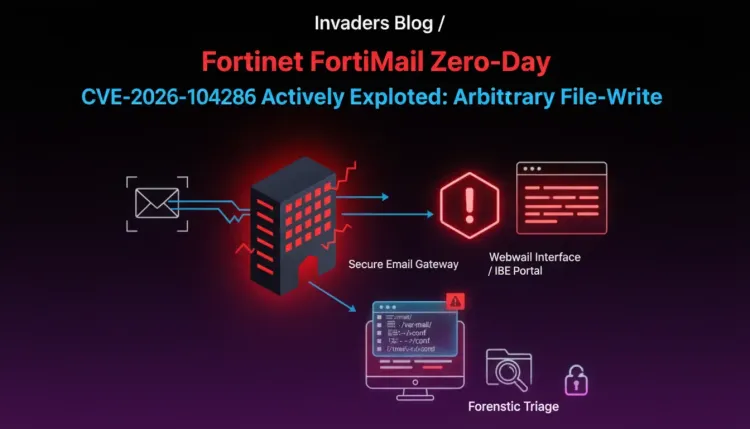
CVE-2026-104286: FortiMail File Write Zero-Day | 2026
Executive Summary
Since October 1, 2026, the critical CVE-2026-104286 vulnerability in Fortinet FortiMail has been treated as an actively exploited edge-appliance risk. Fortinet disclosed the issue in advisory FG-IR-26-175, CISA added it to the Known Exploited Vulnerabilities catalog the same day, and federal civilian agencies were given until October 4, 2026 to apply mitigations.
The flaw combines path traversal and NULL-byte handling weaknesses in FortiMail. Public advisories describe the impact as unauthenticated arbitrary file write through crafted HTTP or HTTPS requests. That is the uncomfortable part: FortiMail is an email security gateway, and gateways often sit where attackers want initial access, mail visibility, and a path deeper into the network.
For defenders, this is not just a "wait for a patch" vulnerability. The immediate work is to find exposed FortiMail systems, apply Fortinet's mitigations, check for indicators, and plan upgrades as fixed builds become available for each branch.
The Flaw: Path Traversal to Arbitrary File Write
CVE-2026-104286 is a critical Fortinet FortiMail vulnerability (CVSS 9.8) involving path traversal and improper NULL-byte handling.
An unauthenticated attacker may be able to write arbitrary files to the underlying appliance by sending crafted HTTP or HTTPS requests. Depending on where files are written and what the appliance executes or loads, arbitrary file write can become a stepping stone to persistence, credential access, webshell placement, configuration changes, or command execution.
This is especially serious for FortiMail because email gateways process sensitive message flows and are commonly reachable from semi-trusted or internet-facing paths. A compromised gateway can become a quiet observation point for messages, credentials, attachments, routing rules, and downstream attacks.
How the Exploit Works
- Reach a vulnerable FortiMail service. The attacker needs network access to an affected FortiMail web-facing component.
- Send crafted HTTP or HTTPS requests. The malicious request abuses path traversal and NULL-byte handling.
- Write files outside the intended path. The appliance may accept a file path that should have been blocked or normalized.
- Establish impact. The attacker may attempt to place or alter files that support persistence, data access, or further execution.
- Blend into gateway traffic. Because email gateways are expected to process external traffic, suspicious activity can hide among normal service exposure unless logs and filesystem indicators are reviewed.
Defenders should pay close attention to requests involving the IBE component when that feature is exposed. Public advisory summaries also call out a compensating web-application-firewall rule for POST requests to /ibe containing traversal patterns such as ../..
POST /ibe
pattern of concern: ../.
That example is a detection and mitigation clue, not a complete exploit recipe. The operational point is that IBE exposure and internet-reachable FortiMail interfaces deserve immediate review.
What Is the CVE-2026-104286 Exploitation Timeline?
| Date | Event | Status |
|---|---|---|
| October 1, 2026 | Fortinet published PSIRT advisory FG-IR-26-175 for CVE-2026-104286. | Public disclosure |
| October 1, 2026 | CISA added CVE-2026-104286 to the Known Exploited Vulnerabilities catalog. | Active exploitation signal |
| October 4, 2026 | CISA mitigation deadline for U.S. federal civilian agencies. | Remediation deadline |
| October 6, 2026 | Exposed FortiMail systems should be mitigated and checked for compromise indicators. | Continuing investigation |
Affected Versions and Upgrade Direction
The public vulnerability records and advisory summaries identify these affected FortiMail branches:
| FortiMail Branch | Affected Versions | Upgrade Direction |
|---|---|---|
| 8.0 | 8.0.0 through 8.0.1 | Upgrade to 8.0.2 or later when available |
| 7.6 | 7.6.0 through 7.6.6 | Upgrade to 7.6.7 or later when available |
| 7.4 | 7.4.0 through 7.4.8 | Upgrade to 7.4.9 or later when available |
| 7.2 | 7.2.0 through 7.2.9 | Move to 7.4 or later |
NVD also lists FortiMail 7.0.0 through 7.0.9 in the affected product information, while some advisory summaries focus on 7.2, 7.4, 7.6, and 8.0. If you still run older branches, do not assume safety from omission. Confirm directly against Fortinet's advisory, support portal, and your appliance build.
Mitigation: What to Do Before the Fix Lands Everywhere
Fortinet's mitigation guidance, reflected in public advisory summaries, centers on reducing the vulnerable surface:
- Disable the IBE feature if the organization does not require it.
- Remove FortiMail webmail and management exposure from the internet, or restrict it to trusted private networks.
- If a web application firewall sits in front of FortiMail, block POST requests to
/ibethat contain traversal sequences such as../.. - Upgrade to the fixed branch as soon as the appropriate FortiMail build is available.
- Ask managed-service providers for written confirmation that mitigations and compromise checks have been completed.
This is a case where access control matters as much as patch management. Exposing administrative or feature-specific web paths from an email gateway to broad internet sources turns a product flaw into an incident opportunity.
Detection: Check for File Changes and IBE Errors
Because arbitrary file write can support persistence, defenders should move quickly from "mitigated" to "checked." CISA's KEV entry points agencies toward forensic triage requirements, and public reporting says Fortinet published indicators for affected appliances.
Review Fortinet's advisory for the current indicator list. Public summaries mention suspicious files and configuration artifacts such as:
liblog.so
smit
webconsole
mailservice
httpd.conf
ld.so.preload
They also mention IBE decryption errors, failed internal-user login patterns, and archive-account behavior as areas to inspect. Treat those signals as leads that require confirmation against your appliance baseline.
Recommended checks:
- Preserve logs before rebooting or making destructive changes.
- Review web access logs for suspicious POST activity against IBE paths.
- Compare system files and configuration files against known-good baselines.
- Look for unexpected archive accounts or remote destinations.
- Check for authentication anomalies and mail-routing changes.
- Escalate to incident response if indicators are present.
If you find suspicious artifacts, assume the gateway may have been used as a staging point. That means the investigation should include mail access, credentials, administrative changes, network egress, and potential lateral movement.
Why Email Gateways Keep Becoming Priority Targets
Email gateways are valuable because they combine exposure, trust, and sensitive data. They inspect attachments, handle inbound and outbound mail flows, and often integrate with identity, routing, quarantine, encryption, and archiving systems.
Attackers understand this. A successful gateway compromise can provide message visibility, internal reconnaissance, credential-harvesting opportunities, and a place to hide malicious infrastructure near trusted communications.
This is why defenders should avoid treating gateway bugs as narrow product maintenance. A critical exploited gateway flaw is a boundary-security event. Mitigation, log review, and digital forensics belong in the same response plan.
Defensive Posture
The best immediate posture is simple: remove unnecessary internet exposure, disable vulnerable optional functionality, inspect for compromise, and upgrade as soon as Fortinet's fixed build is available for the deployed branch.
Teams should also use this incident to review gateway governance:
- Are management and webmail paths limited to known networks?
- Are optional features like IBE enabled only where there is a business requirement?
- Are gateway logs centralized and retained long enough for incident reconstruction?
- Are filesystem-integrity checks or configuration baselines available for FortiMail?
- Can the team quickly identify which appliances are internet exposed?
- Does the email-security runbook include forensic triage for edge-appliance compromise?
The organizations that move fastest will not be the ones with the longest patch spreadsheet. They will be the ones that already know where their gateways are, who owns them, which features are exposed, and where the logs go.
References
- https://fortiguard.fortinet.com/psirt/FG-IR-26-175
- https://www.cisa.gov/news-events/alerts/2026/10/01/cisa-adds-one-known-exploited-vulnerability-catalog
- https://nvd.nist.gov/vuln/detail/CVE-2026-104286
- https://censys.com/advisory/cve-2026-10426/
- https://thehackernews.com/2026/10/critical-fortimail-zero-day-flaw.html
FAQ
CVE-2026-104286 is a critical Fortinet FortiMail vulnerability involving path traversal and NULL-byte handling. It can allow unauthenticated arbitrary file write through crafted HTTP or HTTPS requests.
Yes. Fortinet reported exploitation in the wild, and CISA added the vulnerability to its Known Exploited Vulnerabilities catalog on October 1, 2026.
The main risk is that an attacker can write files to the FortiMail appliance without authentication. On an email gateway, that can support persistence, mail access, configuration changes, or further compromise.
Disable IBE if it is not required, restrict FortiMail web-facing access to trusted networks, inspect for indicators, and upgrade to fixed builds as soon as they are available.
This belongs in the Vulnerability category because the dominant action is mitigation, upgrade planning, and compromise triage for a specific exploited product flaw.