Next.js Critical RCE Fixes Put Self-Hosted Apps on a Short Patch Clock

Next.js Critical RCE Fixes Put Self-Hosted Apps on a Short Patch Clock
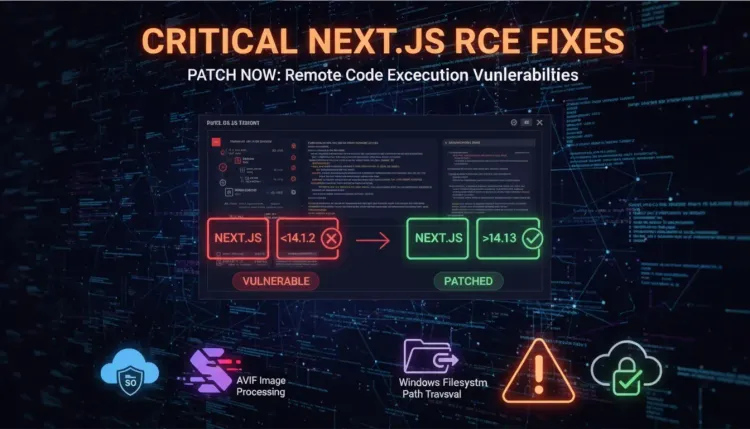
The August 2026 Next.js security release is not a routine framework bump. It fixes two critical paths to unauthenticated remote code execution in self-hosted applications, and the practical response is simple: find exposed Next.js servers, confirm whether they process AVIF images or run on Windows, and upgrade to a patched release.
Vercel published the coordinated release on August 25, 2026, with fixed versions available as Next.js 15.5.24 and 16.3.3. Hosted Vercel applications are protected by platform-level mitigations, but the release matters most for organizations running their own Next.js infrastructure, especially where application teams control framework upgrades separately from central security operations.
What was fixed
The first issue is CVE-2026-75604, tracked as GHSA-p293-qw3h-jr36. It affects Next.js applications using the Pages Router and App Router without Cache Components when the server is hosted on a Windows filesystem. GitHub's advisory rates it critical with a CVSS 3.1 score of 9.0 and says exploitation can lead to remote code execution. There is no known workaround for affected Windows-hosted applications.
The second issue, GHSA-2xp9-vwfh-vxw4, sits in the image optimization path. Next.js uses Sharp for image optimization, and the vulnerable path involves the underlying libheif library when AVIF files are optimized. GitHub rates this advisory critical with a CVSS 4.0 score of 9.5. Until the dependency fix fully propagates, patched Next.js releases disable AVIF optimization and serve AVIF files as-is.
Both advisories share the same operational lesson: framework-level security bugs are production infrastructure bugs. They are not limited to code repositories or dependency dashboards; they affect running Node.js services, preview environments, internal tools, and older applications that may still be internet reachable.
Who should move first
The highest-priority group is any team self-hosting Next.js on Windows. CVE-2026-75604 is specifically tied to Windows filesystem behavior, and the vendor advisory does not offer a configuration-only mitigation. For those servers, delaying the upgrade leaves a critical pre-authentication exposure in place.
The second priority group is broader: applications using the built-in Next.js Image Optimization API and accepting or transforming AVIF content. Even if a deployment is not Windows-hosted, the AVIF advisory can still be relevant if the vulnerable optimization path is reachable. Edge platforms may already route image processing away from the affected code path, but self-hosted teams need to verify that in their own architecture rather than assume it.
Netlify and Vercel both published provider-specific notes saying their managed platforms are not affected in the same way: Vercel disabled AVIF optimization in its managed Image Optimization service and runs Next.js on Linux, while Netlify says requests to /_next/image are rewritten to Netlify Image CDN at the edge. Those statements help customers of those platforms, but they should not be treated as blanket guidance for custom hosting.
What defenders should check
Start with inventory. Search package manifests, lockfiles, container images, and deployed artifacts for vulnerable Next.js versions. The affected ranges are >=13.4 <15.5.24 and >=16.0 <16.3.3 for CVE-2026-75604. For the AVIF optimization advisory, the affected range reaches further back: >=10.0.0 <15.5.24 and <16.3.3 on the 16.x line.
Then map runtime conditions. Identify whether any affected application is hosted on Windows, whether it exposes image optimization endpoints, whether AVIF upload or transformation is possible, and whether preview or staging environments are reachable from the internet. Security teams should include developer platforms and internal business applications in this sweep, because Next.js often powers tools outside the main customer-facing estate.
Upgrade paths are direct. Applications on Next.js 15.x or earlier should move to 15.5.24 or later. Applications on 16.x should move to 16.3.3 or later. After updating, rebuild from a fresh lockfile, redeploy, and verify the running container or server reports the patched package version. A repository merge without a deployed artifact is not remediation.
Detection and response
Neither official advisory should be read as proof that exploitation has occurred in a given environment, but critical unauthenticated RCE advisories deserve a quick hunt. Review logs for unusual requests to Next.js internals and image optimization routes, especially /_next/image. On Windows-hosted services, look for unexpected file access patterns, path traversal indicators, and child process execution from Node.js worker processes.
Endpoint telemetry can also help. Investigate unusual node.exe process trees, outbound connections from web server accounts, archive or script creation in application directories, and modifications to deployment artifacts. If there are signs of compromise, treat secrets available to the application as exposed: rotate environment variables, API keys, OAuth client secrets, database credentials, and CI/CD tokens scoped to the affected service.
This is also a useful moment to tighten framework patching as an operational control. Next.js has become infrastructure for many organizations, and critical fixes now need the same urgency as VPN, edge appliance, and identity provider updates. Put Next.js versions into asset inventory, alert on vulnerable ranges in production images, and require security release rebuilds for both mainline and preview deployments.
Bottom line
The immediate fix is to upgrade to Next.js 15.5.24 or 16.3.3 and redeploy. The deeper lesson is to treat web framework vulnerabilities as live exposure, not just dependency hygiene. If a self-hosted Next.js app is reachable, handles user-controlled images, or runs on Windows, it belongs on today's patch list.
References
- Next.js August 2026 security release
- Unauthenticated Remote Code Execution on windows-hosted servers
- Unauthenticated Remote Code Execution in Image Optimization API when AVIF files are used
- Vercel applications are protected from Next.js August 2026 security vulnerabilities
- Security Update: Two critical Next.js vulnerabilities
FAQ
The August 2026 Next.js security release is not a routine framework bump. It fixes two critical paths to unauthenticated remote code execution in self-hosted applications, and the practical response is simple: find exposed Next.js servers, confirm whether they process AVIF images or run on Windows, and upgrade to a patched release.
Neither official advisory should be read as proof that exploitation has occurred in a given environment, but critical unauthenticated RCE advisories deserve a quick hunt. Review logs for unusual requests to Next.js internals and image optimization routes, especially /next/image. On Windows-hosted services, look for unexpected file access patterns, path traversal indicators, and child process execution from Node.js...