Pack2TheRoot flaw puts Linux systems with PackageKit on a local root path

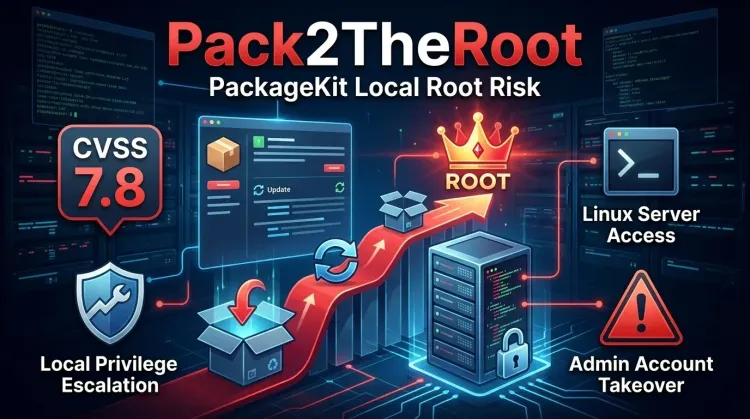
Pack2TheRoot flaw puts Linux systems with PackageKit on a local root path
The newly disclosed Pack2TheRoot issue, tracked as CVE-2026-41651, is a strong reminder that local privilege escalation bugs still deserve immediate attention when they sit in default software paths. In this case, the affected component is PackageKit, the cross-distro package management layer that ships across a wide set of Linux desktops and some server environments.
That matters because this is not a narrow lab-only edge case. Deutsche Telekom's Red Team says any local unprivileged user can abuse the flaw to install or remove packages without authorization and reach full root access on vulnerable systems. The maintainer advisory and NVD entry place the affected range at PackageKit 1.0.2 through 1.3.4, with the fix landing in 1.3.5 and distro backports.
For defenders, the right framing is not just “apply one package update.” It is “identify where PackageKit is reachable in default builds, where Cockpit may have pulled it in on servers, and where a low-privilege foothold could be converted into a full incident response event.”
What happened
According to the public disclosure, the root cause is a time-of-check time-of-use race condition in PackageKit transaction handling. The PackageKit maintainer described it succinctly on the oss-security list: a vulnerability reported by Deutsche Telekom’s Red Team can let users install or remove arbitrary packages and thereby reach a local root exploit on most systems.
NVD adds the detail that the flaw stems from how PackageKit caches transaction flags, allowing an attacker to corrupt execution state after authorization logic has already been crossed. In practice, that means a local user can abuse PackageKit to run package installation flows as root without the normal trust boundary holding.
The research team says they confirmed exploitability on multiple default installations, including:
- Ubuntu Desktop 18.04, 24.04.4, and 26.04 beta
- Ubuntu Server 22.04 to 24.04
- Debian Desktop Trixie 13.4
- Rocky Linux Desktop 10.1
- Fedora 43 Desktop and Server
That list should be treated as confirmed examples, not the whole blast radius.
Why this deserves wider exposure review
Privilege escalation bugs often get downplayed when they are “local only.” That is a mistake when the vulnerable service is broadly present and the attacker only needs an initial low-privilege foothold.
In real environments, that foothold can come from phishing, exposed developer access, weak local account hygiene, stolen VPN credentials, or another exploit that lands a limited shell. Once an attacker reaches a user context on a vulnerable host, Pack2TheRoot can become the step that turns limited access into full system compromise.
This is also why server teams should not assume they are out of scope just because PackageKit feels desktop-adjacent. Deutsche Telekom explicitly noted that PackageKit is an optional dependency of Cockpit, which means some managed Linux servers may have inherited the exposure path as part of administrative tooling.
What defenders should look at now
1. Identify systems with PackageKit installed and active
Do not assume process listings are enough. The disclosure notes that PackageKit and Cockpit can be activated on demand through D-Bus, so the safer review is package presence plus service availability. Scope desktop fleets first, then any Linux servers with Cockpit or related management tooling.
2. Patch or backport immediately
The fixed upstream release is PackageKit 1.3.5, but some distributions may ship the remediation as a backported package rather than a clean version jump. Validate the vendor package state, not just the upstream version string.
3. Review for signs of attempted abuse
The researchers shared a useful detection clue: successful exploitation can crash the PackageKit daemon with an assertion failure visible in system logs. That makes this one of the more practical local vulnerability stories to hunt after disclosure. If you find those log patterns on exposed or shared systems, treat them as potential compromise indicators rather than routine instability.
4. Revisit least-privilege assumptions on Linux estates
Pack2TheRoot is a good example of why “local user” should not be treated as a safe boundary. On multi-user systems, developer jump boxes, lab servers, VDI, and contractor-access hosts, a local user context can still be a meaningful attacker objective because it may enable lateral movement or privilege escalation into more sensitive workflows.
Strategic takeaway
Pack2TheRoot is not the loudest bug this month, but it is exactly the kind of issue defenders regret deprioritizing. It spans many Linux distributions, sits in a trusted system-management path, and turns a modest foothold into root access.
The smart response is to treat CVE-2026-41651 as a broad exposure assessment item:
- patch the vulnerable PackageKit path
- check whether Cockpit-linked systems inherited the risk
- review logs for assertion-failure indicators
- treat shared Linux systems as higher priority than they may first appear
If your organization runs mixed Linux fleets, this is one to clear quickly before public exploit details mature further.
References
FAQ
Pack2TheRoot is the name given to CVE-2026-41651, a high-severity local privilege escalation flaw in PackageKit that can let unprivileged users install packages as root.
Public advisories say versions 1.0.2 through 1.3.4 are affected. The fix is in 1.3.5 and in distribution-specific patched packages.
No. While PackageKit is common on desktops, Deutsche Telekom notes that servers using Cockpit may also be exposed where PackageKit is installed and enabled.
Identify systems with PackageKit present, confirm patched package levels, and review logs for PackageKit assertion failures that may indicate exploit attempts.
How to cite
Lucas Oliveira. Pack2TheRoot flaw puts Linux systems with PackageKit on a local root path. 17 Aug 2026. Invaders Cybersecurity. https://invaders.ie/resources/blog/vulnerability/pack2theroot-packagekit-local-root-risk.
Subscribe via RSS.
Written by
Lucas Oliveira
Research
A DevOps engineer and cybersecurity enthusiast with a passion for uncovering the latest in zero-day exploits, automation, and emerging tech. I write to share real-world insights from the trenches of IT and security, aiming to make complex topics more accessible and actionable. Whether I’m building tools, tracking threat actors, or experimenting with AI workflows, I’m always exploring new ways to stay one step ahead in today’s fast-moving digital landscape.
Hot TopicsLast 7 days
Categories
Stay Updated
Get the latest cybersecurity insights delivered to your inbox.