VMware vCenter RCE exploitation turns syslog exposure into persistence risk

VMware vCenter RCE exploitation turns syslog exposure into persistence risk
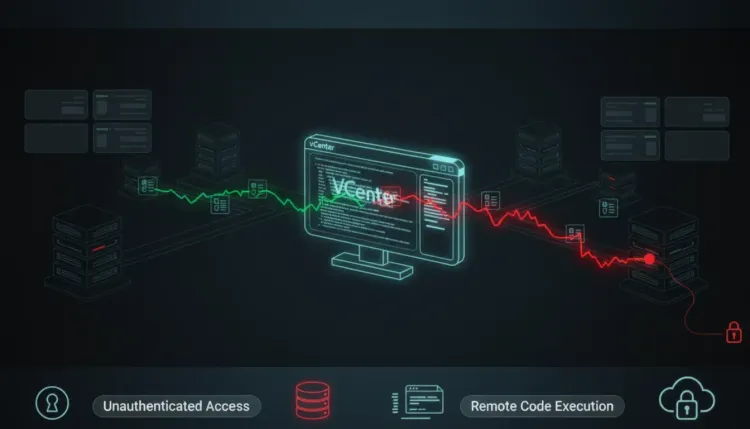
VMware vCenter administrators should treat CVE-2026-59310 as more than a routine vulnerability patch. The flaw affects the vCenter Syslog Server component and is now associated with active exploitation reports where attackers used compromised systems for reverse SSH persistence.
Broadcom disclosed the issue on July 29, 2026 in advisory VMSA-2026-0006, assigning CVE-2026-59310 a CVSS v3.1 score of 9.8. The vendor describes it as a directory traversal vulnerability that can let a malicious actor with network access to vCenter execute arbitrary code.
That combination is uncomfortable: network reachability, no required authentication in the CVSS vector, critical severity, and exploitation reported within days of disclosure. For defenders, the right response is not only "install the update." It is "assume exposed vCenter systems may already need incident response review."
What happened
Broadcom's advisory covers multiple VMware and Broadcom products, including ESX, vCenter, Workstation, Fusion, VMware Cloud Foundation, VMware vSphere Foundation, VMware Telco Cloud Platform, and VMware Telco Cloud Infrastructure. The most urgent vCenter issue in this post is CVE-2026-59310, a directory traversal bug in the Syslog Server component that can lead to arbitrary code execution.
The U.S. National Vulnerability Database describes the same issue as a vCenter Syslog Server directory traversal flaw. NVD lists the CVSS vector as AV:N/AC:L/PR:N/UI:N/S:U/C:H/I:H/A:H, which means network attack vector, low attack complexity, no privileges required, and no user interaction.
Rapid7's analysis of Broadcom's July advisory highlights CVE-2026-59310 alongside CVE-2026-59309, another critical vCenter issue. Rapid7 notes that both vCenter flaws carry CVSS scores of 9.8 and can be exploited by unauthenticated attackers with network access to vulnerable vCenter Server deployments.
The risk then moved from theoretical to operational. Reporting from The Hacker News and BleepingComputer says threat actors began exploiting CVE-2026-59310 after patches were released, with observed activity involving reverse SSH access for persistence and remote control. BleepingComputer reported that compromises were identified across hundreds of IP addresses in dozens of countries.
Why vCenter changes the blast radius
vCenter is not just another server in the rack. It is a management plane for virtual infrastructure. In many environments it can administer ESXi hosts, virtual machines, networking, storage, identity integrations, backup workflows, and privileged operational tasks.
That is why remote code execution on vCenter is so serious. If an attacker can execute code on the management layer, the next stage may involve credential discovery, persistence, host-level access, VM tampering, backup disruption, or movement into adjacent systems.
The reported use of reverse SSH also matters. Reverse tunnels are attractive to attackers because they can create outbound paths from a compromised system to attacker-controlled infrastructure. That can bypass some inbound firewall expectations and give the attacker a durable control channel even after the initial exploit path is patched.
In plain terms: patching closes the front door, but defenders still need to check whether someone already opened a side door.
Who should prioritize this
Organizations should put this near the top of the queue if they run internet-reachable or broadly reachable vCenter deployments, especially where the Syslog Server component can be reached from untrusted networks.
Priority should go to:
- vCenter instances reachable from user, partner, VPN, or internet-adjacent networks
- VMware environments that manage production workloads
- vCenter deployments connected to identity providers or privileged service accounts
- Environments where vCenter can influence backup, recovery, or disaster-recovery operations
- Organizations with limited egress monitoring from management networks
- Any system that was exposed between Broadcom's July 29 disclosure and the current patch window
The practical question is not only whether the version is vulnerable. It is whether the management plane was reachable during the exploitation window and whether outbound persistence would be visible.
Immediate defensive actions
First, apply Broadcom's fixed versions for affected products. The vendor advisory is the authoritative source for product versions and remediation details, and it should be used to confirm the correct target version for each environment.
Second, reduce vCenter reachability. vCenter should not be broadly exposed. Limit access to dedicated admin networks, VPN segments, bastion hosts, or zero-trust access paths. If a vCenter endpoint is reachable from general user networks, treat that as a priority architecture issue, not merely an exception.
Third, review for post-exploitation. The exploitation reports make this an exploit and persistence problem, not just a patch-management item.
Useful checks include:
- Review vCenter appliance logs for unusual Syslog Server activity.
- Look for unexpected file writes, cron entries, startup scripts, or service changes.
- Hunt for reverse SSH binaries, scripts, or command lines.
- Review outbound SSH connections from vCenter or management VLANs.
- Check for new local users, SSH keys, scheduled tasks, or altered admin settings.
- Review vCenter events for unusual privilege changes, host changes, VM operations, or failed/successful logins.
- Compare current network flows from vCenter against known management destinations.
- Rotate credentials that may have been exposed through vCenter or adjacent management tooling.
An example Linux hunt for obvious reverse SSH artifacts:
find / -xdev -type f \( -iname '*reverse*ssh*' -o -iname '*revssh*' -o -iname '*rshell*' \) 2>/dev/null
ps auxww | grep -Ei 'reverse_ssh|revssh|ssh .* -R|autossh'
crontab -l 2>/dev/null
ls -la /etc/cron* /var/spool/cron 2>/dev/null
Those commands are only starting points. Real investigation should preserve evidence, account for the appliance's supported management model, and avoid destructive cleanup before responders understand the timeline.
What to monitor next
Defenders should watch for three classes of activity.
The first is direct exploit traffic. That may be visible in perimeter telemetry, reverse proxies, vCenter logs, or network sensors if management networks are monitored.
The second is persistence. Reverse SSH, unusual outbound TCP sessions, new keys, unexpected processes, cron jobs, and unfamiliar service files deserve attention. A management appliance that suddenly starts initiating SSH-like outbound traffic to an unknown address should be investigated quickly.
The third is management-plane abuse. Look for unusual VM snapshots, exports, power operations, host configuration changes, datastore access, permission changes, and new privileged accounts. If vCenter was compromised, the attacker may not stop at the appliance.
Reduce future exposure
CVE-2026-59310 reinforces a familiar defensive lesson: management planes need stronger isolation than ordinary application servers. They should be patched quickly, but they should also be difficult to reach in the first place.
Practical improvements include:
- Keep vCenter on a restricted management network.
- Require strong MFA-backed admin access through controlled entry points.
- Monitor outbound traffic from management appliances.
- Restrict appliance egress to known update, logging, backup, and identity destinations.
- Maintain tested backups and recovery plans for vCenter and ESXi configuration.
- Centralize logs from vCenter and preserve them outside the appliance.
- Review privileged service accounts and remove stale integrations.
- Document who can administer vCenter and alert on privilege changes.
The goal is to make exploitation harder, persistence noisier, and recovery less dependent on the system that may have been compromised.
The takeaway
CVE-2026-59310 is a reminder that infrastructure management platforms compress risk. A critical unauthenticated RCE in vCenter is not just a server compromise. It is a possible control-plane incident.
Organizations should patch immediately, restrict reachability, and hunt for signs of reverse SSH persistence or management-plane abuse. If vCenter was reachable during the exposure window, defenders should treat the response as both vulnerability management and incident review.
References
- VMSA-2026-0006
- CVE-2026-59310 Detail
- CVE Record: CVE-2026-59310
- Critical VMware vCenter Vulnerabilities Allow Authentication Bypass and Remote Code Execution
- Attackers Exploit VMware vCenter Vulnerability to Gain Persistent Remote Access
- Critical VMware vCenter RCE flaw exploited for reverse SSH access
How to cite
Lucas Oliveira. VMware vCenter RCE exploitation turns syslog exposure into persistence risk. 16 Aug 2026. Invaders Cybersecurity. https://invaders.ie/resources/blog/vulnerability/vmware-vcenter-cve-2026-59310-syslog-rce-persistence.
Subscribe via RSS.
Written by
Lucas Oliveira
Research
A DevOps engineer and cybersecurity enthusiast with a passion for uncovering the latest in zero-day exploits, automation, and emerging tech. I write to share real-world insights from the trenches of IT and security, aiming to make complex topics more accessible and actionable. Whether I’m building tools, tracking threat actors, or experimenting with AI workflows, I’m always exploring new ways to stay one step ahead in today’s fast-moving digital landscape.
Hot TopicsLast 7 days
Categories
Stay Updated
Get the latest cybersecurity insights delivered to your inbox.