BlackCat case shows ransomware risk inside trusted cyber roles

BlackCat case shows ransomware risk inside trusted cyber roles
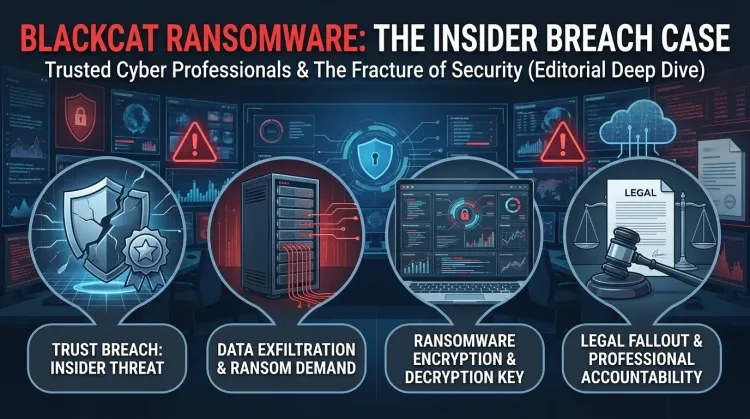
A new U.S. criminal case tied to BlackCat (ALPHV) is a sharp reminder that ransomware risk is not always only external. According to public reporting, two former cybersecurity professionals were sentenced to four years in prison for helping conduct BlackCat ransomware attacks in 2023, despite holding roles in the incident-response and ransomware-negotiation ecosystem.
That matters because it turns a familiar threat story into a governance story. When people trusted to help organizations survive a crisis instead help run the extortion playbook, the problem expands beyond malware and data breach risk. It becomes a trust, oversight, and response-integrity problem inside the wider cyber-defense supply chain.
What the case says happened
Reporting from The Hacker News and BleepingComputer says Ryan Goldberg, a former incident response manager at Sygnia, and Kevin Martin, a former ransomware negotiator at DigitalMint, were sentenced after pleading guilty to conspiracy to obstruct commerce by extortion.
The public reporting says the two, together with Angelo Martino, acted as BlackCat affiliates in 2023 and paid a 20% share of ransoms to the ALPHV operators in exchange for access to the ransomware and extortion platform. One victim reportedly paid about $1.27 million, with the proceeds later split among the conspirators after laundering.
The victim set described in public reporting includes organizations in pharmaceuticals, medical devices, engineering, drone manufacturing, and healthcare. That industry spread is important because it shows again how ransomware operators target sectors where downtime carries real business and safety pressure.
Why this case stands out
1. The attackers allegedly understood the response market from the inside
This is the most uncomfortable part of the story. Negotiation and incident response roles give practitioners visibility into victim behavior, escalation patterns, likely pressure points, and the economics of recovery. In the wrong hands, that knowledge can sharpen extortion strategy.
2. Trust in crisis partners is part of the attack surface
Organizations tend to focus on hardening endpoints, identity, and backups. They spend less time thinking about whether the broader response chain has the right controls, separation of duties, and auditability. This case suggests that trust relationships during a breach deserve more scrutiny.
3. Ransomware is still a business model, not just a technical event
The public details underline how structured the BlackCat model was: platform access, revenue sharing, victim targeting, and payment laundering. That reinforces a core lesson from years of threat intelligence: ransomware operations behave like organized commercial ecosystems.
The bigger lesson for defenders
This case should not be read only as a law-enforcement headline. It should push defenders and executives to ask uncomfortable operational questions:
- Who has access to the most sensitive details during an incident?
- How are negotiator, responder, and legal workflows logged and reviewed?
- What controls exist around insurance-limit visibility, ransom communications, and privileged case information?
- How much of the response chain depends on trust rather than verifiable process?
If an attacker or insider understands both the technical pressure points and the commercial psychology of ransomware events, the extortion leverage gets stronger.
Timeline and context
| Date | Event | Status |
|---|---|---|
| 2023-05 to 2023-11 | Public reporting says the conspirators acted as BlackCat affiliates against multiple U.S. victims | ⚠️ Intrusions and extortion |
| 2025-12 | The two defendants plead guilty according to reporting | ✅ Guilty plea |
| 2026-04 | A third co-conspirator also pleads guilty | 📢 Case development |
| 2026-05 | Two former cybersecurity professionals are sentenced to four years in prison | 🔴 Sentencing |
What organizations should do now
🔴 Review third-party response governance
- Reassess oversight for ransomware negotiators, incident responders, and other crisis partners.
- Make sure sensitive case details are shared on a least-privilege basis.
- Require auditable workflows for major decisions, data access, and outbound negotiations.
🔴 Reduce insider leverage during incidents
- Separate financial, technical, and negotiation responsibilities where possible.
- Log access to insurance details, ransom deliberations, and high-sensitivity investigation material.
- Use peer review for critical response decisions instead of concentrating authority in a single role.
🟠 Treat response partners as part of your supply chain
- Apply due diligence, contractual controls, and periodic review to firms involved in breach response.
- Ask how they monitor for conflicts of interest, policy violations, and unauthorized data access.
- Validate who can access victim data, negotiation transcripts, and recovery plans.
🟠 Keep the core ransomware basics strong
- Maintain offline or well-isolated backups.
- Exercise restoration paths before a crisis.
- Preserve evidence and engage counsel early if extortion occurs.
Strategic takeaway
The BlackCat sentencing matters because it exposes a blind spot in many security programs: defenders often assess technical control failure more rigorously than trust failure inside the response ecosystem. Ransomware defense is not only about preventing initial access. It is also about ensuring that the people brought in to help during the worst day are governed as carefully as the systems they touch.
For boards, security leaders, and legal teams, that means one practical shift: include crisis-partner oversight, auditability, and insider-risk thinking in the ransomware playbook before the next incident starts.
References
FAQ
Because the defendants reportedly held trusted cybersecurity roles connected to incident response and ransomware negotiation. That changes the lesson from pure cybercrime reporting to a broader trust-and-governance warning.
No. It means organizations should treat crisis partners as high-trust suppliers and apply oversight, auditability, and least-privilege controls accordingly.
Strengthen governance around who can access sensitive incident information, who can influence negotiations, and how third-party responders are supervised during a live breach.
How to cite
Lucas Oliveira. BlackCat case shows ransomware risk inside trusted cyber roles. 17 Aug 2026. Invaders Cybersecurity. https://invaders.ie/resources/blog/cybercrime/blackcat-ransomware-trusted-cyber-roles-risk.
Subscribe via RSS.
Written by
Lucas Oliveira
Research
A DevOps engineer and cybersecurity enthusiast with a passion for uncovering the latest in zero-day exploits, automation, and emerging tech. I write to share real-world insights from the trenches of IT and security, aiming to make complex topics more accessible and actionable. Whether I’m building tools, tracking threat actors, or experimenting with AI workflows, I’m always exploring new ways to stay one step ahead in today’s fast-moving digital landscape.
Hot TopicsLast 7 days
Categories
Stay Updated
Get the latest cybersecurity insights delivered to your inbox.