FBI seizes Handala sites after destructive Stryker hack

FBI seizes Handala sites after destructive Stryker hack | 2026
Executive Summary
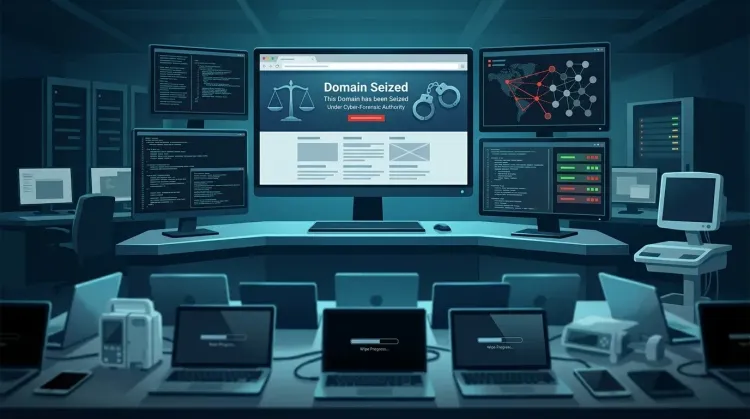
The FBI and U.S. Department of Justice have seized two websites linked to Handala, a pro-Iranian hacktivist group that recently claimed responsibility for a destructive cyberattack on Stryker. According to TechCrunch, one site was used to publicize the group’s operations and another was used to publish personal information about people allegedly tied to Israeli military and defense contractors.
The law enforcement action matters for defenders for two reasons. First, it shows that U.S. authorities are willing to disrupt the public infrastructure used by politically aligned threat groups. Second, the underlying Stryker incident is a useful reminder that compromise of a privileged admin account and abuse of enterprise device-management tooling can produce fast, large-scale operational impact without the attacker needing custom destructive malware.
What happened?
On March 19, 2026, seizure banners replaced two Handala-linked websites. The notice stated that U.S. authorities determined the domains were used to conduct, facilitate, or support malicious cyber activity “on behalf of, or in coordination with, a foreign state actor.” TechCrunch also reported that the domains’ nameserver records had been updated to infrastructure controlled by the FBI.
Handala later acknowledged on Telegram that its sites had been taken offline and described the seizure as censorship. The group’s X account was also reportedly suspended.
The takedown came days after Handala claimed responsibility for a destructive attack on Stryker. TechCrunch reported that the attackers allegedly compromised an internal Stryker administrator account, gained near-unlimited access to the company’s Windows network, and then abused Microsoft Intune dashboards to remotely wipe managed devices.
Stryker had already said earlier in the week that it was still restoring computers and parts of its internal network.
What is confirmed, and what is still a claim?
Defenders should separate confirmed reporting from attacker narrative:
Confirmed in the source reporting
- Two Handala-linked websites were seized and replaced with FBI/DOJ banners.
- The seizure language referenced malicious cyber activity tied to a foreign state actor.
- Handala publicly acknowledged the takedown on Telegram.
- Stryker said it was still restoring systems after the incident.
Reported as attacker-linked or not independently verified in the article
- That Handala broke into a Stryker internal administrator account.
- That the group obtained near-unlimited Windows network access.
- That the attackers used Intune dashboards to wipe company and employee-owned devices.
- The full scope of compromise and how access was originally obtained.
That distinction matters for threat intelligence and incident response. The tactical lesson is still valuable even where some specifics remain based on reporting about the group’s claims.
Why this incident matters
This is not just another website seizure story. The more important lesson is the reported use of legitimate enterprise administration paths to create destructive impact.
If an attacker can compromise a privileged account tied to identity and endpoint management, they may be able to:
- wipe or retire endpoints at scale,
- push malicious or disruptive configuration changes,
- block user access during recovery,
- and slow containment by turning trusted tools into attack infrastructure.
For most organizations, that is a higher-probability risk than cinematic wiper malware. It is also one that often hides inside normal-looking admin actions until defenders review the right logs.
Likely attack path
Based on the source reporting, the likely chain looks like this:
- Admin account compromise provides access to high-impact management functions.
- Privilege abuse expands control inside the Windows and device-management environment.
- Intune console abuse allows remote actions against managed laptops and mobile devices.
- Destructive operations disrupt users and internal operations by wiping or disabling endpoints.
- Recovery pressure shifts the defender focus from investigation to business restoration.
Even when details are still emerging, this pattern is familiar: valid access plus centralized administration can be enough to create enterprise-wide disruption.
Detection priorities
If your environment relies on Microsoft 365, Entra ID, Intune, or similar management platforms, review the following now.
Identity and admin activity
- High-risk sign-ins involving admin accounts
- New or unusual locations, IP ranges, or device fingerprints for privileged access
- Role changes, consent changes, or emergency admin elevation
- Weak or missing multi-factor authentication on high-impact administrators
Intune and device-management telemetry
- Remote wipe, retire, reset, or bulk action events
- Sudden policy deployments affecting many devices
- Enrollment or compliance changes tied to unusual operators
- Device actions outside normal support windows or approval workflows
Endpoint and recovery telemetry
- Large numbers of devices going offline at once
- Re-enrollment spikes or mass rebuild requests
- Abrupt loss of endpoint telemetry from a business unit or region
- Signs that remote actions were initiated from legitimate admin tooling rather than malware
Immediate containment steps
If you suspect admin-tool abuse in your own environment, move fast:
0–24 hours
- Isolate or suspend suspected compromised admin accounts.
- Rotate credentials, refresh tokens, and break-glass access paths where appropriate.
- Review Intune, Entra ID, and Microsoft 365 audit logs for destructive actions.
- Preserve evidence for digital forensics before broad cleanup.
- Confirm backup, rebuild, and endpoint re-enrollment capacity.
- Validate whether attackers touched only managed devices or also identity, email, and file services.
24–72 hours
- Restrict device-management roles to hardened dedicated accounts.
- Enforce stronger conditional access for administrative portals.
- Add detections for unusual volumes of wipe, retire, or policy-change actions.
- Review whether admins can act on personal/BYOD devices and reduce scope if possible.
- Test communications and business continuity procedures for mass endpoint disruption.
Strategic takeaway
The FBI’s seizure of Handala’s sites may reduce the group’s public reach and leak infrastructure, but it does not erase the core lesson from the Stryker incident. Destructive impact can come from abuse of trusted administrative planes, not just from custom malware or ransomware.
That means defenders should treat identity, MDM, and remote management consoles as critical attack surfaces. If those platforms are compromised, lateral movement, operational disruption, and prolonged recovery can follow very quickly.
References
FAQ
According to the seizure banner cited by TechCrunch, U.S. authorities determined the domains were used to support malicious cyber activities on behalf of, or in coordination with, a foreign state actor.
No. The source article separates confirmed operational disruption from several detailed claims attributed to the threat group and reporting around the incident.
Start with privileged identity activity, Intune or equivalent device-management logs, and any evidence of bulk remote actions against endpoints.
Because centralized device-management tooling can be used to create destructive impact at scale if attackers gain the right level of administrative access.
How to cite
Lucas Oliveira. FBI seizes Handala sites after destructive Stryker hack. 17 Aug 2026. Invaders Cybersecurity. https://invaders.ie/resources/blog/threat-hunting-and-intel/fbi-seizes-handala-sites-after-destructive-stryker-hack.
Subscribe via RSS.
Written by
Lucas Oliveira
Research
A DevOps engineer and cybersecurity enthusiast with a passion for uncovering the latest in zero-day exploits, automation, and emerging tech. I write to share real-world insights from the trenches of IT and security, aiming to make complex topics more accessible and actionable. Whether I’m building tools, tracking threat actors, or experimenting with AI workflows, I’m always exploring new ways to stay one step ahead in today’s fast-moving digital landscape.
Hot TopicsLast 7 days
Categories
Stay Updated
Get the latest cybersecurity insights delivered to your inbox.