Swiss SharePoint breach shows why patching alone may not end the incident

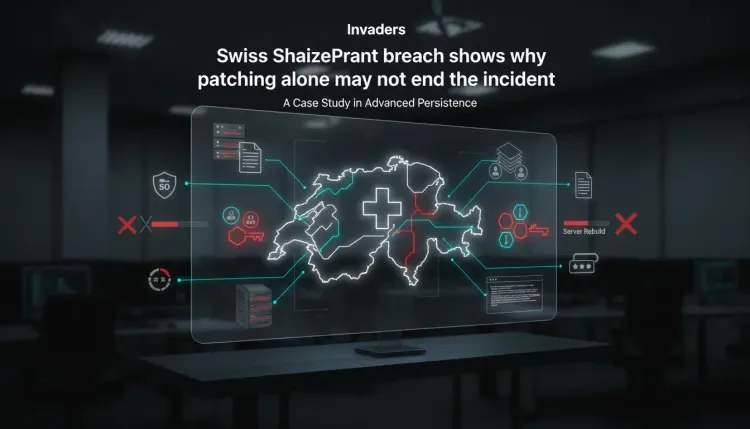
Swiss SharePoint breach shows why patching alone may not end the incident
Switzerland's federal IT office has confirmed a cyberattack against SharePoint servers used by the federal administration, with data linked to around 200 user and technical accounts accessed by unknown attackers. The incident is a practical reminder that vulnerable collaboration platforms are not only document stores. They sit close to identity, credentials, workflows, and internal trust.
The Federal Office of Information Technology, Systems and Telecommunication, often referenced as BIT or FOITT in English reporting, detected abnormal activity on its SharePoint environment on July 28, 2026. By July 31, investigators had confirmed unauthorized access affecting roughly 200 accounts. Authorities blocked internet access to the affected SharePoint servers, reset impacted passwords, and brought Microsoft into the investigation.
The initial access vector has not been publicly pinned to a single CVE. Swiss officials and subsequent reporting point to recently disclosed Microsoft SharePoint vulnerabilities as the likely path. That matters because the July 2026 SharePoint exploitation wave included bugs where ordinary patching may remove the vulnerable code but still leave defenders with stolen credentials, copied data, or exposed server-side cryptographic material.
For defenders, this is the real story: patching is the beginning of incident response, not the end.
What happened
Public reporting says the affected environment was a SharePoint platform operated for Switzerland's federal administration. BIT noticed unusual activity on July 28 and later confirmed that attackers had accessed data from about 200 user and technical accounts.
Authorities said confidential information and particularly sensitive personal data should not be stored on that SharePoint platform. That narrows the reported data exposure, but it does not make the incident minor. Technical accounts can carry permissions, automation paths, service context, and operational metadata. User accounts can reveal internal documents, collaboration patterns, and access relationships. Even a limited SharePoint breach can become useful reconnaissance for follow-on attacks.
The response also shows that the incident was treated as more than a routine patch event. Reported containment steps included blocking internet access to the affected SharePoint servers for external users, resetting affected passwords, and reinstalling affected servers as a precaution.
Those are the right instincts when the target is a high-trust collaboration platform.
Why SharePoint breaches can outlive the patch
On-premises SharePoint has been under heavy attention because recent flaws in the same ecosystem allowed remote code execution and post-exploitation access paths. One of the most important July cases, CVE-2026-50522, was reported as an unauthenticated remote code execution issue that attackers used to steal IIS machine keys from vulnerable SharePoint servers.
Machine keys matter because they help protect and validate authentication state in ASP.NET applications. If attackers obtain them, they may be able to forge valid authentication tokens and impersonate users. In practical terms, this can let an attacker maintain access even after the software vulnerability has been patched.
That changes the defender playbook. A normal vulnerability response asks, "Did we install the update?" A SharePoint compromise asks harder questions:
- Were web server machine keys, signing material, or service credentials exposed?
- Were user or technical accounts accessed before the patch landed?
- Did attackers create web shells, scheduled tasks, new users, malicious workflows, or persistence artifacts?
- Were documents, configuration files, or internal URLs copied?
- Were tokens or cookies forged after the patch window?
If those questions are unanswered, the organization has not finished the response.
The account angle is the warning sign
The Swiss case involved roughly 200 user and technical accounts. That detail is important because attackers often use collaboration platforms as identity maps. SharePoint can reveal which departments work together, which technical accounts touch which applications, which service identities have broad read permissions, and where sensitive operational documents live.
Technical accounts deserve special attention. They are often older, less visible, or treated as plumbing rather than privileged access. In reality, a compromised technical account can provide access to automation jobs, backups, application integrations, and internal repositories. That makes access control review part of the breach response, not a later governance task.
Password resets are necessary, but they may not be sufficient. Defenders should also revoke sessions, rotate service secrets, review application registrations and integrations, and check whether any exposed account had access beyond SharePoint itself.
What defenders should do now
Organizations running on-premises SharePoint should first confirm that every server in every farm has received the relevant July 2026 Microsoft security updates. Verification matters. SharePoint farms can contain multiple servers, legacy nodes, test systems, disaster recovery targets, and forgotten internet-facing endpoints. A single unpatched member can keep the exposure alive.
Next, treat any suspicious exposure as a compromise investigation:
- Enable and verify Antimalware Scan Interface integration for every SharePoint web application.
- Review Microsoft Defender and AMSI detections tied to SharePoint exploitation.
- Hunt web logs for unusual requests to sign-in, ToolPane, deserialization, or administrative endpoints.
- Look for unexpected files in SharePoint web roots, template directories, upload paths, and application folders.
- Check for new or modified scheduled tasks, web shells, IIS modules, timer jobs, workflows, and service accounts.
- Rotate IIS machine keys after hunting for artifacts and confirming the server state.
- Reset affected passwords and revoke active sessions.
- Rotate exposed service-account credentials, application secrets, and integration tokens.
- Rebuild or reinstall servers when compromise cannot be confidently scoped.
The order matters. If defenders rotate keys before they understand persistence, attackers may still be sitting on the server and able to capture the new material. Hunt, contain, eradicate, then rotate.
Reduce the next blast radius
The defensive lesson extends beyond this Swiss incident. Collaboration platforms should be segmented like high-value infrastructure. They hold documents, but they also expose relationships, identity context, internal URLs, and workflow logic. Internet-facing SharePoint should be treated with the same seriousness as VPN, identity, CI/CD, and remote management platforms.
Practical hardening steps include:
- Remove unnecessary internet exposure from on-premises SharePoint.
- Put administrative access behind strong conditional access and network controls.
- Separate service accounts by function and remove broad shared permissions.
- Keep machine keys and secrets under documented rotation procedures.
- Monitor technical-account behavior with the same priority as human administrator behavior.
- Maintain a tested rebuild path for SharePoint servers, not only a patch path.
- Keep server inventories current enough to find every farm member during emergency patching.
The goal is not only to make exploitation harder. It is to make post-exploitation easier to contain.
The takeaway
The Swiss SharePoint breach is not just a public-sector incident. It is a clean example of why enterprise collaboration platforms are valuable targets. Attackers do not need every file in a system to create leverage. A few hundred accounts, a technical identity, or a stolen key can be enough to keep moving.
For security teams, the response pattern should be clear: patch SharePoint quickly, but do not stop there. Validate every server, hunt for artifacts, rotate credentials and machine keys when exposure is plausible, and rebuild systems when trust cannot be restored. In this class of incident, the patch closes the door. The investigation tells you whether someone already walked through it.
References
- Swiss government SharePoint breach compromised 200 accounts
- 200 accounts compromised in Swiss government's Microsoft SharePoint breach
- Another SharePoint RCE exploited: Patch, then rotate your machine keys (CVE-2026-50522)
- CVE-2026-58644: Microsoft SharePoint Server Unauthenticated Remote Code Execution Vulnerability Exploited in the Wild
- Critical SharePoint RCE flaw exploited to steal machine keys
How to cite
Lucas Oliveira. Swiss SharePoint breach shows why patching alone may not end the incident. 9 Aug 2026. Invaders Cybersecurity. https://invaders.ie/resources/blog/vulnerability/swiss-sharepoint-breach-shows-why-patching-alone-may-not-end-the-incident.
Subscribe via RSS.
Written by
Lucas Oliveira
Research
A DevOps engineer and cybersecurity enthusiast with a passion for uncovering the latest in zero-day exploits, automation, and emerging tech. I write to share real-world insights from the trenches of IT and security, aiming to make complex topics more accessible and actionable. Whether I’m building tools, tracking threat actors, or experimenting with AI workflows, I’m always exploring new ways to stay one step ahead in today’s fast-moving digital landscape.
Hot TopicsLast 7 days
Categories
Stay Updated
Get the latest cybersecurity insights delivered to your inbox.