cPanel CVE-2026-65643 turns domain parking into a root-control risk

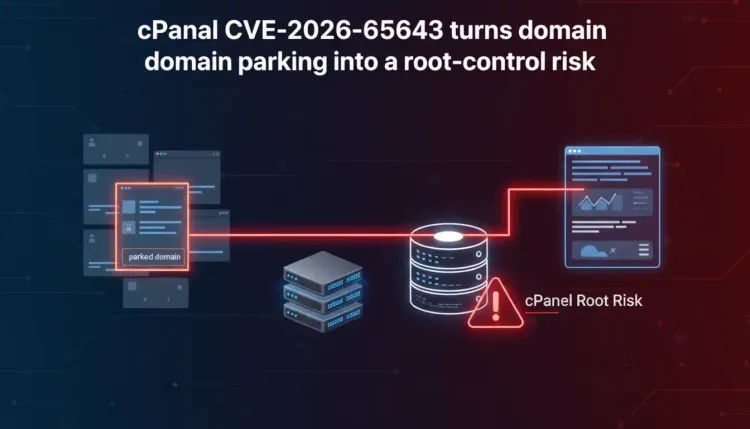
cPanel CVE-2026-65643 turns domain parking into a root-control risk
cPanel has disclosed CVE-2026-65643, a critical vulnerability in domain parking functionality that changes the risk model for shared hosting servers. The issue is not just that a control-panel feature has a bug. It is that a routine hosting permission can become a path from one authenticated account to root-level code execution on the underlying server.
The advisory was published on August 27, 2026. cPanel says the flaw affects all supported versions of cPanel & WHM and that an authenticated account holder who can add parked or addon domains can create arbitrary files on the server. The stated impact is severe: successful exploitation leads to code execution as the root user, with control over the server and every account, website, and database on it.
That makes this a priority item for hosting providers, resellers, managed service providers, and any organization that runs cPanel & WHM in a multi-tenant environment. Domain parking and addon domains are normal features. In shared hosting, normal features often sit close to the isolation boundary between customers. CVE-2026-65643 is dangerous because it appears to cross that boundary.
What happened
cPanel's advisory describes a flaw in the domain parking path used by cPanel & WHM. The vulnerable condition allows an authenticated cPanel account holder with permission to add parked or addon domains to create arbitrary files on the server.
The exact exploit mechanics have not been publicly detailed by cPanel. The advisory does not provide a payload, vulnerable endpoint, CVSS score, compromise-check procedure, or interim mitigation. It does, however, state the outcome clearly enough for defenders to act: arbitrary file creation can lead to root code execution.
The patched versions listed by cPanel are:
11.110.0.141or later11.134.0.53or later11.136.0.37or later11.138.0.2or later- WP Squared
11.138.1.7or later
The product scope matters. This is not a single optional plugin or a niche feature branch. cPanel says all supported cPanel & WHM versions are affected.
Why this is serious for shared hosting
Shared hosting depends on access control boundaries that let one customer manage their own site without touching another customer's data, configuration, or applications. A flaw that starts from an ordinary authenticated account and ends at root breaks the core promise of that model.
If an attacker can obtain or rent a low-privilege hosting account with domain-management rights, they may not need to compromise WHM administrator credentials first. The initial access can be mundane: a legitimate account, a reseller-created account, a stolen customer login, or an account obtained through a weak onboarding process.
From there, arbitrary file creation is the key pivot. On a Unix-like hosting server, the ability to create files outside the expected account boundary can become much more than file clutter. Depending on the writable path and execution context, it may enable persistence, code execution, privilege escalation, configuration poisoning, or tampering with services that run as privileged users.
That is why cPanel's root-code-execution impact statement should be treated as the controlling fact, even without public exploit details.
The tenant-to-root problem
The most important way to think about CVE-2026-65643 is as a tenant-to-root escalation path.
In a typical cPanel environment, the expected trust layers look like this:
- one hosting customer controls their own account
- WHM/root controls the server
- other customers remain isolated from that account
- databases, websites, mailboxes, and files are separated by ownership and permission boundaries
CVE-2026-65643 threatens that separation. If one authenticated account can create arbitrary files at the server level and turn that into root execution, a compromise no longer stays inside one website. It can become a full platform incident.
That changes the incident response question. Teams should not only ask whether a vulnerable customer site was abused. They should ask whether the hosting node itself can still be trusted, and whether other tenants on that node may have been exposed.
Exploitation status is still an open point
As of August 28, 2026, the public record is still thin. cPanel's advisory does not say whether exploitation has been observed. The Hacker News reported that, at the time of its check, the CVE Program had not published a record for CVE-2026-65643, and the issue was not listed in CISA's Known Exploited Vulnerabilities catalog.
That does not make the bug safe to defer. It means defenders should separate two things:
- severity: high enough to patch immediately because root code execution is the stated impact
- exploitation evidence: not publicly confirmed by the advisory at the time of writing
This is also not a moment to chase random "working exploit" claims. Until a credible technical write-up exists, unverified scripts should be treated as hostile or misleading.
What administrators should do now
The first action is simple: update cPanel & WHM to a patched build. Servers on automatic daily updates should receive the fixed build automatically, but administrators should not assume that happened without checking. The Hacker News reports that admins can force the update from a root shell with:
/scripts/upcp --force
The update can also be applied through WHM's upgrade workflow. Afterward, verify the installed version against the patched branch list rather than only checking that an update job completed.
Priority should go to:
- shared hosting servers with customer-controlled cPanel accounts
- reseller environments where many accounts can add domains
- servers that allow parked or addon domains broadly
- systems with older branch pinning or delayed update policies
- nodes with high-value websites, mailboxes, or databases
- environments where customer onboarding is automated
- providers that expose cPanel login to the public internet
If a server is on an end-of-life version, the practical fix is to move it to a supported branch that receives the patch. Unsupported cPanel nodes are a bad place to absorb a root-impact control-panel vulnerability.
Reduce exposure while patching
cPanel did not publish an interim mitigation in the advisory. If immediate updating is delayed, administrators should reduce the number of accounts that can reach the vulnerable path.
Useful temporary controls include:
- restrict parked and addon domain creation to trusted accounts only
- review reseller packages and feature lists that allow domain additions
- pause automated provisioning paths that grant domain-management permissions by default
- monitor account activity around domain parking and addon domain changes
- increase scrutiny of recently created cPanel accounts
- review unusual files created outside expected account directories
- preserve logs before rebuilding or rotating affected systems
These are temporary risk-reduction steps, not substitutes for patching. Once root execution is the stated impact, the fixed build is the real control.
What to check after updating
Patching closes the known vulnerable path going forward. It does not automatically prove a server was never touched.
Because cPanel has not published a compromise checklist for this advisory, defenders need to use general server-assurance logic. Start with the time window around the advisory and any period before patch deployment where untrusted accounts had domain-management rights.
Checks worth prioritizing:
- new or modified files in privileged paths during the exposure window
- unusual domain parking or addon domain activity from customer accounts
- recently created accounts that immediately changed domain settings
- unexpected root-owned files, cron jobs, systemd units, shell profiles, or preload configuration
- suspicious child processes launched from cPanel, WHM, or account-management workflows
- changes to Apache, Nginx, PHP-FPM, mail, DNS, or database configuration
- new SSH keys, sudoers entries, admin users, or authentication changes
- database dumps, compressed archives, or outbound transfers from hosting nodes
- webshell indicators across customer document roots
If telemetry suggests exploitation, treat the server as a full compromise candidate. Root-level execution means other customers on the same node may be in scope, and backup, restore, notification, and containment decisions should be made at the platform level.
The broader lesson
CVE-2026-65643 is a reminder that shared hosting security depends on ordinary product workflows behaving exactly as intended. Domain parking is not exotic. Addon domains are not exotic. That is precisely why a bug in that path deserves attention.
Control panels concentrate sensitive operations: DNS, file paths, web server configuration, databases, mail, certificates, user accounts, and application deployment. A vulnerability in one "small" workflow can land in a privileged part of the system.
For providers, the strategic takeaway is to keep customer-facing administrative actions under least privilege, monitor feature use by risk, and avoid treating authenticated customer actions as inherently safe. Authentication is not the same as trust, especially in multi-tenant hosting.
References
FAQ
CVE-2026-65643 is a cPanel & WHM vulnerability in domain parking functionality. cPanel says an authenticated account holder who can add parked or addon domains can create arbitrary files on the server, leading to root-level code execution.
cPanel lists patched builds as 11.110.0.141 or later, 11.134.0.53 or later, 11.136.0.37 or later, 11.138.0.2 or later, and WP Squared 11.138.1.7 or later.
Yes. The advisory describes the attacker as an authenticated cPanel account holder with permission to add parked or addon domains.
cPanel's advisory does not state that exploitation has been observed. Public reporting on August 28, 2026 said the issue was not in CISA KEV at the time of checking.
Update affected cPanel & WHM servers to a patched build, verify the installed version, restrict domain-management permissions while patching if needed, and review recent domain parking or addon domain activity for suspicious behavior.
How to cite
Lucas Oliveira. cPanel CVE-2026-65643 turns domain parking into a root-control risk. 28 Aug 2026. Invaders Cybersecurity. https://invaders.ie/resources/blog/vulnerability/cpanel-cve-2026-65643-domain-parking-root-risk.
Subscribe via RSS.
Written by
Lucas Oliveira
Research
A DevOps engineer and cybersecurity enthusiast with a passion for uncovering the latest in zero-day exploits, automation, and emerging tech. I write to share real-world insights from the trenches of IT and security, aiming to make complex topics more accessible and actionable. Whether I’m building tools, tracking threat actors, or experimenting with AI workflows, I’m always exploring new ways to stay one step ahead in today’s fast-moving digital landscape.
Hot TopicsLast 7 days
Categories
Stay Updated
Get the latest cybersecurity insights delivered to your inbox.